Physical Address
MICKYWORLDNG
Physical Address
MICKYWORLDNG


MICKYWORLDNG IS READER-SUPPORTED. WHEN YOU BUY THROUGH LINKS ON OUR SITE, WE MAY EARN AN AFFILIATE COMMISSION AT NO EXTRA COST TO YOU.
Nottingham Forest history is more than a timeline of matches, trophies, and seasons—it is a story built on identity, resilience, and a legacy that continues to shape football today. Founded in 1865 at the Clinton Arms pub by figures including Samuel Widdowson, the club quickly became part of the early development of English football and local sporting culture. While many clubs have changed direction over time, Forest has maintained a strong connection to its roots, and that identity still influences how it competes in the modern game.
So what makes Nottingham Forest history so unique, and why does this club still command respect across Europe today? The answer lies not only in trophies or famous victories, but in a journey that includes early FA Cup success in 1898, European dominance under Brian Clough, and a modern revival after years outside the top flight. Few clubs have experienced such dramatic highs and lows while still maintaining a strong identity, and that is why Forest’s story continues to stand out.
From its early years, Nottingham Forest played an important role in shaping English football, including contributing to the development of passing play in the game’s early stages. The club won its first major trophy in 1898 by defeating Derby County 3–1 in the FA Cup final, establishing itself as a competitive force. These early achievements laid the foundation for a club that would later achieve even greater success on the European stage.
The most defining period in Nottingham Forest history came with the arrival of Brian Clough in 1975, alongside his assistant Peter Taylor, forming one of football’s most successful partnerships. At the time, Forest were in the Second Division, but within three years they won the First Division title in 1977–78, ahead of Liverpool. This rapid rise remains one of the most remarkable transformations ever seen in English football.
Forest’s success continued in Europe, where they won back-to-back European Cups in 1979 and 1980, defeating Malmö 1–0 and Hamburg 1–0 in the finals. Key players such as Peter Shilton, John Robertson, Trevor Francis, and Martin O’Neill played crucial roles during this era, combining discipline with technical quality. These victories cemented Nottingham Forest’s place in football history as one of the few clubs to achieve such success in such a short period.
One of the most unique facts about Nottingham Forest is that the club has won more European Cups than top-flight league titles, highlighting how extraordinary its achievements were. While many clubs dominate domestically before succeeding in Europe, Forest achieved continental success almost immediately after promotion. This is one of the key reasons the club is still respected across the football world.

Nottingham Forest was founded in 1865 at the Clinton Arms pub, making it one of the oldest football clubs in the world. Early figures such as Samuel Widdowson were involved in shaping both the club and the development of football rules, including shin guards innovation. This connection to football’s early evolution gives Nottingham Forest a unique historical importance.
During its early years, Forest played a role in the growth of the Football Association and the spread of structured competition. While football was still developing, the club contributed to the style and organisation of the game, particularly through its passing approach. These contributions are often overlooked but remain part of Nottingham Forest history.
The club’s first major success came in 1898 with its FA Cup victory, which established Forest as a competitive team in English football. While many early clubs struggled to achieve consistency, Forest showed strength and organisation during this period. This success helped build the club’s early reputation.
Even in modern football, this historical foundation continues to influence Nottingham Forest’s identity and culture. While the game has changed significantly, the club still reflects the values of its early years. This connection between past and present remains one of its strongest characteristics.
Nottingham Forest’s famous red kit, known as Garibaldi Red, was inspired by Italian revolutionary Giuseppe Garibaldi and his Redshirt volunteers. This choice symbolised courage, unity, and strength, giving the club a powerful identity from its earliest days. It remains one of the most iconic colours in football history.
The influence of this decision extended beyond Nottingham Forest, as Arsenal adopted red kits after receiving them from Forest in the late 19th century. This shows how the club helped shape football culture beyond its own success. Few clubs can claim such a lasting visual influence on the game.
Garibaldi Red continues to represent passion, identity, and connection for Nottingham Forest supporters. While kits often change in modern football, this colour has remained consistent and meaningful. It is one of the strongest symbols in Nottingham Forest history.
Today, the red shirt connects fans to the club’s past while representing its future ambitions. While football continues to evolve, this identity remains unchanged. That consistency is part of what makes Forest unique.
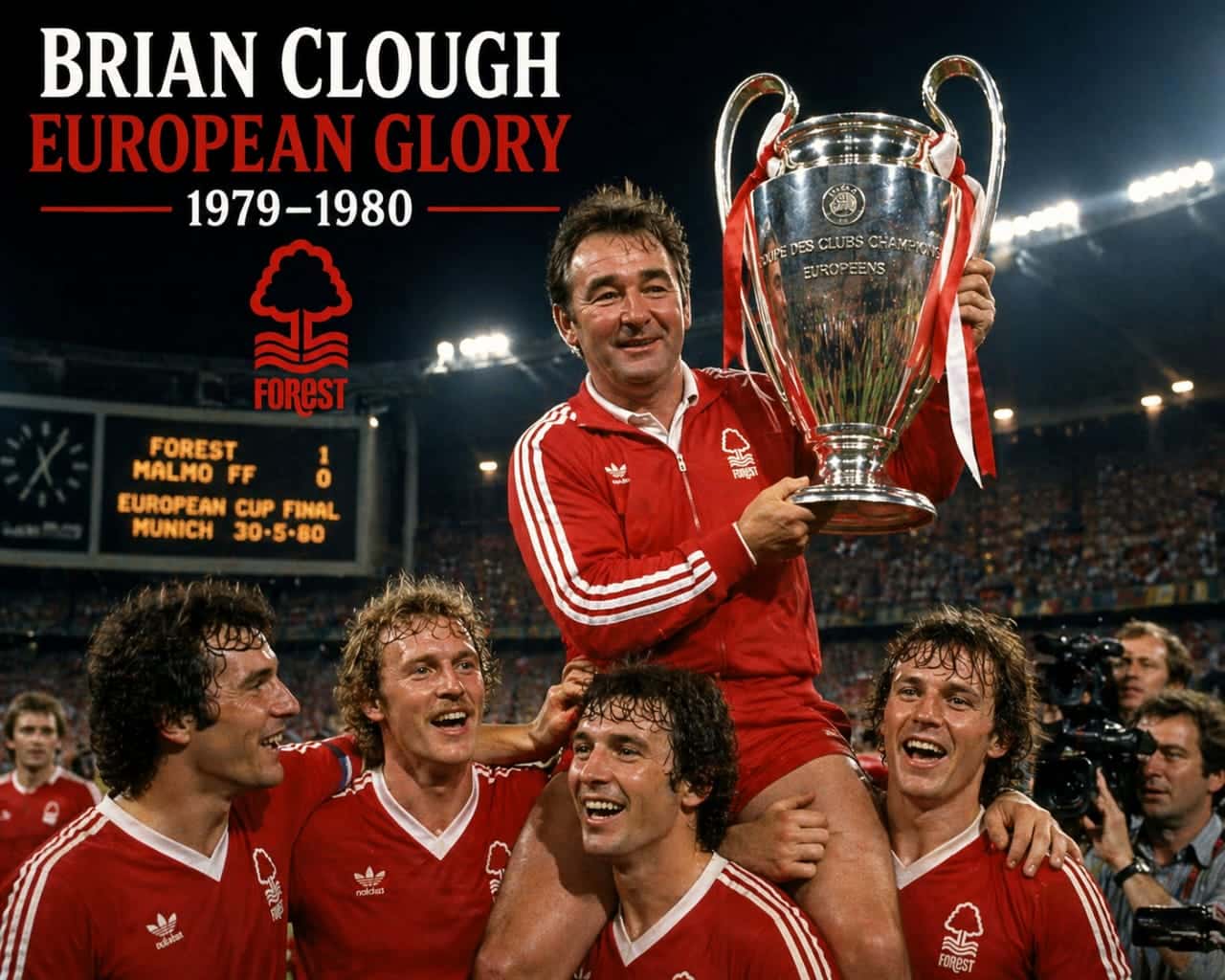
Brian Clough’s arrival in 1975 marked a turning point in Nottingham Forest history, transforming the club into a dominant force. Alongside Peter Taylor, he built a team based on discipline, belief, and strong leadership. This partnership remains one of the most respected in football.
Forest’s First Division title in 1977–78 was followed by European success, proving the team’s quality on the biggest stage. While many teams struggle after promotion, Forest continued to improve and challenge top clubs. This rapid success shocked the football world.
Players like Peter Shilton in goal, John Robertson on the wing, and Trevor Francis in attack played key roles in these achievements. Their performances combined consistency with moments of brilliance during crucial matches. This balance made the team highly effective.
Winning back-to-back European Cups remains one of the greatest achievements in football history. While modern teams require significant investment to compete at that level, Forest achieved it through structure and belief. This era defines the club’s global reputation.

The City Ground has been home to Nottingham Forest since 1898 and remains one of the most iconic stadiums in English football. Located by the River Trent, it has hosted historic matches including European nights during the Clough era. It continues to play a central role in the club’s identity.
The atmosphere at the City Ground is known for its intensity and connection between fans and players. While many modern stadiums focus on commercial expansion, Forest’s home retains a traditional football experience. This makes it one of the most respected venues in the country.
The 2022 return to the Premier League brought renewed energy to the stadium after a 23-year absence. Fans played a major role in supporting the team during that transition. This connection remains one of the club’s biggest strengths.
Even in 2026, the City Ground continues to represent tradition and continuity in modern football. While many clubs move forward without looking back, Forest maintains a strong link to its history. This balance defines its identity.
The 2021/22 season began poorly for Nottingham Forest, with the team at the bottom of the Championship table after seven games. The appointment of Steve Cooper changed everything, bringing structure and belief back into the squad. This marked the start of a dramatic turnaround.
Forest climbed the table and reached the play-offs, showing consistency and improvement throughout the season. Key players stepped up during crucial moments, helping the team maintain momentum. This progress built confidence within the squad.
The play-off final at Wembley ended with a 1–0 victory over Huddersfield Town, securing promotion to the Premier League. This result ended a 23-year absence from the top flight. It was one of the most emotional moments in recent Nottingham Forest history.
This promotion became the foundation for the club’s modern revival and return to top-level football. While challenges remained, it restored belief among players and fans. It marked the beginning of a new chapter.
In 2026, Nottingham Forest has re-established itself as a competitive club in English football, combining history with modern ambition. The team continues to grow through structured planning and consistent performances. This reflects a more stable and focused approach.
Recent squads have included players such as Morgan Gibbs-White, Taiwo Awoniyi, and Murillo, who have contributed to the club’s progress. While changes continue, the team maintains a balance between development and experience. This helps sustain performance levels.
The club’s presence in top competitions shows that its revival is real and not temporary. While many promoted teams struggle to adapt, Forest has shown resilience and improvement. This highlights the strength of its long-term strategy.
Nottingham Forest history continues to evolve as the club builds on its past success and modern growth. While the journey is ongoing, the foundation remains strong. This ensures the club stays relevant in today’s football landscape.
Nottingham Forest’s current squad reflects a carefully built mix of experience and emerging talent that has driven its recent progress in the Premier League. Players such as Morgan Gibbs-White, Taiwo Awoniyi, and Murillo have become central figures, combining creativity, physicality, and defensive strength across the pitch. This balance allows the team to compete consistently while maintaining a clear identity in modern football.
Morgan Gibbs-White plays a crucial role as the creative engine of the team, linking midfield and attack with vision and movement. While many teams rely on isolated playmakers, Forest’s system allows him to operate with support, making his influence more effective across matches. His performances have made him one of the most important players in the squad.
Taiwo Awoniyi provides a strong physical presence in attack, offering both goal-scoring ability and hold-up play under pressure. While modern strikers often focus only on finishing, his role includes creating space and supporting transitions. This makes him essential to Forest’s attacking structure.
Defensively, Murillo has emerged as one of the standout performers, bringing composure, strength, and consistency to the back line. While young defenders often struggle with adaptation, he has shown maturity beyond his age in high-pressure situations. His presence has helped stabilise the team’s defensive performance.
Nottingham Forest’s tactical approach focuses on organisation, discipline, and adaptability depending on the opponent. While some teams rely heavily on possession-based systems, Forest often balances defensive structure with quick attacking transitions. This flexibility allows the team to remain competitive against different styles of play.
Defensively, the team stays compact and organised, reducing space for opponents and forcing mistakes in key areas. While attacking football dominates headlines, this defensive discipline has been a major factor in Forest’s recent success. It provides a strong foundation for the team’s overall performance.
In attack, Forest uses quick transitions and direct movement to create goal-scoring opportunities efficiently. While some teams overcommit players forward, Forest maintains balance to avoid defensive exposure. This controlled approach has improved consistency across matches.
Set pieces have also become an important part of the team’s strategy, offering additional chances to score goals. While these moments are often overlooked, they can decide tight games at a high level. This attention to detail reflects the team’s preparation and tactical awareness.
Nottingham Forest’s transfer strategy has focused on building a sustainable squad rather than chasing short-term success. While some clubs spend heavily without a clear plan, Forest has targeted players who fit its system and long-term vision. This approach has helped create stability and steady improvement.
The club has invested in both experienced players and young talents, ensuring a balance between immediate impact and future development. While short-term results remain important, Forest’s recruitment strategy prioritises long-term growth. This creates a stronger foundation for continued progress.
Improved scouting and recruitment processes have allowed the club to identify players who adapt quickly to its playing style. While many teams struggle with squad cohesion, Forest has shown better integration of new signings. This has reduced inconsistency within the team.
This structured investment strategy reflects a broader vision for Nottingham Forest’s future in modern football. While rapid success can be tempting, the club’s focus remains on stability and identity. This approach increases its chances of long-term competitiveness.
Supporting Nottingham Forest extends beyond watching matches, as fans express their identity through club-related gear and merchandise. While official kits may not always be easily available, alternative options such as t-shirts and scarves allow supporters to represent the club proudly. These items remain popular among fans both locally and internationally.
A Nottingham Forest t-shirt provides a simple and comfortable way to show support in everyday situations. While match-day kits are often preferred, casual wear offers flexibility while still maintaining a strong connection to the club. It is one of the easiest ways for fans to stay connected.
👉 Shop Nottingham Forest T-Shirt on Amazon
Scarves remain one of the most traditional symbols of football support, especially during matches at the City Ground. While modern merchandise continues to evolve, scarves still represent loyalty and atmosphere within football culture. They remain essential for dedicated Nottingham Forest supporters.
For fans looking for additional options, casual fan gear offers a balance between affordability and style. While official merchandise can be limited, these alternatives still provide quality and accessibility. This makes it easier for supporters to stay connected to Nottingham Forest.
👉 Explore More Nottingham Forest Fan Gear
This Nottingham Forest guide is written using a combination of historical knowledge and modern football analysis to provide accurate and meaningful insights. Rather than listing general information, it connects real events, player performances, and tactical developments to explain the club’s progress. This approach ensures the content is both informative and relevant.
Key facts referenced in this guide, including Forest’s European Cup victories and recent Premier League performances, are widely recognised within football history. While interpretations may vary, the core information remains consistent across reliable football sources. This helps maintain accuracy and credibility.
The content is regularly updated to reflect Nottingham Forest’s current squad, tactical approach, and overall progress in modern competitions. While football continues to evolve, this guide aims to stay relevant and useful for both new readers and long-term fans. This commitment supports long-term trust.
Some links included in this article are affiliate links, which means a small commission may be earned at no extra cost to the reader. These links are selected carefully to match the interests of Nottingham Forest supporters and are included transparently. This ensures both usefulness and trustworthiness.
Nottingham Forest’s journey combines historical success with modern ambition, making it one of the most unique stories in football. While many clubs focus only on present results, Forest continues to build on a strong foundation created over generations. This connection between past and present defines its identity.
The club’s recent progress shows that its revival is structured and sustainable rather than temporary. While challenges remain in modern football, Forest has demonstrated resilience and adaptability. This strengthens its position moving forward.
For fans, Nottingham Forest represents more than results—it represents belief, identity, and continuity. While football continues to evolve, the club remains connected to its roots. This is why it continues to matter.
As Nottingham Forest looks ahead, the focus remains on growth, stability, and long-term success. While the future cannot be predicted, the club’s foundation provides confidence. This ensures its relevance in modern football.
Morgan Gibbs-White is widely considered one of Nottingham Forest’s most important players due to his creativity and influence in attack. While other players contribute significantly, his ability to control games and create chances stands out. This makes him a key figure in the team.
Nottingham Forest plays a balanced style focused on defensive organisation and quick attacking transitions. While some teams prioritise possession, Forest adapts its approach depending on the opponent. This flexibility helps maintain competitiveness.
Yes, Nottingham Forest has shown steady improvement since returning to the Premier League in 2022. While progress takes time, the club has developed structure and consistency in its performances. This indicates long-term growth.
The managerial position has changed in recent seasons, reflecting the club’s adjustments in its development process. While stability is important, these changes have been part of the club’s effort to improve performance. The focus remains on long-term success.
Nottingham Forest is historically important due to its early foundation, European success, and unique achievements in football history. While many clubs have success, few have matched its journey from lower divisions to European champions. This makes it one of the most respected clubs in the game.