Physical Address
MICKYWORLDNG
Physical Address
MICKYWORLDNG

MICKYWORLDNG IS READER-SUPPORTED. WHEN YOU BUY THROUGH LINKS ON OUR SITE, WE MAY EARN AN AFFILIATE COMMISSION AT NO EXTRA COST TO YOU.
Best football socks 2026 are no longer just a basic part of your kit—they have become a performance layer that directly influences how stable you feel inside your boots, how quickly you can react during transitions, and how confidently you move under pressure. The modern game demands precision in every step, and even small inefficiencies, like your foot shifting inside your boot, can affect your balance, timing, and overall control. What used to be considered a minor detail is now something serious players pay attention to, because once you experience the difference between standard socks and performance-focused options, it becomes difficult to ignore how much they impact your game.
Most players don’t notice their socks until something starts to feel off during a match. It might be a slight internal slip when turning, or a gradual discomfort that builds as the game progresses when your foot is not properly supported. These small issues might not seem significant in isolation, but over time they begin to affect how you move, especially in fast-paced situations where decisions need to be made instantly. When your foot is secure, your movement feels sharper, your reactions become more natural, and your confidence increases without you even thinking about it. When it is not, you start making subtle adjustments that disrupt your rhythm, and that is where performance starts to drop.
If you have already gone through the full breakdown in this essential football gear guide, you will understand that football equipment works best when everything connects properly rather than functioning as separate pieces. Socks, boots, and shin guards all play a role in how your foot interacts with the ground, and when one part is not performing as it should, it affects the entire system. This is why players who take time to optimise their setup tend to perform more consistently, because their equipment supports their movement instead of working against it.
There is also a direct relationship between your socks and your boots that many players overlook, particularly when it comes to traction and control. You can invest in high-performance boots, but if your socks allow your foot to move inside them, you lose that advantage almost immediately. The connection between your foot and the boot needs to feel secure for you to get the best out of your movement, especially on surfaces that require quick adjustments and precise foot placement. If you want to understand this connection in more detail, this football boots guide for artificial grass explains how traction, stability, and movement work together during real match situations.
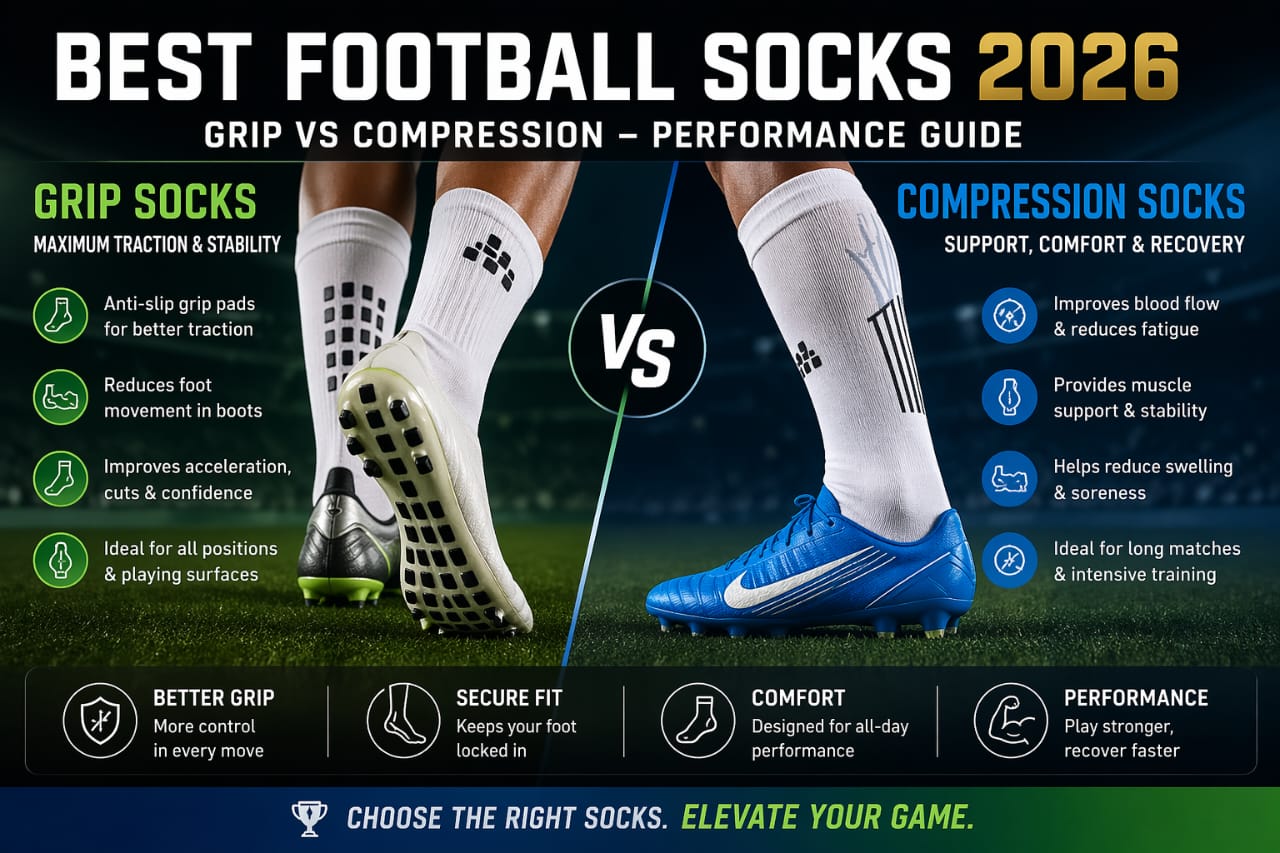
The difference between grip socks, compression socks, and regular football socks is not just about design—it is about how each type influences your movement, your comfort, and your overall performance throughout a match. Grip socks are specifically engineered to reduce internal slippage by creating friction between your foot, the sock, and the inside of your boot. This friction produces a locked-in feeling that allows you to move with more confidence, particularly when sprinting, stopping, or changing direction quickly. For players who rely on speed and sharp movements, this added stability can translate into more precise control and quicker reactions.
What makes grip socks particularly effective is not just the presence of grip elements, but how they distribute pressure and maintain contact during movement. Instead of your foot sliding slightly with each step, the sock holds it in place, which improves the efficiency of your movement. This means that the energy you generate when pushing off the ground is transferred more directly into your motion, rather than being lost through internal movement. Over the course of a match, this small improvement can make a noticeable difference in how responsive and controlled your movements feel.
Compression socks, on the other hand, focus on a completely different aspect of performance by supporting your muscles and improving blood circulation. They apply consistent pressure to your lower leg, which can help reduce fatigue and improve endurance during longer sessions. This makes them particularly useful for recovery or for players who need additional support over extended periods of play. However, because they are not designed to improve traction inside the boot, they do not provide the same locked-in feel that grip socks offer during high-intensity movements.

Regular football socks remain the most common option, but they are primarily designed for basic comfort and to hold shin guards in place rather than to enhance performance. They do their job in terms of coverage and simplicity, but they lack the specialised features that improve stability or reduce internal movement. While they are still suitable for casual play or training sessions, they often fall short in competitive environments where small performance advantages can make a real difference. Understanding these distinctions allows you to choose a sock that actually supports your style of play instead of simply following what is most common.
Feature |
Grip Socks |
Compression Socks |
Regular Football Socks |
|---|---|---|---|
Primary Purpose |
Traction and stability inside boots |
Muscle support and circulation |
Basic comfort and coverage |
Performance Impact |
Improves balance and reduces slipping |
Reduces fatigue over time |
No direct performance benefit |
Grip Technology |
Silicone or rubber grip elements |
No grip technology |
No grip technology |
Best Use |
Matches and high-intensity play |
Recovery and long sessions |
Training and casual play |
Comfort Level |
Snug and performance-focused |
Tight and supportive |
Loose and traditional |
Choosing the right football socks becomes easier when you focus on how each option supports your movement and comfort rather than simply looking at popularity or brand recognition. The goal is to find something that improves how you feel during a match without becoming a distraction, because the best gear is the one you stop thinking about once the game starts. When your socks work properly, your attention shifts entirely to your performance, and that is where real improvement happens.
Best Overall (Performance & Grip): TRU Sox Grip Socks
View on Amazon
TRU Sox are known for their strong grip system, which creates a secure connection between your foot and your boot, reducing unwanted movement during play. This stability allows for more precise control when turning, accelerating, or stopping quickly, which is especially important in fast-paced matches where small margins matter. The design focuses on performance without adding unnecessary bulk, making it a reliable option for players who want consistency in how they move throughout the game. Once you use this type of grip-focused sock, the difference in stability becomes immediately noticeable.
Best Premium Brand Option: Nike Grip Vapor Socks
View on Amazon
Nike Grip Vapor socks provide a more refined balance between comfort and performance by using specialised materials to reduce internal movement while maintaining a lightweight feel. Instead of relying on aggressive grip patterns, they focus on controlled friction that supports natural movement without making the sock feel restrictive. This makes them suitable for players who prefer a more subtle approach to performance enhancement while still benefiting from improved stability. The result is a comfortable, consistent experience that works well for both matches and regular training sessions.

Choosing the best football socks in 2026 is not about following trends or simply buying what professional players wear—it is about understanding how your own style of play interacts with your equipment and making decisions that support your movement on the pitch. Every player moves differently, reacts differently under pressure, and relies on different strengths during a match, which means the same type of sock will not work equally well for everyone. What feels perfect for one player might feel uncomfortable or restrictive for another, and this is why making the right choice requires a deeper understanding of how socks influence performance.
For players who rely heavily on speed, acceleration, and quick directional changes, grip socks tend to offer the most noticeable advantage because they reduce internal movement inside the boot. When your foot stays locked in place, your reactions become sharper and your movements more efficient, especially during high-intensity situations where there is no time to adjust. This is particularly important for wingers, attacking midfielders, and full-backs who depend on explosive movements to create space or recover defensively. In these roles, even a slight delay caused by instability can affect the outcome of a play.
Players who operate in more physically demanding roles, such as central midfielders or defenders, often benefit from a slightly different balance between support and comfort. While grip still matters, the ability to maintain comfort over longer periods becomes equally important, especially in matches where endurance plays a major role. This is where some players begin to consider compression elements or more supportive sock designs that help reduce fatigue while still maintaining enough stability for controlled movement. The key is finding a setup that does not force you to compromise one aspect of your game for another.
It is also worth considering how often you play and the type of matches you are involved in, because your needs during a competitive game may differ from your needs during training sessions. Some players prefer to use high-performance grip socks during matches while switching to more comfortable options during training, creating a balance between performance and practicality. This approach allows you to get the best of both worlds without overloading your setup with unnecessary features when they are not needed. Understanding when to use each type of sock is just as important as choosing the right one.
This is one of the most common questions players ask, and the answer depends on how you define performance. Grip socks do not magically make you faster or more skilled, but they remove a layer of inefficiency that can affect how you move during a match. When your foot slips inside your boot, even slightly, you lose a small amount of control with each step, and that loss builds up over time. Grip socks reduce that movement, allowing your energy to transfer more directly into your actions, which makes your movements feel sharper and more responsive.
In practical terms, this means you are able to push off more effectively when sprinting, change direction with greater confidence, and maintain better balance during physical challenges. These improvements might seem subtle when viewed individually, but over the course of a match they can influence how consistently you perform. Players who switch to grip socks often notice that their movement feels more controlled, especially in situations where quick reactions are required. That sense of control is what makes them valuable rather than any exaggerated claims about performance enhancement.
Another benefit that is often overlooked is how grip socks help reduce friction-related issues such as blisters. When your foot moves less inside your boot, there is less rubbing against the inner material, which reduces the likelihood of discomfort developing over time. This is particularly important during longer matches or intense training sessions where small irritations can become significant distractions. By reducing these issues, grip socks contribute to a more consistent and comfortable playing experience.
One of the most common mistakes players make is choosing socks based purely on appearance or brand rather than how they actually perform during a match. While it is natural to be influenced by what professional players wear, it is important to remember that their needs, playing conditions, and level of competition may be very different from yours. Choosing socks that look good but do not suit your style of play can lead to discomfort and reduced performance, especially during longer matches.
Another mistake is ignoring the fit and sizing of the socks, which can have a significant impact on how they perform. Socks that are too loose will not provide the stability needed to keep your foot secure, while socks that are too tight may restrict movement or cause discomfort over time. Finding the right balance between a snug fit and overall comfort is essential, because this is what allows the sock to perform its function without becoming a distraction. Proper fit is often overlooked, but it is one of the most important factors to get right.
Some players also make the mistake of using the same type of sock for every situation without considering how their needs change depending on the context. What works well during a casual training session may not be suitable for a competitive match, and failing to adjust your setup accordingly can limit your performance. Being flexible in your approach and understanding when to use different types of socks can help you get more out of your gear without overcomplicating your setup.
Football socks do not function in isolation—they are part of a system that includes your shin guards, your boots, and even how you wear your kit. The way your socks hold your shin guards in place affects both comfort and safety during a match, and this is something that becomes more noticeable as the intensity of the game increases. If your shin guards shift during play, it creates distractions and can reduce your confidence in physical situations.
This is why many players combine their socks with sleeves or specific setups that help keep everything in place without restricting movement. The goal is to create a secure and comfortable fit that allows you to move freely while still maintaining protection. If you want a deeper understanding of how shin guards fit into this system, this football shin guards guide explains how different setups affect comfort and performance on the pitch.
When your socks, shin guards, and boots all work together properly, your entire setup feels more stable and predictable. This allows you to focus on your performance without constantly adjusting your gear or dealing with small discomforts that build up over time. It is this level of consistency that separates a well-optimised setup from a basic one, and it often makes a bigger difference than players expect.
Understanding when to use grip socks versus compression socks can help you get more out of both options without forcing one to do everything. Grip socks are best suited for matches and high-intensity training sessions where stability and control are essential. They provide the traction needed to move confidently and reduce internal slippage during fast movements, making them the preferred choice for most competitive situations.
Compression socks, on the other hand, are more suited for recovery, travel, or situations where muscle support is more important than traction. They can help reduce fatigue after matches and improve circulation during longer periods of activity, which makes them a useful addition to your overall routine. Rather than choosing one over the other, many players use both in different contexts to support different aspects of their performance and recovery.
This approach allows you to maximise the benefits of each type without compromising your performance during matches or your recovery afterwards. By understanding the role each type of sock plays, you can build a more effective and balanced setup that supports your game over time.
The best football socks in 2026 are not simply the most expensive or the most popular ones, but the ones that match your playing style, your level of competition, and how your body responds during movement. When your socks support your movement instead of working against it, everything feels more natural, from your first touch to your final sprint. That sense of comfort and control is what allows you to perform consistently without being distracted by your equipment.
Taking the time to understand what works for you is one of the simplest ways to improve your overall performance without making major changes to your game. Once you find the right balance between grip, comfort, and support, your focus shifts entirely to the match itself, which is exactly where it should be. At that point, your equipment becomes something you rely on rather than something you need to manage, and that is what makes the right choice truly valuable.
Do grip socks really make a difference?
Yes, they help reduce internal movement inside the boot, which improves stability and overall control during matches.
Are compression socks good for football?
They are useful for recovery and muscle support, but they do not provide the same grip benefits as performance socks.
Can I wear grip socks with normal football socks?
Yes, many players combine grip socks with cut or standard socks to get both performance and team kit compatibility.
How tight should football socks be?
They should be snug enough to stay in place without restricting movement or causing discomfort.
Which socks do professional players use?
Most professional players use grip socks during matches because they provide better stability and control.