Physical Address
MICKYWORLDNG
Physical Address
MICKYWORLDNG

MICKYWORLDNG IS READER-SUPPORTED. WHEN YOU BUY THROUGH LINKS ON OUR SITE, WE MAY EARN AN AFFILIATE COMMISSION AT NO EXTRA COST TO YOU.
How to control the tempo of a football game is one of the most important tactical skills in modern football because it determines how fast or slow a match is played and which team controls the rhythm. Teams that control tempo are not just reacting to the game—they are actively shaping it, deciding when to keep possession, when to accelerate, and when to disrupt the opponent’s structure.
At the highest level, controlling tempo is what separates average teams from dominant ones. It is not about constantly playing fast or slow, but about knowing when to change the speed of the game based on the situation. This ability allows teams to stay in control, reduce risk, and create better attacking opportunities.
Understanding how to control the tempo of a football game requires more than technical ability. It involves decision-making, awareness, positioning, and the ability to read the flow of the match. Players must constantly assess what is happening and adjust their actions accordingly.
When done correctly, tempo control makes the game easier for your team and more difficult for the opponent. It forces them to react, chase, and lose structure, while your team maintains balance and control.
To understand how to control the tempo of a football game, you must first understand what tempo actually means. Tempo refers to the speed and rhythm at which a team moves the ball and transitions between phases of play, including attack and defense.
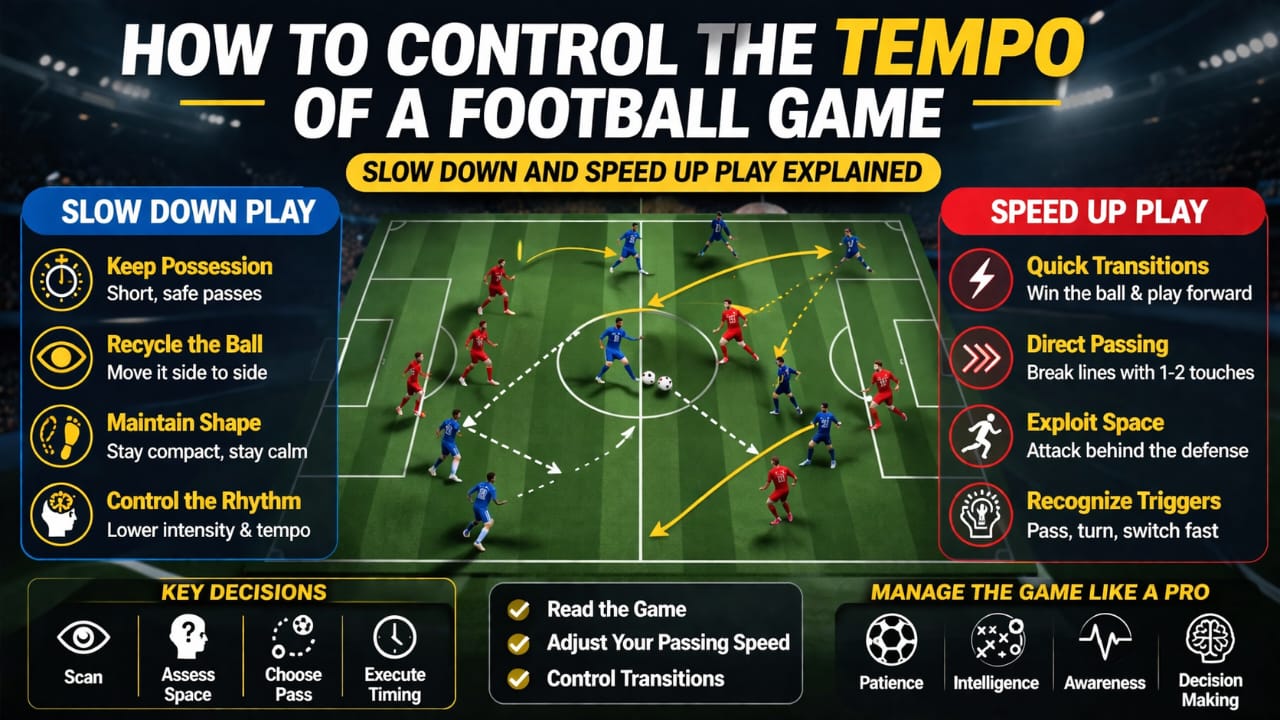
A slow tempo involves keeping possession, circulating the ball, and reducing risk. This approach is often used to calm the game, maintain control, and limit the opponent’s chances to press effectively.
A fast tempo, on the other hand, focuses on quick passing, forward movement, and rapid transitions. This is used to exploit space, catch defenders out of position, and create goal-scoring opportunities.
The key is not choosing one style, but knowing when to switch between them. Teams that master this balance are able to dominate matches and control the overall flow of the game.
One of the most important parts of learning how to control the tempo of a football game is understanding when to slow things down. Slowing the game is not about being passive—it is a strategic decision that helps maintain control and reduce pressure.
Teams often slow the tempo when they are leading, when they need to recover shape, or when facing an aggressive pressing opponent. By keeping the ball and reducing speed, they force the opponent to chase and lose energy.
This is achieved through short, controlled passes, recycling possession, and maintaining good positioning across the pitch. Players focus on keeping the ball moving without taking unnecessary risks.
The choice between short and long passing also plays a major role here, as explained in short vs long passing in football, where passing decisions directly influence the speed and rhythm of the game.
Slowing the tempo also allows teams to reset mentally and physically, ensuring they stay organized and prepared for the next phase of play.
Equally important in understanding how to control the tempo of a football game is knowing when to increase the speed of play. Speeding up the tempo is used to create urgency, break defensive lines, and take advantage of disorganized opponents.
This usually happens during counter-attacks, when the opponent loses shape, or when there is space to exploit quickly. In these moments, hesitation can reduce effectiveness, so quick decision-making is essential.
Players must move the ball forward with purpose, using quick passes, forward runs, and minimal touches to progress play rapidly. This creates pressure on defenders and increases the chances of creating scoring opportunities.
However, speeding up the game requires accuracy. Poor passing can result in turnovers, which is why technical consistency is crucial, as discussed in how to improve passing accuracy in football, where control and precision support effective tempo changes.
When executed properly, increasing tempo transforms defensive situations into dangerous attacking moments within seconds.
At the core of how to control the tempo of a football game is decision-making. Every pass, movement, and action contributes to the overall rhythm of the match, making decision-making one of the most important skills on the pitch.
Players must constantly evaluate whether to slow the game down or speed it up based on the positioning of teammates, opponents, and available space. This requires awareness and the ability to process information quickly.
Good decision-making ensures that tempo changes are effective rather than random. It allows teams to maintain control while still being dynamic and unpredictable.
This is why top players appear calm under pressure—they are not rushing, but choosing the right moment to act.

Possession is one of the most powerful tools in mastering how to control the tempo of a football game. Teams that keep the ball effectively are able to dictate the pace, limit opposition chances, and control where the game is played.
By circulating the ball across different areas of the pitch, players can slow the game down, stretch the opponent, and create openings over time. This controlled approach reduces chaos and increases stability.
However, possession is not just about keeping the ball—it is about using it with purpose. Teams must recognize when to maintain control and when to accelerate play to create attacking opportunities.
This balance between patience and urgency is what defines effective tempo control in modern football.
Imagine a team leading 1–0 late in the game. Instead of rushing forward, they focus on keeping possession, moving the ball calmly, and reducing the tempo. This forces the opponent to chase and creates fewer opportunities for them to attack.
Now imagine the opposite situation—a team is losing and needs a goal. They increase the tempo, play forward quickly, and take more risks to create chances. The speed of the game increases, and the match becomes more open.
These contrasting situations show that how to control the tempo of a football game depends entirely on context. The best teams are those that can adapt their approach based on what the game requires.
This ability to switch between control and intensity is what makes teams tactically flexible and difficult to play against.
To fully master how to control the tempo of a football game, players and teams must go beyond basic passing and understand advanced tactical concepts that influence the rhythm of play. Modern football is no longer just about keeping possession or attacking quickly—it is about controlling when and how those actions happen.
One key concept is using possession as a strategic weapon rather than a passive action. Teams deliberately circulate the ball not just to keep it, but to manipulate the opponent’s shape, draw them out of position, and create openings in specific areas of the pitch.
This controlled movement forces defenders to constantly adjust, which increases the likelihood of mistakes over time. Once a gap appears, the tempo can immediately increase to exploit that space before the opponent can recover.
Another important technique is recognizing tempo triggers. These are specific moments in the game—such as a poor defensive shape, a misplaced pass, or a numerical advantage—that signal when to speed up play instantly.
Understanding these triggers allows players to switch tempo naturally instead of forcing decisions, making their play more effective and less predictable.
A crucial part of mastering how to control the tempo of a football game is understanding transitions.Transitions occur when possession changes, and they are often the fastest and most dangerous moments in a match.
Teams that react quickly during transitions can immediately increase the tempo and attack before the opponent has time to reorganize. This is why speed of thought is just as important as speed of movement.
Players must recognize these moments instantly and decide whether to accelerate or slow the game based on the situation. A delayed decision can eliminate the advantage completely.
Quick combinations and forward movement during transitions often involve coordinated runs and support play, which is why concepts like how to create space in football become essential for exploiting these high-tempo situations effectively.
When transitions are managed well, teams can control not just the tempo, but also the direction and outcome of the game.
Another key element of how to control the tempo of a football game is maintaining the right positioning and team structure. Without structure, tempo becomes chaotic and difficult to manage.
Players must position themselves in ways that provide constant passing options, allowing the team to either slow the game down or speed it up depending on the situation. Good spacing ensures that the ball can move efficiently across the pitch.
When players are too close together, the game becomes crowded and predictable. When they are too far apart, it becomes difficult to maintain control and support.
Balanced positioning allows teams to switch tempo smoothly, keeping control while still being able to attack quickly when opportunities arise.
At higher levels, how to control the tempo of a football game depends heavily on decision-making under pressure. Players rarely have time and space, so they must make quick and accurate choices while being pressed by opponents.
This requires constant scanning, awareness, and the ability to read the game before receiving the ball. Players who scan early are able to decide faster and execute actions more effectively.
Good decision-making ensures that tempo changes are intentional rather than reactive. It allows players to maintain control even in difficult situations.
This is why experienced players appear calm—they are not rushed by pressure, but prepared for it.
Even teams that understand how to control the tempo of a football game can struggle if they make simple mistakes. One of the most common issues is playing at one speed for too long, making the team predictable and easier to defend.
Another mistake is forcing fast play when the situation requires patience. This often leads to unnecessary turnovers and loss of control.
On the other hand, slowing the game down too much can reduce attacking threat and allow the opponent to regain organization. The key is balance.
Poor communication and lack of awareness can also disrupt tempo, as players may not recognize when to change speed or adjust their positioning.
By identifying and correcting these mistakes, teams can improve their ability to manage the rhythm of the game effectively.
At the highest level, controlling tempo is often led by midfield players who act as the “brain” of the team. These players do not just pass the ball—they decide the speed of the entire game.
Elite players constantly scan the pitch, assess options, and choose whether to slow the game down or speed it up. Their decisions influence how the entire team plays.
A simple change in passing speed or direction can completely alter the rhythm of a match. This is why tempo control is less about physical ability and more about intelligence and awareness.
Great players understand that controlling tempo is about controlling the game itself, making it easier for their team and more difficult for the opponent.

Mastering how to control the tempo of a football game gives players and teams a significant advantage because it allows them to dictate how the match is played. It transforms football from a reactive game into a controlled and strategic one.
By understanding when to slow the game down and when to speed it up, players can make better decisions, reduce mistakes, and create more effective attacking opportunities.
This ability comes from a combination of awareness, positioning, communication, and decision-making, all working together to influence the rhythm of play.