Physical Address
MICKYWORLDNG
Physical Address
MICKYWORLDNG

MICKYWORLDNG IS READER-SUPPORTED. WHEN YOU BUY THROUGH LINKS ON OUR SITE, WE MAY EARN AN AFFILIATE COMMISSION AT NO EXTRA COST TO YOU.
How to create space in football is one of the most important skills that separates average players from elite performers, because football is not just about what you do on the ball but what you do before you receive it. Space is rarely given freely in modern football, which means players must learn how to move intelligently, manipulate defenders, and position themselves in ways that create time and options.
In reality, space is not something you find—it is something you create through awareness, timing, and deception. Defenders are constantly adjusting their position, closing passing lanes, and reducing gaps, so attackers must think ahead and move before the opportunity becomes obvious. This is why the best players always seem to have time on the ball, even in tight situations.
Understanding how to create space allows players to receive the ball more comfortably, make better decisions, and influence the game more consistently. Without this ability, even technically gifted players can struggle because they are constantly under pressure and forced into rushed actions.
To master this skill, you need to understand the core principles behind movement, positioning, and timing, and how they all work together within the flow of the game rather than as isolated actions.
The first step in creating space begins before movement even happens, and that step is scanning. Players who do not scan regularly are essentially playing blind, reacting late instead of anticipating what is coming next. Scanning allows you to understand where defenders are, where the space is likely to appear, and how you can position yourself before receiving the ball, a concept explained further in football scanning awareness.
Elite players scan every few seconds, constantly updating their picture of the game. This helps them identify weak points in the defensive structure, especially areas where defenders cannot see both the ball and the attacker at the same time.
One key concept here is the “blind side,” which refers to positioning yourself where the defender cannot fully track your movement. By staying just outside their line of vision, you increase your chances of receiving the ball without immediate pressure.
This level of awareness is closely connected to structured team movement, especially in systems explained through positional play in football, where spacing and positioning are used to stretch defenses and create passing options.
Creating space is not just about movement—it is about moving at the right time. If you move too early, the defender follows you and closes the space. If you move too late, the passing window disappears. This balance between patience and explosiveness is what defines effective off-ball movement.
Separation from defenders is often achieved through simple but intelligent actions such as double movements. This involves moving in one direction to attract the defender, then quickly changing direction to create space in the opposite area.
Another effective technique is the “V” movement, where a player drops short to pull a defender out of position before accelerating into the space behind them. This type of movement creates both horizontal and vertical gaps in the defensive line.
These actions may seem simple, but when executed with the right timing, they become extremely difficult to defend because they force defenders into constant decision-making under pressure.
Even when space is created, players must be able to use it effectively, and this is where body orientation becomes important. The way you position your body when receiving the ball determines what options are immediately available to you.
A half-turned or open body position allows you to see both the ball and the direction of play at the same time. This gives you more time and makes it easier to play forward instead of backward.
Players who receive the ball with a closed body shape often limit their own options, forcing themselves into predictable or slower actions that allow defenders to recover.
By combining good movement with proper body orientation, players can not only find space but also maximize the advantage it provides once they receive the ball.
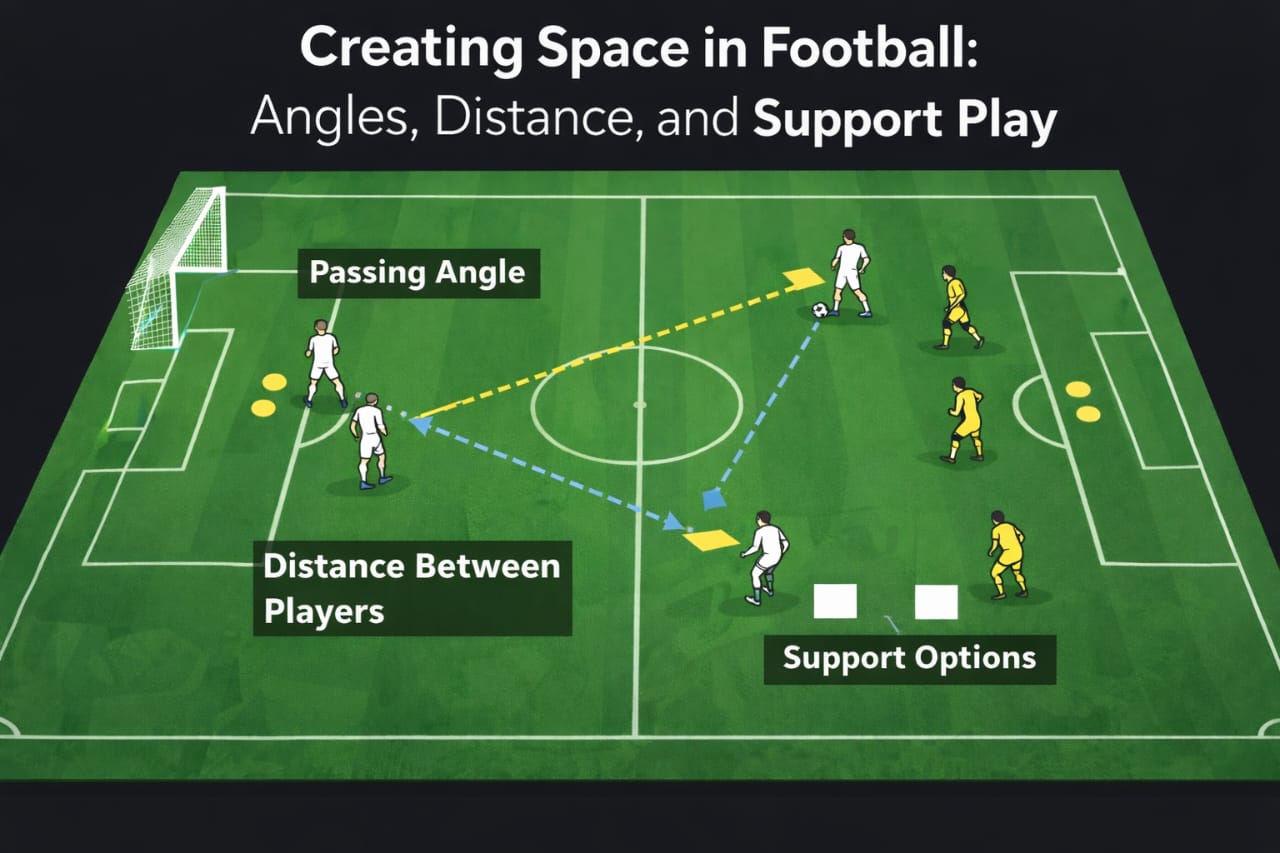
Creating space is not always about moving far away from defenders; sometimes it is about adjusting your angle and distance relative to the ball. Small movements can create better passing lanes and improve the overall structure of the team.
Good players constantly adjust their position to remain available, ensuring they are neither too close nor too far from the ball carrier. This balance makes it easier to maintain possession and progress play.
Support play also involves understanding triangles and passing networks, where players position themselves to provide multiple options at all times. This reduces pressure and increases the speed of play.
When these movements are coordinated across the team, it becomes much harder for opponents to defend because they are constantly being stretched in different directions.
Space creation is not just an individual skill; it is also a collective effort. When players move together with purpose, they can manipulate the defensive shape and open gaps that would not exist through individual actions alone.
One of the most effective examples of this is the use of third-man runs, where a player moves into space after a pass is played between two teammates. This creates dynamic movement that is difficult for defenders to track.
The timing of these runs is crucial because they often exploit moments when defenders are focused on the ball rather than the movement happening around them.
This concept is explored further in third man runs in football, where coordinated movement creates opportunities that cannot be achieved through static positioning.
In modern football, space is often created between players rather than in open areas of the pitch. This is known as relative space, and it focuses on the gaps that exist within defensive structures.
For example, the spaces between defenders or between defensive lines can be more valuable than wide open areas because they allow players to receive the ball in dangerous positions.
Players who understand this concept position themselves between lines, forcing defenders into difficult decisions about whether to step out or hold their position.
This constant pressure on defensive organization creates uncertainty, which is exactly what attackers need to exploit space effectively.

As the game becomes more structured and tactically organized, simple movement is no longer enough to consistently create space. Players must use advanced movement patterns that actively disrupt defensive organization and force opponents into uncomfortable decisions. These movements are often subtle, but when executed correctly, they create gaps that can be exploited immediately.
One of the most effective patterns is moving across the defender’s line instead of directly away from them. This lateral movement forces defenders to constantly adjust their body shape, which naturally creates small openings that can be used to receive the ball or attack space.
Another important concept is positional rotation, where players interchange roles during play. This movement breaks defensive marking structures because defenders are forced to decide whether to follow or hold their position, often leading to confusion.
These patterns become even more dangerous when combined with structured attacking ideas, especially those seen in positional play in football, where spacing and coordinated movement are used to stretch defenses and create passing lanes.
Deception is a critical part of space creation because defenders react to visual cues such as body shape, eye direction, and movement speed. By manipulating these cues, players can create separation without needing large or obvious movements.
A simple body feint can shift a defender’s balance just enough to open a passing lane or create room to receive the ball. These small details are often more effective than big movements because they happen quickly and are difficult to predict.
Changing speed is another powerful tool. Slowing down can make defenders relax or stop adjusting, while a sudden acceleration creates immediate separation and advantage. This contrast in tempo is what makes movement unpredictable.
When deception is used consistently, it forces defenders into reactive positions, giving attackers more control over how and where space is created during the game.
Rondos such as 3v1 or 4v2 are highly effective because they force players to stay active, scan continuously, and adjust their position to remain available for passes. These drills improve both awareness and quick decision-making.
Blind-side movement drills are also important, as they teach players how to position themselves outside a defender’s field of vision before receiving the ball. This helps develop intelligent movement habits that translate directly into matches.
Small-sided games increase the number of touches and situations where players must create space quickly, making them one of the most effective ways to develop this skill consistently.

Many players struggle to create space not because they lack ability, but because of repeated mistakes in their movement and decision-making. One of the biggest issues is staying static and waiting for the ball instead of actively adjusting position before receiving.
Another common mistake is moving into areas that are already occupied by teammates, which reduces spacing and makes it easier for defenders to cover multiple players at once. This lack of awareness limits attacking options.
Poor timing is also a major factor. Moving too early allows defenders to track you easily, while moving too late means the opportunity has already disappeared. Timing must always match the moment of the pass.
These mistakes often become more obvious in direct duels, which is why they are closely related to situations explained in 1v1 situations in football, where small positional errors can immediately lead to losing the advantage.
Creating space consistently requires more than just understanding movement—it requires applying it continuously throughout the game. Players must remain active, constantly scanning and adjusting their position even when they are not directly involved in play.
This level of consistency is what separates intelligent players from reactive ones. Instead of waiting for the game to come to them, they actively influence it through their positioning and movement.
Game intelligence plays a key role here, as players must read situations quickly and make decisions based on both teammates and opponents. Over time, this awareness becomes instinctive.
The result is a player who always seems available, always has time on the ball, and consistently makes better decisions under pressure.
Understanding how to create space in football changes the way you approach the game completely, because it shifts your focus from reacting to situations to controlling them through movement and awareness.
By mastering scanning, timing, deception, and positioning, players can consistently find and use space even against well-organized defensive teams.
The key is repetition and application, turning these concepts into habits that become automatic during matches rather than something you have to think about.
When this happens, the game becomes easier, decisions become faster, andoverall performance improves significantly, allowing you to play with more time, control, and confidence in every situation.