Physical Address
MICKYWORLDNG
Physical Address
MICKYWORLDNG

MICKYWORLDNG IS READER-SUPPORTED. WHEN YOU BUY THROUGH LINKS ON OUR SITE, WE MAY EARN AN AFFILIATE COMMISSION AT NO EXTRA COST TO YOU.
Football scanning awareness is one of the most important skills in modern football, especially in high-pressure environments where time and space are extremely limited. At the highest level, players are not simply reacting to what happens in front of them—they are constantly gathering information before the ball even arrives.
This article is part of the Football Tactical Mastery Series.
This ability to scan the environment—checking shoulders, assessing pressure, identifying teammates, and reading space—is what separates average players from elite performers. In fast-paced matches, the difference between keeping possession and losing the ball often comes down to what a player already knows before receiving it.
In simple terms, scanning is not just about looking around—it is about collecting useful information, filtering what matters, and turning that information into faster, smarter decisions before pressure arrives.
As the game continues to evolve tactically, football scanning awareness has become a non-negotiable skill. Teams press more aggressively, defensive structures are more compact, and decision-making time is shorter than ever. Without awareness, even technically gifted players struggle to perform consistently.
Football scanning awareness is the ability to observe, interpret, and react to the environment before receiving the ball. It involves understanding not only where players are, but also where space is opening and where pressure is developing. This is not just a physical action—it is a mental process.
Players must convert visual information into decisions within seconds. For example, a midfielder scanning effectively may recognize a defender approaching from behind, a passing lane opening between lines, a teammate making a forward run, or a space that can be attacked with the first touch.
The key difference is not what is seen, but how quickly it is understood and used. This is why scanning is closely linked to positional play in football, where players must constantly interpret space and structure.
At the core of football scanning awareness is a simple but powerful process: see, decide, and execute. Players must gather information, select the best option, and perform the action quickly and cleanly.
Top-level players complete this sequence almost instantly. What looks like calmness under pressure is actually preparation done in advance, which is why elite players always seem one step ahead of the game.
Players who fail to scan skip the first step entirely. This forces them into reactive football, where decisions are delayed and often incorrect. In modern football, reacting is not enough—anticipation is what separates levels.
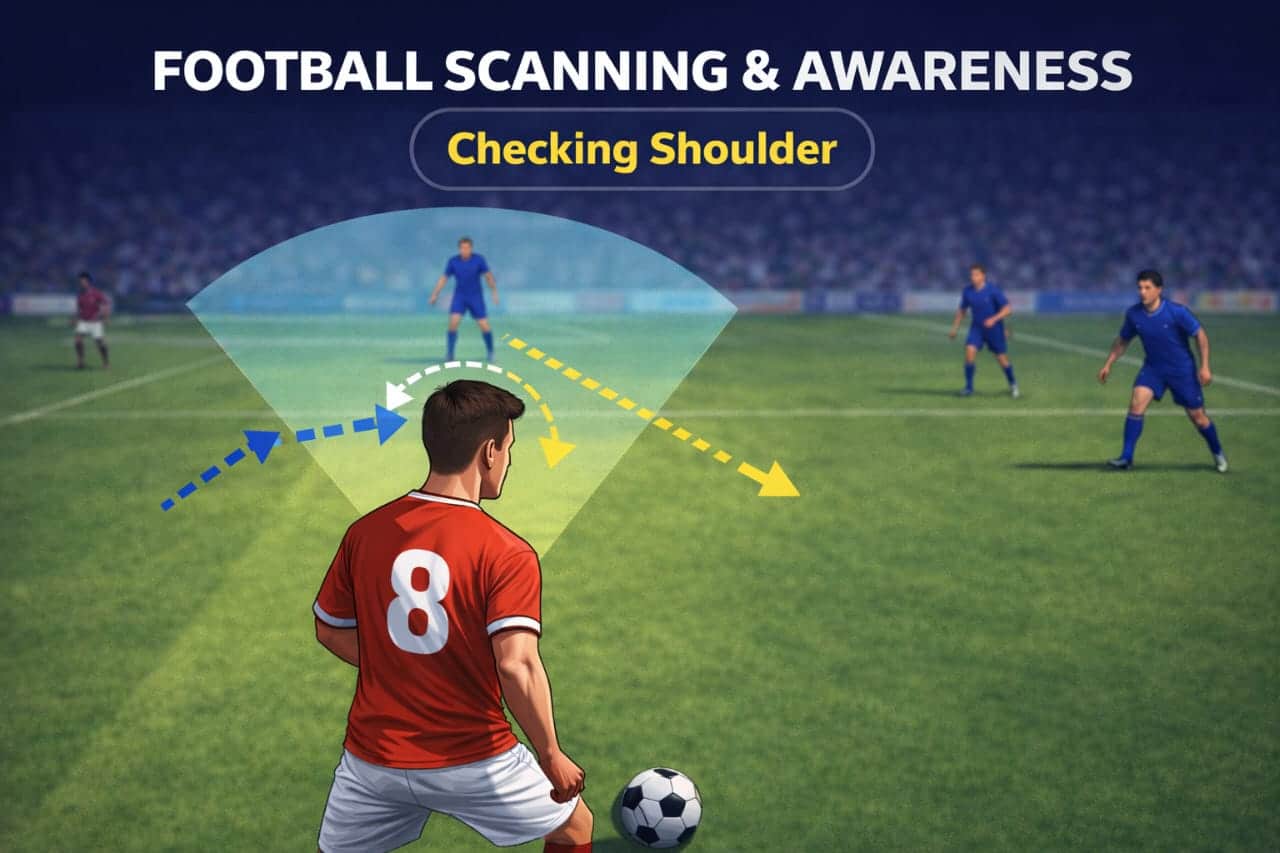
The most important moment in scanning is the final look before receiving the ball, often referred to as the critical scan. This scan provides the most accurate and up-to-date picture of the situation.
Football is constantly changing, and information from earlier moments can quickly become outdated. A defender who was five meters away can suddenly be pressing aggressively, and a passing lane that was open can close within seconds.
The critical scan ensures that decisions are based on the current reality, not past information. Without this, players are always one step behind the game.
Elite players scan repeatedly, not occasionally. In many cases, they check their surroundings every 2–3 seconds when off the ball, allowing them to build a mental map of the pitch.
By the time they receive the ball, they already know where the pressure is coming from, where the space is located, and what their next action will be.
This is why they appear to have more time than others—even when they don’t. In reality, they are not faster—they are better prepared. Time in football is often an illusion created by awareness.
Scanning alone is not enough. It must be supported by correct body positioning, which allows players to use the information they have gathered effectively.
The most effective players receive the ball in a half-turn position, allowing them to see both the ball and the space ahead while maintaining multiple options.
If a player scans but receives facing their own goal, the advantage is lost. Awareness without the ability to act on it provides no real benefit, which is why scanning and body orientation must function together.
One of the biggest differences between average and elite players is what they focus on. Average players focus on the ball, while elite players focus on space and how it will develop.
Instead of reacting to defenders, they identify where space will appear and position themselves accordingly. This includes understanding where the next free space is, how to receive between lines, and how to create separation before the ball arrives.
This concept becomes crucial when playing between the lines in football, where small positional adjustments can create major advantages and reduce pressure.
Scanning becomes even more important in high-pressure situations, where opponents press aggressively and time becomes extremely limited.
Players who scan effectively can play one-touch passes, turn away from pressure, switch play quickly, and progress the ball under pressure without hesitation.
Players who do not scan are forced into rushed decisions, often leading to turnovers and loss of control.

One of the most important truths in football is this: the best decisions are made before receiving the ball. Scanning allows players to pre-plan their next action.
This reduces hesitation and increases the speed of play, allowing players to act immediately instead of thinking after receiving.
This is essential in modern football, where pressing systems punish hesitation instantly and reward quick decision-making.
Despite its importance, many players struggle with scanning awareness due to poor habits and lack of tactical understanding.
These weaknesses become exposed at higher levels, where pressure is faster and more coordinated. Improving awareness requires deliberate training and consistent repetition.
Football scanning awareness is a major component of football intelligence. Players with high football IQ process information faster and understand situations before they fully develop.
This allows them to make quicker decisions, control the tempo of play, and reduce mistakes under pressure.
In many cases, awareness allows players to outperform others who may be physically stronger or faster.
The modern game is faster, more structured, and more demanding than ever before. Teams press collectively, defend compactly, and attack with coordinated movements.
This reduces time and space across all areas of the pitch, making awareness essential for consistent performance.
As a result, football scanning awareness is no longer optional—it is a core requirement for players at all levels of the game.
Ultimately, scanning is about control. It allows players to control the speed of the game, the direction of play, and the outcome of pressure situations.
Players who scan effectively are never rushed—they are prepared. They do not just react to the game—they influence it, which is what separates good players from elite ones.
Improving football scanning awareness is not about random repetition—it requires structured training that forces players to process information under realistic conditions.
The key principle is simple: scanning must be trained alongside decision-making, not in isolation. Players should not just look around—they must connect what they see with what they do next.
This is why modern training focuses on cognitive-technical integration rather than purely physical drills, ensuring that awareness translates into real performance.
For example, instead of passing drills with no pressure, players are placed in situations where they must scan, recognize cues, and react within seconds. This builds real-game awareness rather than artificial habits.
The closer training is to real match conditions, the more effective scanning development becomes.
The most important habit players must develop is scanning before the ball arrives. This sounds simple, but it is one of the hardest behaviors to master consistently.
Many players only look after receiving the ball, which immediately puts them under pressure and limits their options.
To correct this, coaches emphasize scanning early, scanning during movement, and scanning just before receiving, ensuring that players always have updated information.
When this becomes automatic, decision-making speed increases significantly and performance improves under pressure.
To develop football scanning awareness, training must simulate real match conditions where players are forced to think and react quickly.
Some of the most effective drills include structured reaction exercises, awareness-based rondos, pressure simulations, and wall-based scanning drills.
Players receive visual cues such as colored cones or signals before receiving the ball, with each color representing a different action.
This forces players to scan, interpret information, and execute quickly under pressure.
Unlike traditional rondos, players are required to check their shoulders before receiving while responding to external cues from coaches.
This creates constant awareness in tight spaces and improves reaction speed under pressure.
A defender applies passive or delayed pressure from behind, forcing the attacking player to scan and recognize where pressure is coming from before receiving.
This directly replicates real match situations and improves awareness under pressure.
Players pass against a wall and must scan a target behind them before the ball returns, training timing and awareness without needing a full team setup.
Over time, these drills build automatic scanning behavior that translates into matches.
Scanning alone is not enough—the information gathered must be used quickly and effectively in real situations.
In modern football, players often have less than two seconds to act, which makes decision-making speed critical.
Players who combine scanning with fast decision-making become extremely difficult to press and highly effective in possession.
Football scanning awareness is important for every position, but it is applied differently depending on the role and responsibilities of each player.
Midfielders rely heavily on scanning because they operate in crowded central areas, requiring constant awareness of pressure and passing options.
Defenders scan to track runs, maintain line structure, and anticipate danger before it develops.
Attackers use scanning to identify space behind defenders and time their movements effectively.
This is closely connected to third man runs in football, where awareness of timing and positioning creates goal-scoring opportunities.
Modern tactical systems demand high levels of awareness, as players must constantly interpret space and movement within structured systems.
Whether a team is playing positional football or counter-attacking, scanning allows players to maintain discipline, identify overloads, and exploit weak spaces.
This is why awareness is deeply connected to positional play in football, where every movement depends on understanding space and timing.
Even when players understand scanning, they often make key mistakes that reduce its effectiveness in real matches.
These mistakes are punished quickly at higher levels, where pressure is faster and more coordinated. The goal is not just to look—but to understand and act.
Modern football trends are making football scanning awareness even more important as the game becomes faster and more structured.
Teams now use high-intensity pressing systems, hybrid man-marking structures, and compact defensive blocks, all of which reduce time and space.
As a result, awareness is becoming one of the most valuable skills in football, and players who cannot scan effectively struggle to adapt.
The ultimate goal of scanning training is performance in real matches, where decisions must be made quickly and accurately under pressure.
Players must transfer what they practice into competitive situations by scanning before receiving, making faster decisions, and staying calm under pressure.
When done correctly, scanning becomes automatic and part of how a player naturally plays the game.
Football scanning awareness is not just a technical detail—it is a game-changing skill that affects every action on the pitch.
It influences passing, movement, positioning, and decision-making, making it one of the most important abilities in modern football.
Players who master scanning gain a clear advantage because they see more, think faster, and play with greater control.
In a game where time and space are constantly shrinking, awareness is what creates opportunity and defines performance.
And in modern football, where time and space are limited, that advantage often determines the difference between keeping control and losing it.