Physical Address
MICKYWORLDNG
Physical Address
MICKYWORLDNG

MICKYWORLDNG IS READER-SUPPORTED. WHEN YOU BUY THROUGH LINKS ON OUR SITE, WE MAY EARN AN AFFILIATE COMMISSION AT NO EXTRA COST TO YOU.
How to win 50/50 duels in football is one of the most decisive skills in the game because these moments often determine which team gains control under pressure. A 50/50 duel is not just a physical battle—it is a situation where positioning, timing, awareness, and composure all come together in a split second. Whether it is a loose ball in midfield, a second ball after a long pass, or a shoulder-to-shoulder contest, the player who understands how to handle these situations correctly will consistently come out on top.
Most players approach these duels with only aggression, thinking effort alone is enough. But at a higher level, how to win 50/50 duels in football is about control. It is about arriving balanced, reading the situation early, and using your body intelligently rather than just forcefully. When done properly, you are not just competing for the ball—you are dictating what happens next.
Before improving how to win 50/50 duels in football, it is important to understand what these moments actually involve. A 50/50 duel is rarely truly equal. One player usually has a slight advantage—either better positioning, better timing, or better awareness. The goal is to consistently be that player.
These duels occur in different forms. Sometimes it is a ground challenge where both players try to shield and control the ball. Other times it is an aerial duel where timing and jump coordination matter more than strength. In many cases, it is about reacting to a loose ball faster than your opponent. Each type requires a slightly different approach, but the core principles remain the same.
What separates effective players is not just their willingness to compete, but their ability to stay composed in these chaotic moments. Instead of rushing, they stay controlled, adjust their body shape, and make smart contact with the ball.
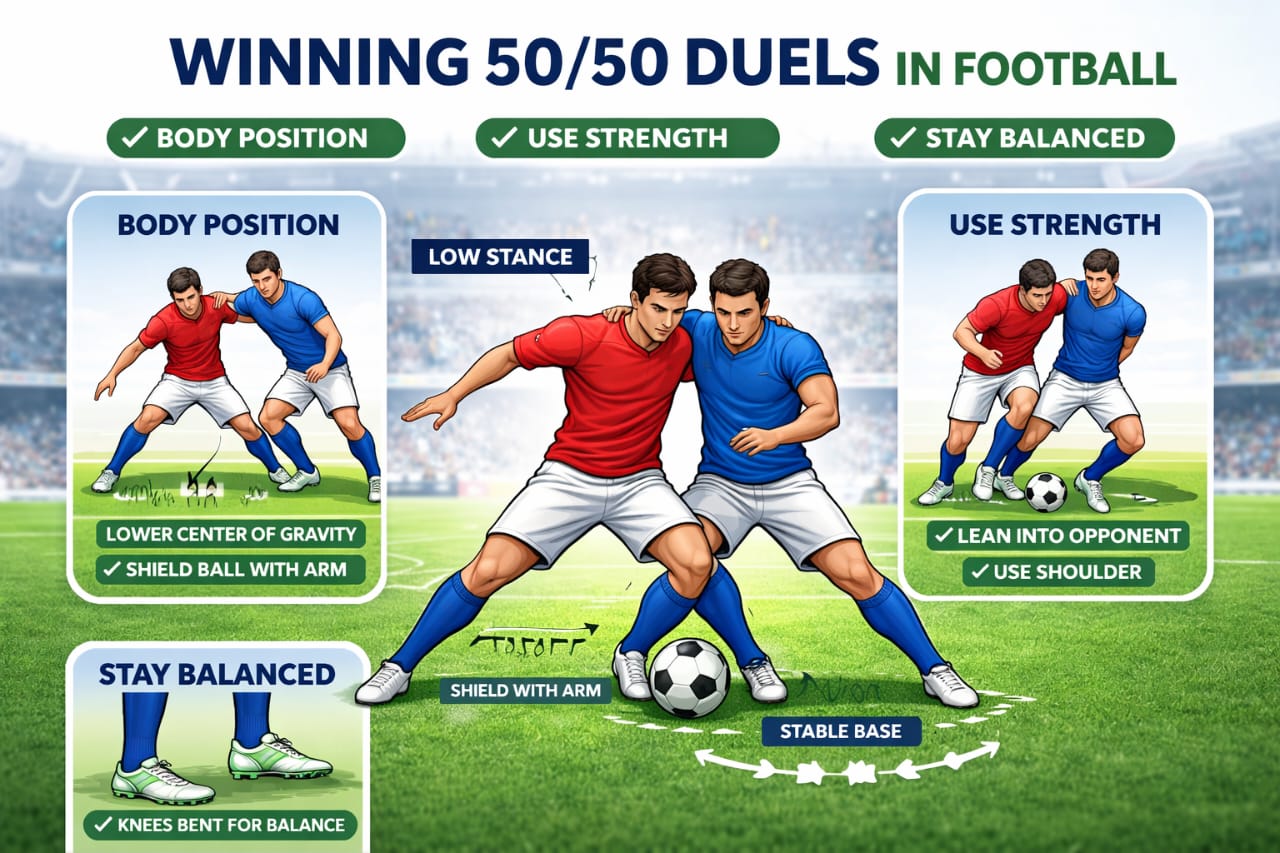
The biggest advantage in how to win 50/50 duels in football comes before the challenge even begins. Body positioning determines whether you are in control or reacting under pressure. Players who arrive side-on, balanced, and slightly goal-side (or ball-side depending on the situation) have a natural edge.
Getting your body between the opponent and the ball is critical, a concept closely linked to positional play in football where controlling space and positioning gives players a natural advantage in duels. When done properly, you are not just contesting the duel—you are protecting the outcome before it happens.
Lowering your center of gravity is equally important. Bending your knees, keeping your weight balanced, and staying compact makes it much harder for an opponent to push you off the ball. Players who stay too upright often lose balance on contact, which is why they struggle in physical battles.
Arm positioning also matters. Strong players use their arms subtly to feel the opponent and maintain space without committing fouls. This allows them to stay stable and adjust quickly if the ball moves unexpectedly.
Timing is often the difference between winning and losing a duel. In how to win 50/50 duels in football, rushing into challenges is one of the most common mistakes. Players who dive in too early give their opponent time to react, adjust, or draw a foul.
The key is patience. Instead of attacking immediately, you wait for the right moment—usually when the ball is slightly away from the opponent or when they are off balance. This is when your chances of winning the ball increase significantly.
Good timing also applies to aerial duels. Jumping too early or too late reduces your ability to make clean contact. The best players time their jump so they meet the ball at its highest or most controllable point, giving them maximum control and power.

Balance is what allows strength to be effective. In how to win 50/50 duels in football, players who maintain stability during contact are far more likely to come away with the ball. This is not just about physical strength—it is about how that strength is applied.
Keeping a strong base with your feet slightly apart improves stability. When contact happens, you are able to absorb it rather than being pushed off the ball. This is where core strength plays a major role, as it helps you stay upright and controlled even under pressure.
One useful concept is staying “compact” during contact. Instead of stretching or overreaching, you keep your body tight and controlled. This reduces the chances of losing balance and allows you to react quickly if the ball changes direction.
Another key part of how to win 50/50 duels in football is anticipation. The best players do not arrive late—they read the situation early and position themselves before the duel even becomes obvious.
This involves scanning the field, understanding where the ball is likely to go, and adjusting your position in advance. When you arrive early, you can set your body properly and control the situation instead of reacting under pressure.
Anticipation is especially important when dealing with second balls. After a clearance or deflection, the ball often drops into unpredictable areas. Players who are alert and ready can move quickly and gain control before others react.
Even with good positioning, there are moments where reaction speed becomes the deciding factor. In how to win 50/50 duels in football, reacting quickly to loose balls or sudden changes gives you a crucial advantage.
This is particularly important in midfield, where space is limited and decisions must be made instantly. A quick first step, sharp awareness, and the ability to adjust your body position rapidly can turn a neutral situation into a winning one.
Training reaction speed through realistic match scenarios helps players develop this ability. Small-sided games, tight-space drills, and pressure-based exercises are all effective in improving how quickly players respond.
A long pass is played forward and gets cleared by the defender. The ball drops just outside the midfield area, and two players move toward it. One player runs straight at the ball without adjusting their body, while the other slows slightly, positions their body between the opponent and the ball, and prepares for contact.
As the ball drops, the second player lowers their center of gravity, absorbs the contact, and controls the ball cleanly. This is a perfect example of how to win 50/50 duels in football using positioning, timing, and balance rather than pure strength.
Coaches often emphasize that winning duels is not about being the strongest player on the pitch. It is about being the smartest in those moments. Players who understand how to win 50/50 duels in football focus on details—how they approach the ball, how they position their body, and when they commit.
Smart players make the game easier for themselves. They avoid unnecessary physical battles by arriving early, using angles, and controlling space. This allows them to win duels more consistently without relying on excessive force.
Over time, this approach leads to better performance, fewer fouls, and more control during matches. It turns chaotic situations into controlled ones, which is exactly what top-level football demands.
Once players understand the basics of how to win 50/50 duels in football, the next step is refining the small details that consistently give them the edge. At higher levels, these duels are no longer random—they are controlled through subtle adjustments in body shape, timing, and decision-making.
One key technique is approaching the duel at an angle instead of running directly toward the ball. This allows you to naturally place your body between the opponent and the ball, giving you control before contact even happens. Straight runs often lead to collisions, while angled approaches create advantage.
Another important detail is using your first touch wisely after winning the duel. Many players win the ball but lose it immediately because they do not prepare for what comes next. The best players already know their next action—whether to pass, carry, or shield—before the duel is even completed.
Physicality is a major part of how to win 50/50 duels in football, but it must be controlled. Players who rely only on force often give away fouls or lose balance. The key is to apply strength in a way that is legal, controlled, and effective.
Shoulder-to-shoulder contact is one of the most common ways to compete. Instead of pushing, players lean into the opponent while staying balanced. This makes it difficult for the opponent to stay stable without committing a foul.
Foot placement also matters. A strong planted foot provides stability and allows you to resist pressure. Without this base, even strong players can be pushed off the ball easily.
Using strength correctly means staying composed, controlled, and focused on the ball rather than just the opponent.
A huge part of how to win 50/50 duels in football comes from second balls—situations where the ball is loose after a tackle, clearance, or deflection. These moments are often unpredictable, which is why anticipation and positioning become even more important.
Players who dominate second balls are always alert. They stay on their toes, scan constantly, and move early. Instead of reacting late, they are already in position when the ball arrives.
This is closely connected to movement and timing concepts found in third man runs in football, where arriving at the right moment gives players a clear advantage. The same principle applies here—being early is better than being fast.
Winning second balls consistently gives teams control of the game, especially in midfield where transitions happen quickly.
Understanding how to win 50/50 duels in football also means adapting to different opponents. Not every duel should be approached in the same way.
Against stronger players, the focus should be on positioning and timing rather than direct physical battles. By arriving early and using your body smartly, you can avoid being overpowered.
Against quicker players, anticipation becomes more important. Reading the play early allows you to intercept or control the ball before they can use their speed advantage.
Adapting your approach based on the opponent makes you more effective and consistent in different situations.

Even players who understand how to win 50/50 duels in football can struggle if they make simple mistakes. One of the most common issues is approaching the duel upright, which makes it easy to lose balance during contact.
Another mistake is committing too early. Rushing into the challenge often gives the opponent time to adjust and take advantage. Patience and timing are always more effective than aggression alone.
Poor awareness is also a problem. Players who do not scan the field arrive late or position themselves incorrectly, reducing their chances of winning the ball.
Fixing these mistakes requires focus on fundamentals—body position, timing, and awareness.
Improving how to win 50/50 duels in football requires training in realistic conditions. Simple drills that simulate match situations are the most effective way to develop this skill.
One useful drill is controlled 1v1 challenges, where players compete for loose balls in a small area. This improves body positioning, balance, and reaction speed.
Another effective method is small-sided games, which create frequent duel situations. These games force players to react quickly and apply their skills under pressure.
Reaction drills and quick transitions also help players improve how they respond to unpredictable situations, which is essential in real matches.
Mastering how to win 50/50 duels in football gives players a major advantage because it allows them to control key moments in the game. These small battles often decide possession, momentum, and even match outcomes.
By focusing on body positioning, timing, balance, and anticipation, players can consistently win duels without relying purely on strength. This makes their performance more efficient and reliable.
The key is consistency. Winning one duel is not enough—players must apply these principles repeatedly throughout the game.
When this becomes a habit, players not only win more duels but also become more dominant and influential on the pitch.