Physical Address
MICKYWORLDNG
Physical Address
MICKYWORLDNG

MICKYWORLDNG IS READER-SUPPORTED. WHEN YOU BUY THROUGH LINKS ON OUR SITE, WE MAY EARN AN AFFILIATE COMMISSION AT NO EXTRA COST TO YOU.
How to stay compact as a team in football is one of the most important tactical principles in modern football because it determines how well a team can control space, limit attacking options, and maintain defensive stability. Teams that understand team compactness in football are able to reduce gaps between players, making it extremely difficult for opponents to play through them.
In today’s game, defensive success is not just about tackling or individual defending. It is about defensive shape in football, structure, and how players move together as a unit. When a team stays compact, it becomes organized, connected, and difficult to break down, regardless of the opponent’s attacking quality.
This is why learning how to stay compact as a team in football is essential for players at all levels. It improves defensive organization, strengthens team structure, and allows teams to control the rhythm of the game without always having possession of the ball.
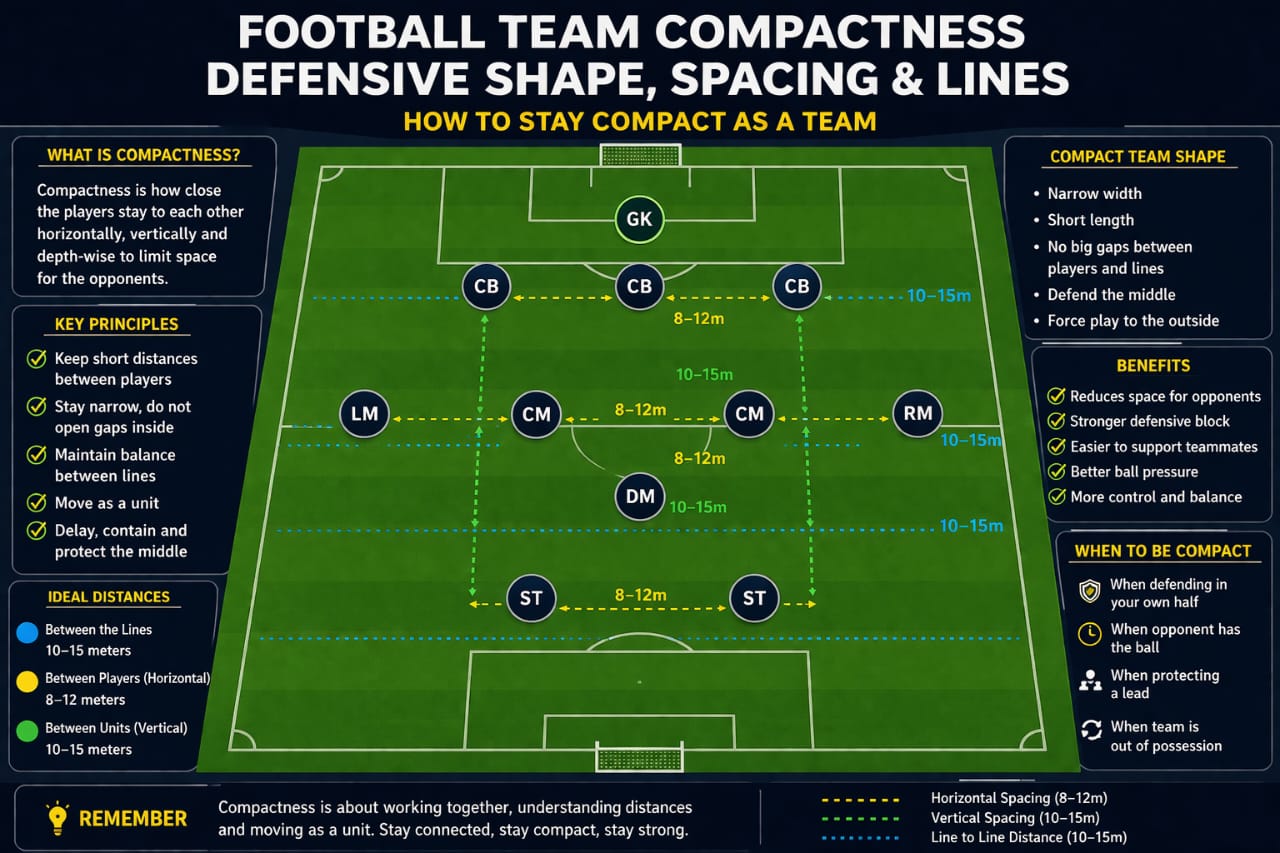
Team compactness in football refers to how closely players position themselves relative to each other when defending. It involves maintaining short distances between teammates both horizontally and vertically, ensuring that the team remains connected at all times.
Horizontal compactness focuses on how narrow the team is across the pitch. By staying narrow, teams protect central areas and force opponents to move the ball wide, where attacking threats are less dangerous.
Vertical compactness refers to the distance between defensive lines—defenders, midfielders, and forwards. When these lines stay close together, it prevents opponents from finding space between them, which is one of the most dangerous areas on the pitch.
Understanding football defensive structure explained in this way helps players realize that defending is about controlling space, not just marking opponents.
This directly contrasts with attacking principles like creating space in football, where teams try to stretch the opposition. Compact teams do the opposite—they compress space and reduce options.
To fully master how to stay compact as a team in football, players must understand the balance between horizontal and vertical compactness.
Horizontal compactness ensures that the team stays narrow enough to block central passing lanes. This forces opponents to play around the block rather than through it. When done correctly, it limits dangerous through balls and reduces the effectiveness of creative players operating centrally.
Vertical compactness ensures that the distance between lines remains tight. Ideally, teams maintain around 10–15 meters between defensive lines and about 8–12 meters between players horizontally. These distances allow the team to stay connected without becoming too crowded.
When both types of compactness are combined, the team forms a compact defensive block in football that is extremely difficult to penetrate.
This structure is what defines defensive organization in football at the highest level.

Another key part of how to stay compact as a team in football is maintaining the correct football team shape and positioning. Shape refers to how players are arranged on the pitch, while structure refers to how they move together.
Teams often defend in structured formations such as a 4-4-2, 4-3-3, or 5-4-1, but the formation itself is less important than how compact the team remains within that shape.
A compact shape ensures that players are always in positions to support each other. When one player presses, others provide cover and balance, maintaining the overall structure.
This coordinated movement is what allows teams to defend effectively as a unit rather than relying on individual actions.
A critical aspect of how teams defend as a unit is shifting together toward the side of the ball. This movement is often referred to as “tilting,” where the entire defensive block shifts to close down space on the ball side.
By shifting as a unit, teams maintain compactness while also applying pressure. The ball side becomes crowded, limiting options for the opponent, while the far side remains compact enough to prevent easy switches.
This coordinated movement ensures that the team stays connected, reducing gaps and maintaining control of space.
Without this synchronization, teams become stretched and lose their defensive structure in football, making them vulnerable to quick passes and movement.
One of the most overlooked aspects of spacing between players in football is maintaining consistent distances. If players are too far apart, gaps appear that opponents can exploit. If they are too close, the team loses flexibility and mobility.
The ideal balance allows players to support each other while still covering enough space to react to changes in play.
This balance is what creates an effective compact defensive block in football, where players can press, cover, and recover without breaking the team’s structure.
Maintaining these distances requires constant awareness, which is why concepts like football scanning awareness are essential for recognizing positioning and adjusting in real time.
Imagine a team defending in a mid-block against an opponent building from the back. The defending team stays narrow, with midfielders and defenders positioned close together, maintaining vertical compactness.
As the ball is played to the right side, the entire team shifts in that direction, keeping the shape intact. The central area becomes crowded, forcing the opponent to play wide.
Once the ball reaches the wing, the defending team applies pressure while still maintaining compactness. The lack of space forces a mistake, allowing the team to regain possession.
This example shows how how to stay compact as a team in football is not just about positioning, but about coordinated movement, awareness, and decision-making.
Teams that master team compactness in football are difficult to break down because they remove the space that attackers rely on. Without space, even the most talented players struggle to create opportunities.
Compact teams also control the tempo of the game by dictating where the ball can be played. They force opponents into predictable patterns, making it easier to defend.
This is why defensive organization in football is considered one of the most important aspects of modern tactics.
By staying compact, teams reduce risk, maintain control, and increase their chances of winning the ball back in favorable positions.
One of the most important aspects of how to stay compact as a team in football is how the team reacts immediately after losing possession, because transitions are the moments where structure is most vulnerable and space opens up quickly. If players do not react together, the team becomes stretched and disconnected, leaving dangerous gaps for opponents to attack. This is why teams must respond instantly, with the closest players applying pressure while others recover into position. Maintaining team compactness in football during these moments ensures the defensive shape remains intact and difficult to break.
To rebuild the defensive shape in football, players must move as a unit rather than individually, reconnecting lines quickly and reducing the space between midfield and defense. When this reaction is delayed, opponents can exploit the space between lines, especially during fast counter-attacks. Compact teams avoid this by closing space around the ball while keeping their structure behind it organized and balanced. This combination of pressure and positioning is what allows teams to stay controlled even in chaotic situations.
Understanding how to stay compact as a team in football also depends on the defensive approach, because compactness must adapt whether a team is pressing high or defending deep. The principle of team compactness in football remains the same, but how it is applied changes based on the situation and location on the pitch. When pressing high, the team must stay vertically compact, with the defensive line pushing up and midfield staying close to support the press. This reduces space and makes it difficult for opponents to play through.
When defending deeper, the focus shifts toward forming a strong compact defensive block in football, where the team stays narrow and protects central areas. This forces opponents to play wide, where they are less dangerous and easier to control. In both situations, success depends on maintaining distances and moving together as a unit rather than reacting individually. This coordinated movement is what keeps the team connected and difficult to break down.
A key part of how to stay compact as a team in football is communication, because players must constantly guide each other to maintain defensive organization in football throughout the game. Defenders usually lead this process by organizing the line and ensuring the team stays connected, while midfielders adjust their positioning to maintain vertical compactness. This constant communication keeps the team balanced and prevents gaps from appearing between lines. Without it, players react too late and lose structure.
Simple actions such as calling players in, pushing the line forward, or warning teammates about movement behind them play a huge role in maintaining compactness. These small details ensure that the entire team moves together instead of breaking into individual actions. When communication breaks down, the defensive shape becomes stretched and easier to exploit. This is why strong communication is essential for maintaining a compact and organized team.
Maintaining how to stay compact as a team in football also depends on the opponent’s tactical system, because different formations create different types of threats that must be managed carefully. Against teams that use width, compact teams stay narrow and shift quickly toward the ball side to prevent central penetration. This reduces danger while still allowing coverage on the wings when needed. The focus remains on protecting the most dangerous areas of the pitch.
Against teams that play through the middle, maintaining team compactness in football becomes even more important, as the space between lines must be tightly controlled. If this space opens up, opponents can receive the ball in dangerous positions and turn quickly. Modern teams adjust their compactness constantly based on movement and positioning rather than staying fixed in one structure. This flexibility is what makes defensive systems effective at higher levels.
One of the biggest advantages of team compactness in football is the ability to force opponents into mistakes by limiting the space and time they have on the ball. When players are surrounded and passing options are restricted, they are forced to make quicker decisions under pressure. This often leads to misplaced passes, poor touches, or rushed actions that can be exploited. Compact teams use this to regain possession in strong areas of the pitch.
This approach focuses on controlling space rather than chasing the ball, allowing teams to defend more efficiently and with less risk. It is closely connected to positional play in football, where controlling space is just as important as controlling possession. By staying compact, teams dictate where the game is played and force opponents into predictable patterns. This makes defending more controlled and effective.
Even when teams understand how to stay compact as a team in football, small mistakes can quickly break the structure and create opportunities for opponents. One of the most common issues is pressing alone without support, which creates gaps and breaks team compactness in football. This allows opponents to play through easily and attack space that should be controlled. These mistakes often come from poor decision-making rather than lack of ability.
Poor spacing between lines is another major problem, especially when the midfield and defense become disconnected. Ball-watching also affects defensive shape in football, as players lose awareness of their positioning within the team. These small errors quickly lead to bigger defensive problems if not corrected. Fixing them requires discipline, awareness, and constant communication.
Improving how to stay compact as a team in football requires structured training that focuses on positioning, awareness, and coordinated movement under realistic conditions. Small-sided games are highly effective because they force players to stay close together and react quickly to changes in possession. These situations naturally improve team compactness in football by increasing pressure and reducing space.
Defensive shape drills help players understand how to move as a unit, while scenario-based training allows teams to practice compactness in real match situations. Over time, these repetitions build habits that make compactness automatic during games. This is what allows teams to stay organized even under pressure.

Mastering how to stay compact as a team in football allows teams to control space, limit attacking options, and maintain structure throughout the game. It is a combination of positioning, communication, and awareness working together as one system. Teams that stay compact are more organized, more disciplined, and harder to break down.
By consistently applying these principles, players develop a better understanding of space and team structure, making them more effective in defensive situations. This is what separates well-organized teams from those that struggle defensively. Compactness is not just a tactic—it is a foundation of modern football.