Physical Address
MICKYWORLDNG
Physical Address
MICKYWORLDNG


MICKYWORLDNG IS READER-SUPPORTED. WHEN YOU BUY THROUGH LINKS ON OUR SITE, WE MAY EARN AN AFFILIATE COMMISSION AT NO EXTRA COST TO YOU.
What is a low block in football is a fundamental question in understanding modern defensive tactics. A low block refers to a structured defensive approach where a team positions itself deep in its own half, prioritising compactness, central protection, and control of space rather than aggressive pressing.
This article is part of the Football Tactical Mastery Series.
Instead of engaging the opponent high up the pitch, teams using a low block deliberately retreat into a compact structure. This is not passive defending—it is a calculated strategy designed to control space and limit high-quality chances. This approach forces the opponent to play in front of the defensive structure rather than through it, meaning possession is allowed but progression is controlled.
At its core, a low block is about denying quality, not denying the ball. Teams accept that the opponent may dominate possession, but they restrict the areas where that possession becomes dangerous. This is why many teams can have high possession numbers against a low block but still struggle to create clear chances.
The system is built on discipline, spacing, and collective movement. Every player must maintain their role within the structure, ensuring the team remains compact at all times.
The primary goal of a low block is to protect central areas, which are the zones where the most dangerous chances are created, including through balls, cutbacks, and close-range shots. By closing these spaces, the defending team forces the opponent into less effective areas, particularly wide zones, shifting the attacking threat away from high-probability scoring situations into lower-quality opportunities.
Instead of defending actions, the low block defends space. The opponent may have the ball, but they do not control the dangerous areas, and that distinction is important because players are not chasing the ball—they are controlling zones.
This spatial control is closely linked to how teams use positional play in football, where attacking sides try to stretch and manipulate compact structures. The low block is essentially the defensive answer to positional play.
The 4-4-2 formation is the most widely used shape for a low block because it naturally creates two compact lines. The defensive line of four protects the penalty area and prevents runs in behind, while the midfield line of four sits just ahead, reducing space between lines and blocking central passing lanes.
The two forwards remain slightly higher, not to attack, but to screen passes into midfield and apply minimal pressure when needed. This creates a layered defensive system that is difficult to penetrate, as each line supports the one behind it, ensuring there are no easy gaps.
However, the effectiveness of this shape depends entirely on spacing. If the lines are too far apart, the structure breaks.
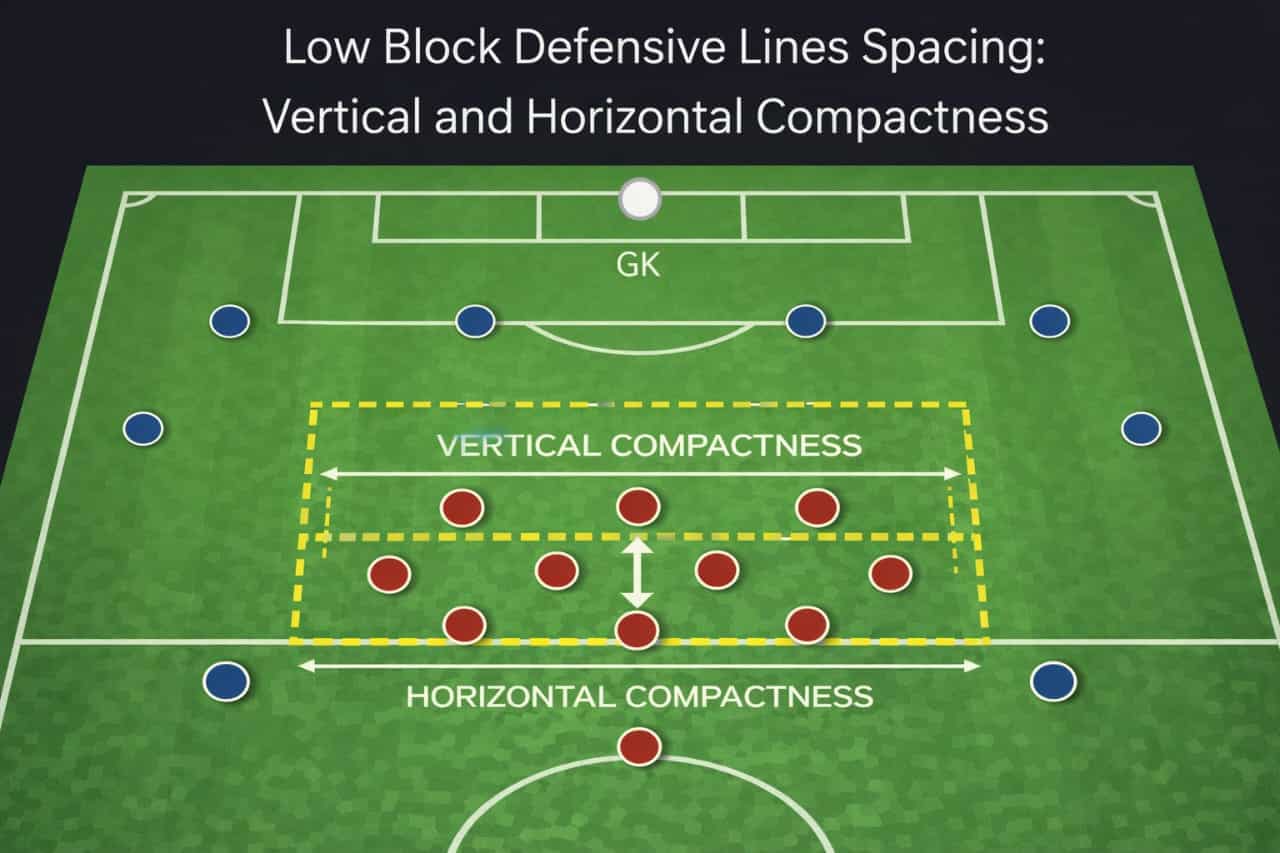
Compactness is the most important principle in a low block. Vertical compactness refers to how close the defensive, midfield, and forward lines are to each other, and when these lines are tight, it becomes extremely difficult for attackers to receive the ball between them.
Horizontal compactness refers to how narrow the team is across the pitch. Players shift together toward the ball, reducing passing lanes and closing central space. These two forms of compactness work together to reduce the effective playing area, meaning the opponent may still have possession, but their usable space is significantly reduced.
This is what makes attacks feel slow and predictable against a well-organized low block.

This is why breaking a low block requires more than passing ability—it requires movement, timing, and structural understanding. Without compactness, the low block loses its effectiveness, as gaps appear and those gaps can be exploited. This is also why coordination is critical, because every player must move together to maintain the structure.
Another key feature of a low block is forcing the opponent wide. Since central areas are heavily protected, attackers are pushed toward the flanks, and this is a deliberate strategy rather than a weakness.
Wide areas are less dangerous because they limit angles and reduce shooting opportunities. Crosses become the main attacking option, but these can be defended more easily when the defensive line is set, as defenders face the ball, maintain position, and clear danger effectively.
This is why many teams appear comfortable even when defending for long periods in a low block, because the threat is controlled even if possession is not. This concept connects directly to playing between the lines in football, which low blocks are specifically designed to prevent.
A low block is not static—it constantly shifts based on the position of the ball. When the ball moves, the entire team moves with it, maintaining compactness and preventing gaps from opening.
If one player steps out at the wrong time, the structure can break, which is why communication is essential. Players must constantly adjust their positioning in relation to teammates and opponents, ensuring distances are maintained, angles are controlled, and timing is precise.
This level of coordination is what makes elite defensive teams so difficult to break down.
Defending in a low block is mentally demanding. Players must remain focused for long periods without the ball and resist the urge to chase possession or press unnecessarily, which requires discipline and patience.
The structure only works if every player trusts the system, because one mistake or one moment of impatience can create space for the opponent. This is why low blocks are often associated with tactically organised and mentally strong teams.
It is not just a defensive strategy—it is a test of concentration and collective understanding.
The reason low blocks are so effective is because they reduce space, time, and options. Attackers have less room to operate, fewer passing lanes, and more pressure, which leads to slower attacks and predictable patterns.
Teams often circulate the ball without finding penetration, and over time frustration builds, causing decision-making to become rushed or conservative. This is exactly what the low block is designed to achieve, as it disrupts attacking rhythm and forces teams into low-percentage actions.
Understanding what is a low block in football therefore goes beyond formation—it is about how teams control space, shape the game, and limit attacking effectiveness.
Understanding what is a low block in football is only one side of the tactical picture, as the real challenge comes when teams try to break it. Because space is limited and central areas are protected, attacking teams must rely on structure, movement, and patience rather than speed alone.
The first requirement is stretching the defensive shape. A low block thrives on compactness, so the only way to disrupt it is to increase the distances between players. This is often done by using width, where wingers stay wide, full-backs overlap, and the pitch is stretched horizontally.
Once the defensive line is pulled apart, small gaps begin to appear between players, and those gaps are the key to penetration. Without creating these gaps, even sustained possession becomes ineffective, but stretching alone is not enough because timing matters. Movement must be coordinated with the ball, not separate from it, which is why positional discipline in attack is just as important as defensive discipline in a low block.
One of the most effective ways to break a low block is through quick passing combinations. Because defenders stay close together, individual dribbling becomes difficult, so the ball must move faster than the defensive shape.
Short passes, one-touch play, and quick exchanges create moments where defenders cannot adjust quickly enough. This is where patterns like third-man runs become important, as a player passes, moves, and another player arrives at the right moment to receive in space.
These movements are structured and rehearsed rather than random, allowing teams to bypass defenders without needing physical space. This approach is closely linked to third man runs in football, where timing and positioning create passing options that are not immediately visible.
Against a low block, these subtle movements often make the difference.
Patience is one of the most underrated qualities when facing a low block. Because the opponent is not pressing aggressively, it can feel like there is time and space to attack quickly, but rushing attacks usually benefits the defending team.
Low blocks are designed to deal with direct, predictable actions, and they are less comfortable when the ball is circulated with control and purpose. This is why teams often recycle possession multiple times before finding an opening, as they are not being passive but waiting for the right moment.
The key is to move the defensive shape, not just the ball, and this distinction is what separates structured attacks from predictable possession. Every pass should have a purpose—to shift the block, create imbalance, or open a lane.
Another important method is switching play quickly from one side of the pitch to the other. Low blocks shift toward the ball, creating temporary space on the opposite side, and if the ball is switched quickly enough, that space can be exploited before the defense reorganizes.
This requires accuracy and speed, as the pass must travel fast and the receiving player must be ready to attack immediately. Delays allow the defensive block to recover, while quick switches force defenders to move longer distances, increasing the chance of mistakes.
These moments of delayed movement are often where the first real gap appears, and this method becomes even more effective when combined with width and overlapping runs.

Overloads are another essential tool when facing a low block, involving placing more players in a specific area than the opponent to create numerical superiority.
For example, a team may create a 3v2 situation in midfield or a 2v1 on the wing, forcing defenders into difficult decisions. If they press, space opens elsewhere, and if they hold position, the attacking team gains time on the ball.
Overloads are not just about numbers—they are about positioning and timing, as players must arrive at the right moment and support each other with correct spacing. This concept is closely related to overloads in football, where teams manipulate defensive structures to create advantages.
Against a low block, overloads can create the small gaps needed to break through.
Even with all these methods, many teams still struggle against low blocks, and the reason is often not tactical knowledge but execution.
Breaking a low block requires precision, patience, and consistency. If passing is too slow, the defense stays organized, if movement is not coordinated, gaps do not appear, and if decisions are rushed, attacks break down.
It is a system designed to punish mistakes, which is why teams that rely heavily on individual brilliance often struggle, as low blocks are built to neutralize individual actions and force collective solutions.
While the primary goal of a low block is defensive, it also creates attacking opportunities. When possession is regained, the opponent is often out of position, creating space for counter-attacks.
Because the attacking team has committed players forward, transitions become dangerous, and quick forward passes, direct runs, and simple decision-making can turn defense into attack within seconds.
This is why many teams combine low block defending with counter-attacking strategies, where the defensive structure provides stability while transitions provide threat.
A low block is ultimately about managing risk, as teams accept less control of the ball in exchange for greater control of space. This trade-off defines the strategy, reducing the number of dangerous situations faced even if it increases defensive workload.
Success depends on discipline, organisation, and understanding. When executed well, it can neutralise even the most dominant attacking teams, but when executed poorly, it becomes passive and vulnerable.
The difference lies in detail, and understanding what is a low block in football ultimately means understanding how teams control space, manage risk, and shape the game without the ball—often without needing possession to stay in control.