Physical Address
MICKYWORLDNG
Physical Address
MICKYWORLDNG

MICKYWORLDNG IS READER-SUPPORTED. WHEN YOU BUY THROUGH LINKS ON OUR SITE, WE MAY EARN AN AFFILIATE COMMISSION AT NO EXTRA COST TO YOU.
Why teams struggle against low blocks in football is one of the most important tactical questions in the modern game. Many teams dominate possession, control territory, and circulate the ball for long periods—yet still fail to create clear chances.
This article is part of the Football Tactical Mastery Series.
The issue is not simply about quality. Even the most technically gifted teams can look ineffective against a low block, because the problem is structural rather than individual. Space is controlled, passing lanes are limited, and every action becomes more predictable.
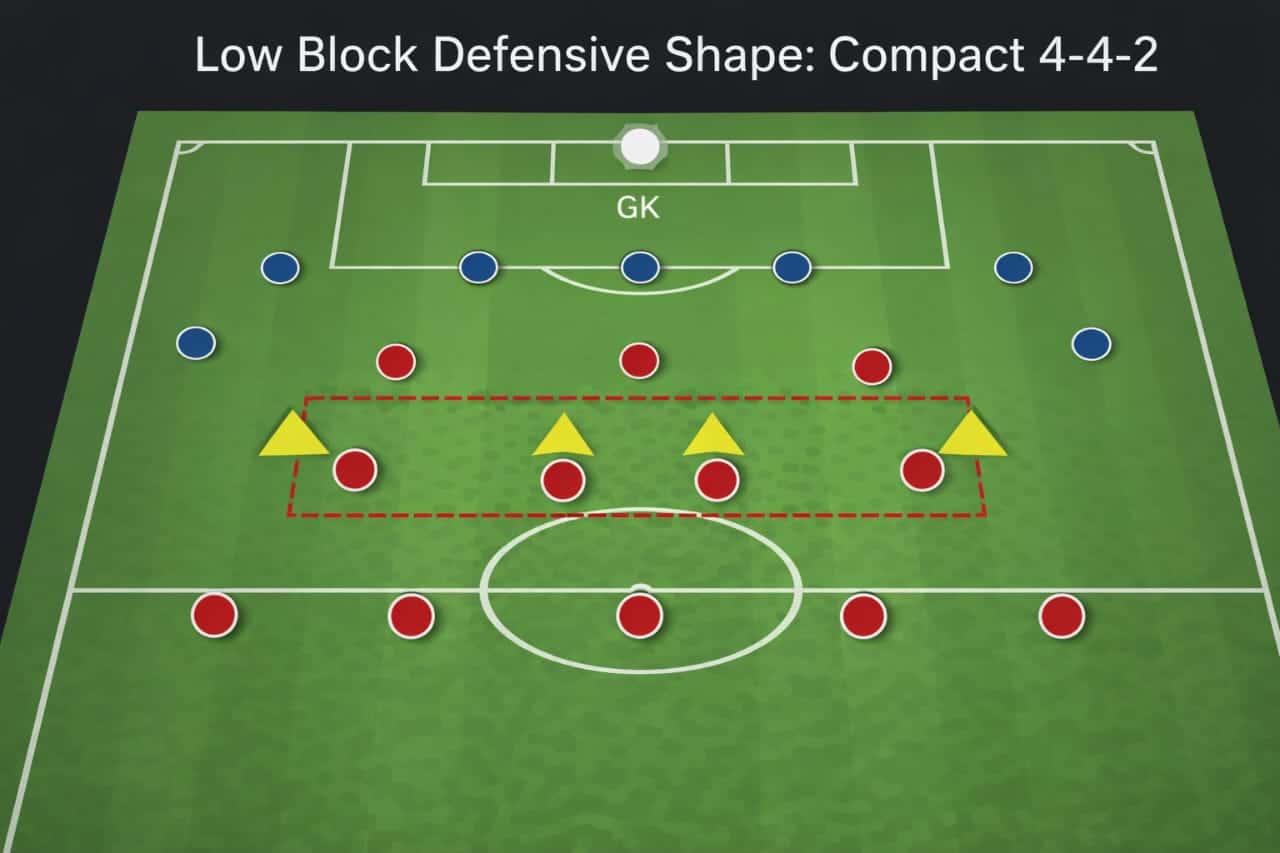
A low block is designed to remove space. It compresses the pitch vertically and horizontally, forcing the attacking team to play in front rather than through or behind the defense.
This creates a game state where possession becomes predictable. The ball moves, but the defense remains comfortable.
Understanding why this happens requires breaking down the core problems teams face against compact defensive structures.
The biggest strength of a low block is compactness. Defenders and midfielders stay close together, reducing the distance between lines.
This eliminates passing lanes into dangerous central areas. Even when the ball is circulated well, there is simply no space to exploit.
Instead of gaps, the attacking team sees a wall of players positioned intelligently to block progression.
This is why many attacks become slow and repetitive. The ball is moved side to side, but penetration is limited.
In these moments, possession becomes passive rather than threatening.
The team controls the ball, but not the opponent.
This is also where understanding positional play in football becomes critical, because structure determines whether space can be created or remains closed.
One of the clearest signs of struggling against a low block is the U-shape pattern of possession.
The ball moves from one full-back to the center-backs, then across to the other side, without ever entering central zones.
This happens because the midfield is marked or blocked, making forward passes too risky.
As a result, teams circulate the ball around the block rather than through it.
This type of possession looks controlled, but it rarely leads to chances.
It creates the illusion of dominance without actually destabilizing the defensive structure.
It becomes predictable, allowing the defending team to remain organized without being stretched.

Over time, this pattern reduces attacking threat. The more predictable the circulation, the easier it is for the defense to maintain shape.
Breaking this pattern requires verticality—but that is exactly what the low block is designed to prevent.
Another key reason why teams struggle is the inability to access central spaces between defensive and midfield lines.
These areas are often referred to as the most dangerous zones on the pitch.
However, against a low block, these spaces are tightly controlled.
Defenders stay close to midfielders, reducing the gaps that attackers normally exploit.
Without players operating effectively in these zones, attacks become predictable and easier to defend.
This is directly connected to playing between the lines in football, where positioning and awareness are crucial for breaking compact structures.
When teams fail to occupy these spaces, they are forced wide. And wide areas, while useful, are less dangerous when the box is crowded.
Spacing is one of the most underrated factors in attacking against a low block.
If players are positioned too close together, they become easier to mark.
If they are too far apart, combinations become difficult.
The best teams maintain optimal distances, creating passing triangles and angles that stretch the defense.
However, many teams fail to achieve this balance.
They either overcrowd certain zones or leave others empty.
This leads to predictable patterns and reduces the effectiveness of possession.
Without proper spacing, creating overloads becomes difficult—and without overloads, breaking a compact defense becomes unlikely.
Speed of play is critical against a low block.
If the ball moves slowly, the defense has time to adjust and maintain its shape.
Quick circulation, on the other hand, forces defenders to shift constantly, increasing the chance of mistakes.
Many teams struggle because their tempo is too slow.
They take too many touches, hesitate in key moments, and allow the defense to stay organized.
In tight spaces, speed of decision-making is often more important than speed of movement.
The faster a team can move the ball and make decisions, the harder it becomes for the defense to remain compact.
There is also a mental aspect to why teams struggle against low blocks.
When space is limited and chances are rare, players become cautious.
They avoid risky passes and choose safer options, even when those options do not progress the attack.
This creates a cycle of safe but ineffective possession.
The team controls the ball but does not create danger.
Over time, frustration builds, and decision-making becomes even more conservative.
This psychological pressure is often the hidden factor behind ineffective attacks.
Breaking a low block is not just about tactics—it is also about confidence and willingness to take calculated risks.
How Elite Teams Break Low Blocks: Creating Problems Instead of Waiting for MistakesIf Part 1 explains why teams struggle against low blocks in football, then Part 2 focuses on the solutions. Breaking a compact defensive structure is not about doing one thing better—it is about combining multiple principles at the same time.
Low blocks are comfortable when the game is predictable. The moment unpredictability is introduced, the structure begins to break.
This is why elite teams do not rely on patience alone. They actively manipulate the defensive shape to create openings.
The key idea is simple: instead of waiting for space, you must create it.
This is what separates reactive teams from proactive ones.
This shifts the mindset from passive possession to proactive attacking.
The most effective way to break a low block is through intelligent positional play.
Rather than focusing only on the ball, teams focus on occupying key zones across the pitch.
Width stretches the defense horizontally. Depth stretches it vertically. Between-the-lines positioning stretches it internally.
When all three are applied together, the compact structure begins to lose its shape.
This is not random movement—it is controlled occupation of space.
Players position themselves to create passing angles, not just to receive the ball.
This principle is strongly connected to positional play in football, where structure defines how space is manipulated rather than simply used.
Once the block is stretched, small gaps begin to appear—and those gaps are the key to progression.

Low blocks rely on balance. Every player has a role, and the structure depends on maintaining numerical equality in key zones.
Overloads break that balance.
By placing more players in a specific area than the opponent can handle, attacking teams create local superiority.
This forces defenders to make decisions—step out or stay compact.
Both choices create problems.
If a defender steps out, space opens behind them. If they stay, the attacking team has numerical advantage.
This is where intelligent movement becomes crucial.
Players must not only occupy space but also time their movements to maximize the impact of overloads.
Without timing, overloads become static and easy to defend.
One of the most effective tools against low blocks is the third-man concept.
Instead of forcing a direct pass into a crowded area, teams use an indirect combination.
Player A passes to Player B, who immediately sets the ball for Player C moving into space.
This allows the ball to bypass defensive lines without predictable movement.
It also increases the speed of play, making it harder for defenders to react.
This concept is explained further in third man runs in football, where movement and timing combine to unlock compact defenses.
Against a low block, direct passes are often blocked—but indirect combinations can create openings that were not visible initially.
Low blocks are naturally ball-oriented. As the ball moves, the entire defensive unit shifts toward that side.
This creates a hidden opportunity—the weak side.
Switching play quickly from one side to the other forces the defense to move large distances.
If the switch is fast enough, the defense cannot recover its compactness in time.
This creates temporary isolation, which is one of the few ways to generate advantage against a low block.
This creates 1v1 situations, especially for wingers or full-backs.
However, switching play is not just about long passes.
It is about timing, speed, and recognizing when the block is overloaded on one side.
A slow switch allows the defense to reset. A fast switch creates immediate danger.
Even after breaking part of the structure, the final challenge remains—creating a clear chance.
In the final third, space is extremely limited, and decisions must be precise.
This is where quick combinations become essential.
Wall passes, one-touch play, and short passing sequences can break defensive lines in tight areas.
These actions rely on timing and understanding between players.
Every movement must be coordinated.
This is closely linked to final third combinations in football, where small details determine whether an attack succeeds or fails.
Against a low block, there is no room for hesitation. The moment must be exploited immediately.
One of the most effective ways to disrupt a low block is through late runs from midfield.
Defenders are often focused on the ball and the immediate attackers.
This creates blind spots for players arriving from deeper positions.
These runs are difficult to track because they are not part of the initial defensive reference.
When timed correctly, they create high-quality chances.
However, timing is everything.
If the run is too early, it is easily marked. If it is too late, the opportunity is lost.
Elite teams coordinate these movements with precision.
Crossing is often seen as a basic solution against low blocks, but ineffective crossing is one of the biggest reasons teams fail.
Random crosses into a crowded box rarely lead to goals.
In fact, they often reset possession and allow the defense to remain comfortable.
Effective crossing requires structure.
Players must attack specific zones—near post, far post, and cutback areas.
The delivery must match the movement.
Low, driven crosses and cutbacks are often more effective than high balls.
This is because they target defenders facing their own goal, increasing the chance of mistakes.
Crossing should be a calculated action, not a desperate one.
One of the most difficult aspects of breaking a low block is managing tempo.
Too much patience leads to predictability.
Too much urgency leads to poor decisions.
The best teams combine both.
They remain patient in circulation but become aggressive when an opportunity appears.
This balance is what separates effective attacks from ineffective possession.
It is not about playing fast all the time—it is about playing fast at the right moment.
Even with the right structure and ideas, some teams still struggle.
This is because execution matters as much as strategy.
Poor first touches, slow decisions, and lack of movement can destroy even the best tactical plan.
Breaking a low block requires precision.
Every action must be clean, quick, and coordinated.
At the highest level, small details make the difference.
This is why the topic of why teams struggle against low blocks in football is not just tactical—it is also technical and psychological.
A low block is designed to bring order to the game. It reduces space, limits options, and forces predictability.
To break it, teams must do the opposite.
They must create controlled chaos—through movement, speed, and intelligent positioning.
It is not about forcing the game. It is about manipulating it.
When done correctly, even the most compact defense can be broken.
But when done poorly, even the best teams can look ineffective.
That is the reality of modern football—and why breaking a low block remains one of the most complex challenges in the game.