Physical Address
MICKYWORLDNG
Physical Address
MICKYWORLDNG


MICKYWORLDNG IS READER-SUPPORTED. WHEN YOU BUY THROUGH LINKS ON OUR SITE, WE MAY EARN AN AFFILIATE COMMISSION AT NO EXTRA COST TO YOU.
Breaking low block in football is one of the most demanding tactical problems in the modern game. When teams defend deep, they deliberately compress space, protect central zones, and force opponents into low-probability attacking situations. This is not passive defending—it is an organized, calculated system designed to remove risk and frustrate attacking structures.
This article is part of the Football Tactical Mastery Series.
At elite level, solving this problem is not about individual brilliance or random creativity. It is about control—control of space, control of tempo, and control of structure. Every movement and every pass is used to manipulate the defensive block, gradually stretching it until gaps appear.
The biggest challenge comes from how effectively low blocks eliminate central access. The distance between defensive and midfield lines is extremely small, horizontal compactness is maintained, and passing lanes into dangerous zones are deliberately closed. This creates a situation where teams can dominate possession but still struggle to create clear chances, as the ball moves but the defense remains stable. Because of this, breaking a low block is not about attacking faster—it is about attacking smarter, with structure, timing, and control.
Low blocks are effective because they prioritize structure over pressure. Unlike high pressing systems, they do not chase the ball aggressively, instead maintaining shape and waiting for mistakes. This leads to central areas becoming overcrowded, passing lanes being blocked rather than contested, and the attacking team being pushed into wide zones.
One of the most important aspects is vertical compactness. The distance between the defensive line and midfield line is kept minimal, often within 10–15 meters, removing the “pocket” space where creative players usually operate. At the same time, horizontal compactness ensures that the team shifts together as a unit, and when the ball moves, the entire block moves with it, making it extremely difficult to isolate defenders or create numerical superiority in key areas. The result is a defensive system that does not need to win the ball immediately—it only needs to delay and restrict, and the longer the attack is delayed, the more predictable it becomes.
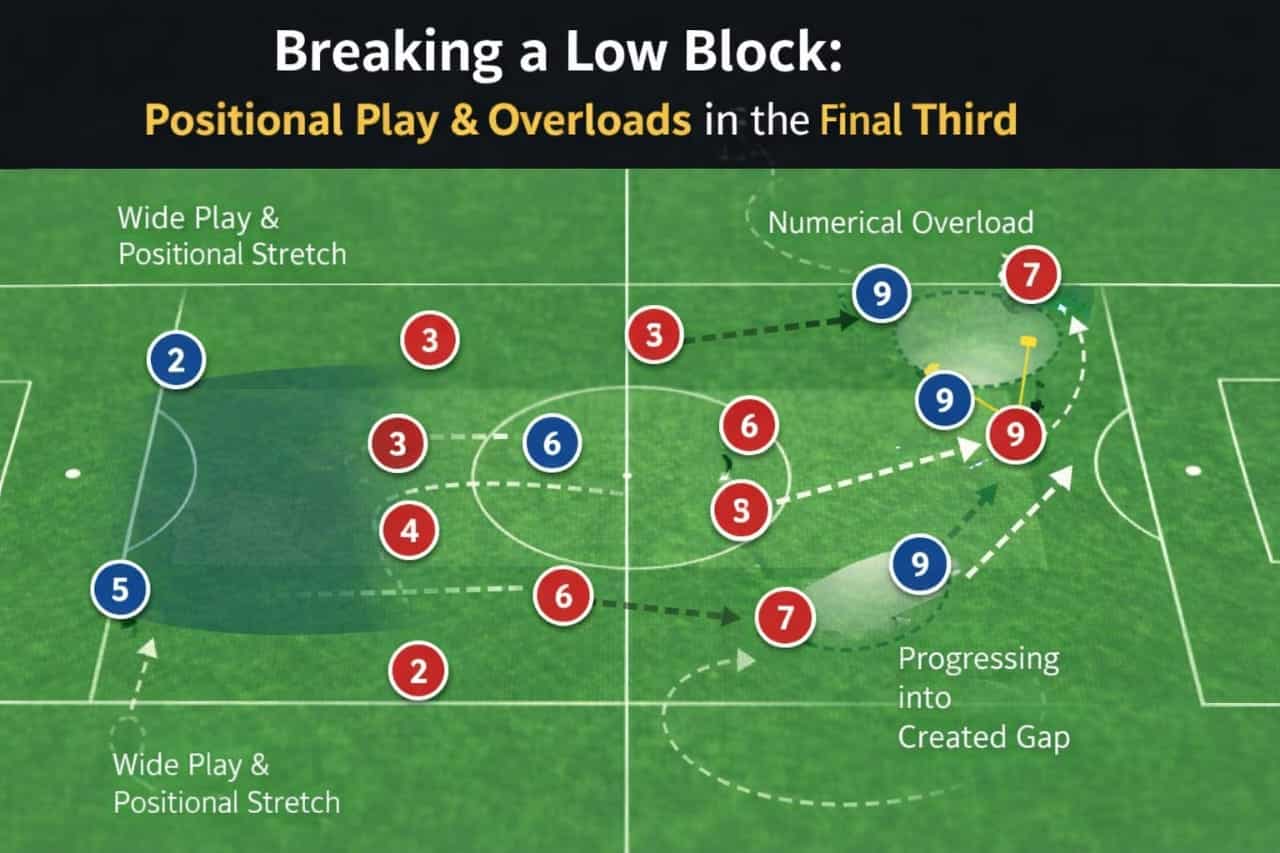
To solve this, teams rely heavily on positional play in football, which is the foundation of all effective attacking against compact defenses. Positional play ensures that players are distributed across the pitch in a way that maximizes space occupation, with each player having a defined zone to create passing angles and maintain structure. This structure stretches the defensive block while also creating constant passing options, ensuring that attacking play remains organized rather than chaotic.
Without structure, attacking becomes chaotic, but with structure, every movement has purpose. This is what allows teams to create space against opponents designed to deny it. For example, maintaining width with wingers and depth with forwards forces the defensive line to make decisions—if they stay compact, wide spaces open, and if they spread out, central gaps appear. This constant tension is what attacking teams aim to exploit.
Width is not just about staying wide—it is about forcing defensive expansion. Low blocks are naturally narrow because they prioritize central protection, but by positioning players on the touchline, attacking teams stretch the defensive shape horizontally, creating larger distances between defenders.
However, width must be dynamic rather than static. Static wide players are easy to defend, but effective width involves rotations between full-backs and wingers, underlapping and overlapping runs, and quick switches of play.
The aim is not just to stretch the block, but to stretch it at the right moment to create maximum disruption.
One of the most effective tools in breaking low block in football is the use of third man runs in football. Low blocks are built to track direct passing options, but third-man movements introduce complexity that defensive systems struggle to handle. Instead of passing directly into pressure, the ball is played to a supporting player, who then finds a third runner attacking space.

This sequence shifts defensive attention away from the final receiver while also creating new passing angles that bypass compact lines.
Because these movements are based on timing rather than space, they are extremely effective in tight areas, and even a well-organized low block can struggle when multiple players move in coordinated patterns.
Possession is not the objective—manipulation is. When attacking teams circulate the ball, the goal is to move the defensive block and force reactions that gradually create imbalances.
These small imbalances are what lead to breakthroughs, but circulation must have tempo. Slow passing allows the defense to stay compact, while sharp, purposeful movement forces errors. Body orientation also matters, as players receiving on the half-turn can accelerate attacks instantly, while static positioning slows everything down.
Breaking a low block is not just tactical—it is psychological. Defending teams rely on frustration and expect attackers to lose patience and force low-quality actions. This is why patience is critical. Elite teams do not rush; they circulate, probe, and wait, but when the moment appears, they accelerate immediately. This contrast between slow control and sudden speed destabilizes defensive structures while also creating mental fatigue in defenders, where concentration drops and positioning becomes less precise, leading to small but decisive mistakes.
The key to success is timing. Attacking too early means facing a fully organized block, while attacking too late allows the defense to reset.
These moments are short, and the best teams recognize them instantly and act without hesitation, making decision-making just as important as structure.
Several repeatable patterns are consistently used when breaking low block in football, including wide overloads, cutbacks, half-space combinations, and switches of play. Each pattern targets a specific weakness in the defensive structure. For example, cutbacks exploit defenders facing their own goal, switches of play exploit slow defensive shifting, and overloads create decision-making pressure.
When combined within a structured system, these patterns become extremely difficult to defend. At the highest level, success is built on repetition, coordination, and understanding of space rather than randomness. Breaking low block in football is therefore not about forcing solutions—it is about creating the conditions where solutions naturally appear.
One of the most effective solutions in breaking low block in football is the use of quick switches of play. Because low blocks are designed to shift toward the ball, they often leave temporary space on the opposite side of the pitch. This movement is a strength of the system—but also its weakness, as the block remains compact on the ball side but becomes vulnerable on the far side.
When the ball is circulated on one side, the defensive block compresses that area, but this creates a trade-off where the far side becomes less protected. If the attacking team can move the ball quickly enough, that weak-side space becomes accessible before the defense has time to recover.

The key to effective switching is speed and timing. The pass must travel quickly, and the receiving player must be positioned to attack immediately. Delays allow the defensive block to reset, while quick execution creates moments of imbalance. This is why diagonal passes, long switches, and quick combinations are essential tools against compact defenses.
Another crucial concept is creating overloads. This involves placing more players in a specific area than the opponent, forcing defenders into difficult decisions.
The purpose is not just to outnumber opponents—but to create better options. When defenders are outnumbered, they must choose between pressing or holding shape, and either choice creates space somewhere else. This is where coordinated movement becomes critical, as overloads only work when players understand spacing and timing, often leading directly to penetration or disorganization in the defensive block.
The ultimate objective when attacking a low block is to access the space between defensive and midfield lines. This area is the most dangerous because it allows attackers to turn, combine, and create chances. However, low blocks are specifically designed to protect this zone, which is why gaining access requires intelligent movement and positioning.
Players must constantly adjust their positioning to find pockets of space, which are often small and temporary, while receiving in these areas also requires technical quality—particularly body orientation and awareness. This concept is explained further in playing between the lines in football, where positioning and timing are key to unlocking defensive structures.
Once a player receives between the lines, the entire dynamic changes, as the defense is forced to react and gaps begin to open.
Breaking into the final third is only part of the challenge. The next step is converting that access into chances. Low blocks remain compact even near the penalty area, so attacking actions must be precise and well-coordinated.
Cutbacks are particularly effective because defenders are often facing their own goal, making it harder to react quickly. Quick combinations exploit small gaps that appear between defenders, while late runs are difficult to track because they come from deeper positions. Each of these actions targets a specific weakness in the defensive setup.
Tempo is one of the most misunderstood aspects of attacking against low blocks. It is not about playing fast all the time—it is about changing speed at the right moment. Slow circulation is used to move the defensive block and create imbalance, while fast actions are used to exploit that imbalance.
This contrast between control and acceleration is what creates openings. Without variation, even well-structured attacks become predictable and easy to defend, as teams that play too slowly allow organization while teams that play too quickly lose control. The balance between these two is what defines effective attacking.
Another important opportunity comes during transitions. When attacking teams lose possession against a low block, they often remain in advanced positions, which creates immediate opportunities to win the ball back. Quick reactions after losing possession can catch the defensive team off balance, and this is closely linked to counter-pressing in football, where teams apply immediate pressure to regain control.
Winning the ball back quickly prevents the defense from resetting and creates new attacking opportunities, while second balls also play a key role. When crosses or long passes are cleared, the team that reacts faster can sustain pressure and continue the attack.
One of the biggest mistakes teams make is relying too much on individual brilliance. Low blocks are designed to stop individual actions and deal with dribbling, direct passes, and predictable movements, but what they struggle against is coordinated structure.
When players move together, create overloads, and manipulate space, the defensive system becomes stretched, and this is when gaps appear. Structure creates consistency, allowing teams to generate chances repeatedly rather than relying on isolated moments.
In modern football, breaking low blocks has evolved significantly. Teams now use more fluid positioning, rotating players across zones to disrupt defensive marking. Full-backs move into midfield, midfielders drift wide, and attackers drop deeper, creating constant uncertainty for defenders.
Rather than holding fixed positions, players adapt based on the situation, and this flexibility makes defensive tracking more difficult while increasing the chances of creating space. At the same time, the emphasis on structure remains, because fluidity without structure leads to chaos, and the balance between organization and movement defines modern attacking systems.
Understanding breaking low block in football requires more than knowing individual tactics. It requires understanding how all these elements connect—width stretches the defense, combinations create angles, switches exploit weak sides, overloads create advantages, and timing turns opportunities into chances.
Each element builds on the other, and when executed together, they transform a compact defensive block into a system under constant pressure. That is the key: not forcing solutions, but creating the conditions where solutions become inevitable—and where even the most compact defenses begin to break.