Physical Address
MICKYWORLDNG
Physical Address
MICKYWORLDNG

MICKYWORLDNG IS READER-SUPPORTED. WHEN YOU BUY THROUGH LINKS ON OUR SITE, WE MAY EARN AN AFFILIATE COMMISSION AT NO EXTRA COST TO YOU.
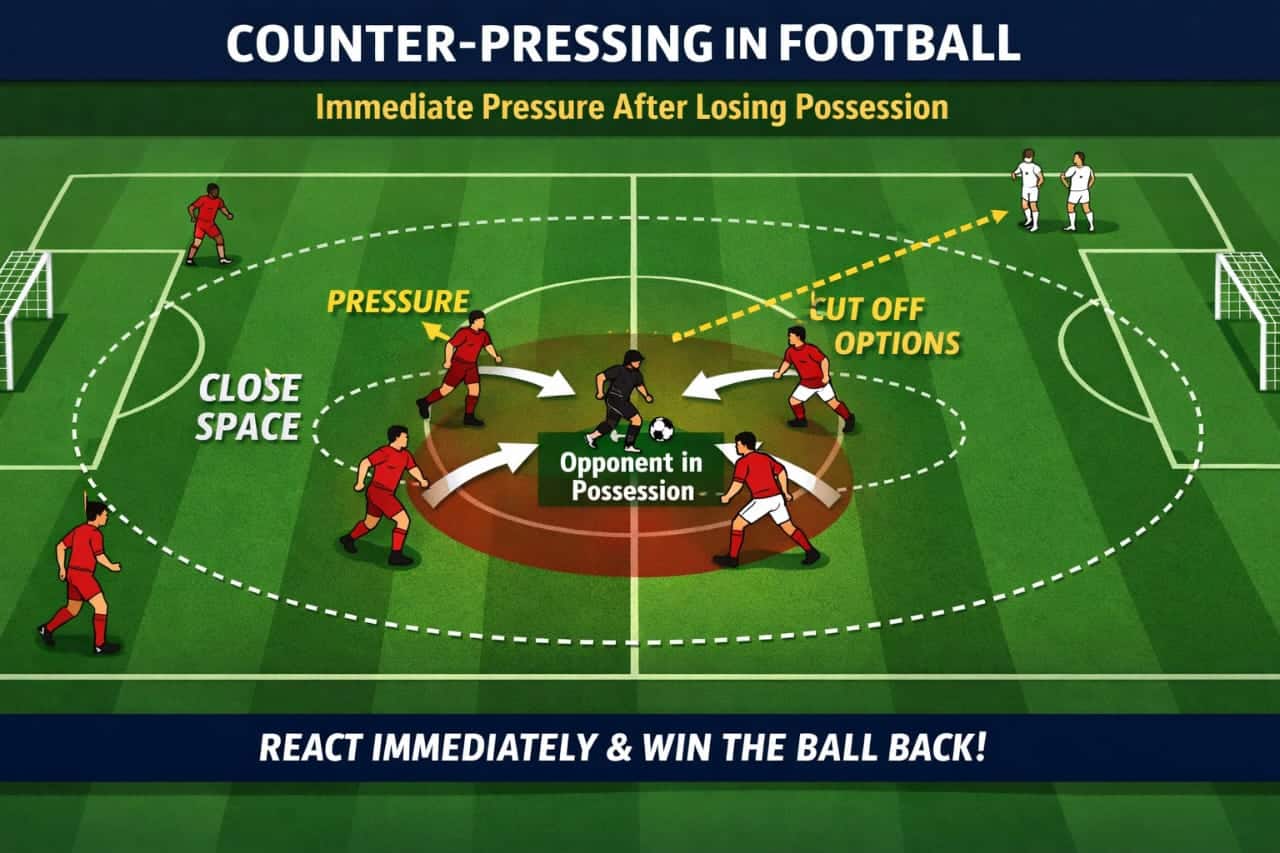
Counter-pressing in football is a structured and immediate reaction to losing possession, where players attempt to win the ball back within seconds before the opponent can organize their next action. Rather than retreating into a defensive shape, teams step forward aggressively, compress space, and apply pressure around the ball in a coordinated and controlled manner.
This approach is based on a simple but powerful idea: the opponent is most vulnerable at the exact moment they win possession, because their shape is not yet stable, their body orientation may be poor, and their passing options are often unclear, creating small but important moments of instability.
Instead of allowing the opponent time to settle, counter-pressing targets this window with immediate and collective action, where players react not individually but as a coordinated unit designed to disrupt, delay, and force mistakes before the opponent can progress play.
The first player closest to the ball initiates the press, applying immediate and direct pressure, but this action is rarely about winning the ball cleanly. Instead, it focuses on reducing time and space, forcing the opponent into rushed decisions that can be exploited.
At the same time, nearby teammates adjust their positions intelligently, with some closing passing lanes, others moving to intercept potential outlets, and others preparing to react to second balls, creating a layered and coordinated pressing structure.
This collective reaction transforms a simple loss of possession into a controlled pressing situation, where every movement is connected and purposeful rather than reactive or chaotic.
This concept is closely connected to pressing triggers in football, where specific moments signal when pressure should be applied, and counter-pressing represents the most immediate form of these triggers, activated instantly after losing the ball.
From the outside, counter-pressing can appear chaotic, as players sprint toward the ball, close space quickly, and apply intense pressure, but beneath this intensity lies a clear and structured system of movement and positioning.
Every action is calculated, with players moving purposefully rather than randomly, understanding their role within the pressing structure and focusing on controlling the environment around the ball rather than simply chasing it.
When possession is lost, the team does not spread out but instead becomes more compact, reducing distances between players, tightening angles, and surrounding the opponent in a controlled space.
This compactness is what makes counter-pressing effective, as it limits both time and space, making even technically strong players struggle to make clean and composed decisions.
The pressure is not only physical but also cognitive, forcing the opponent to think faster than they are comfortable with, which often leads to mistakes and loss of control.
This is the moment where the pressing team gains advantage, not through random effort but through structured pressure.
Counter-pressing is often misunderstood as an aggressive attempt to win the ball immediately, but in reality it is a method of controlling space, with the ball acting as the reference point for that control.
Players move toward the ball in a coordinated manner, but not all of them aim to tackle, as some focus on blocking forward passes, others cut off central options, and others position themselves to intercept the next action.
This coordinated movement creates a small and controlled zone where the opponent has very limited options and is forced into uncomfortable situations.
The objective is to make the playable area so tight that any action becomes risky, whether through intercepted passes, heavy touches, or ineffective clearances that return possession.
In this sense, counter-pressing is less about winning individual duels and more about shaping the opponent’s decisions under pressure.
The opponent is not just pressured—they are guided into making mistakes that benefit the pressing team.
The effectiveness of counter-pressing depends heavily on timing, with the first few seconds after losing possession being the most critical phase of the entire action.
This is when the opponent is least organized, as teammates may not yet be in support positions, body orientation may limit forward play, and awareness of pressure may be delayed.
Pressing during this window significantly increases the likelihood of regaining possession, as the opponent has not yet stabilized their structure.
However, this opportunity exists only briefly, and if the opponent escapes the initial pressure, the situation changes rapidly.
The pressing team can become stretched, and spaces begin to appear between players, making continued pressing more dangerous and less effective.
This is why counter-pressing is short and intense rather than continuous, with teams applying immediate pressure before reorganizing if the ball is not recovered.
This balance prevents over-commitment while maintaining defensive stability and structure.
One of the defining features of counter-pressing is collective movement, as it is not enough for one player to react quickly—the entire team must respond in a synchronized manner.
The first player applies pressure, but their effectiveness depends on the support around them, with teammates closing passing lanes, reducing space, and anticipating the opponent’s next action.
If this support is missing, the press becomes ineffective, allowing the opponent to bypass the first action and exploit the space left behind.
This is why coordination is essential, as every player must recognize the moment of transition and adjust their positioning accordingly.
This synchronization transforms counter-pressing from individual effort into a structured team strategy that controls the game.
Pressing is not only about speed but also about direction, as the way a player approaches the ball carrier determines the options available to the opponent.
Instead of running directly at the ball, players angle their runs to block specific passing lanes, forcing the opponent into predictable directions where support is already positioned.
This small detail has a significant impact, as it allows teams to control the direction of play and anticipate the opponent’s next move more effectively.
By guiding the opponent into certain areas, teams increase their chances of winning the ball or limiting danger even if the press is partially bypassed.
This ensures that pressure remains structured and controlled rather than reactive and disorganized.
While counter-pressing focuses on immediate pressure, it must also account for the possibility of failure, as not every pressing action results in regaining possession.
This is where rest defense becomes essential, referring to the positioning of players who are not directly involved in the pressing action.
These players maintain balance, protect central spaces, and prepare to deal with potential counter-attacks if the press is broken.
Without this structure, counter-pressing becomes highly risky, as the opponent can exploit the spaces left behind and create dangerous situations.
The best teams combine intensity with control, pressing aggressively while maintaining a solid defensive foundation.
Counter-pressing in football is more than just a defensive reaction—it is a method of controlling the entire game by regaining possession quickly and sustaining attacking pressure.
Instead of allowing transitions to become chaotic, counter-pressing turns them into structured opportunities that favor the pressing team.
The opponent is denied time, space, and clarity, which forces mistakes and creates chances while reducing the need for prolonged defensive phases.
When executed correctly, it creates the feeling that the opponent never fully gains control of possession, as the ball is lost and immediately recovered.
This continuous cycle of pressure, recovery, and control defines modern football at the highest level.
Counter-pressing in football is not executed in a single uniform way, as the core principle remains consistent but the method varies depending on tactical structure and player characteristics.
Some teams use a man-oriented approach, where players engage the nearest opponent immediately, creating intense pressure but requiring precise coordination to avoid structural breakdowns.
Other teams adopt a ball-oriented approach, collapsing around the ball to restrict passing options and control space rather than focusing on individual duels.
A third variation is space-oriented pressing, where players prioritize controlling key zones, blocking passing lanes, and guiding the opponent into less dangerous areas.
Each method depends on collective understanding and coordination, as without these elements even the most aggressive press becomes ineffective.
In match situations, these approaches appear within seconds, with success determined by how quickly players recognize and react to the same moment.
The effectiveness of counter-pressing is strongly influenced by how high a team positions its defensive line, as higher positioning reduces distances between players and enables quicker reactions.
This relationship is explained in high defensive line in football, where compact spacing supports immediate pressure and coordination.
When possession is lost in advanced areas, counter-pressing becomes more dangerous because the opponent is closer to their own goal and more vulnerable to mistakes.
However, this approach also carries risk, as breaking the press can expose space behind the defensive line, making balance and positioning essential.
Not every counter-press results in immediate success, and when the opponent escapes the first wave of pressure, the situation changes quickly.
Players must recognize this moment and transition from aggressive pressing to controlled defensive positioning, ensuring stability is maintained.
This phase is critical, as it prevents disorganization and protects against counter-attacks.
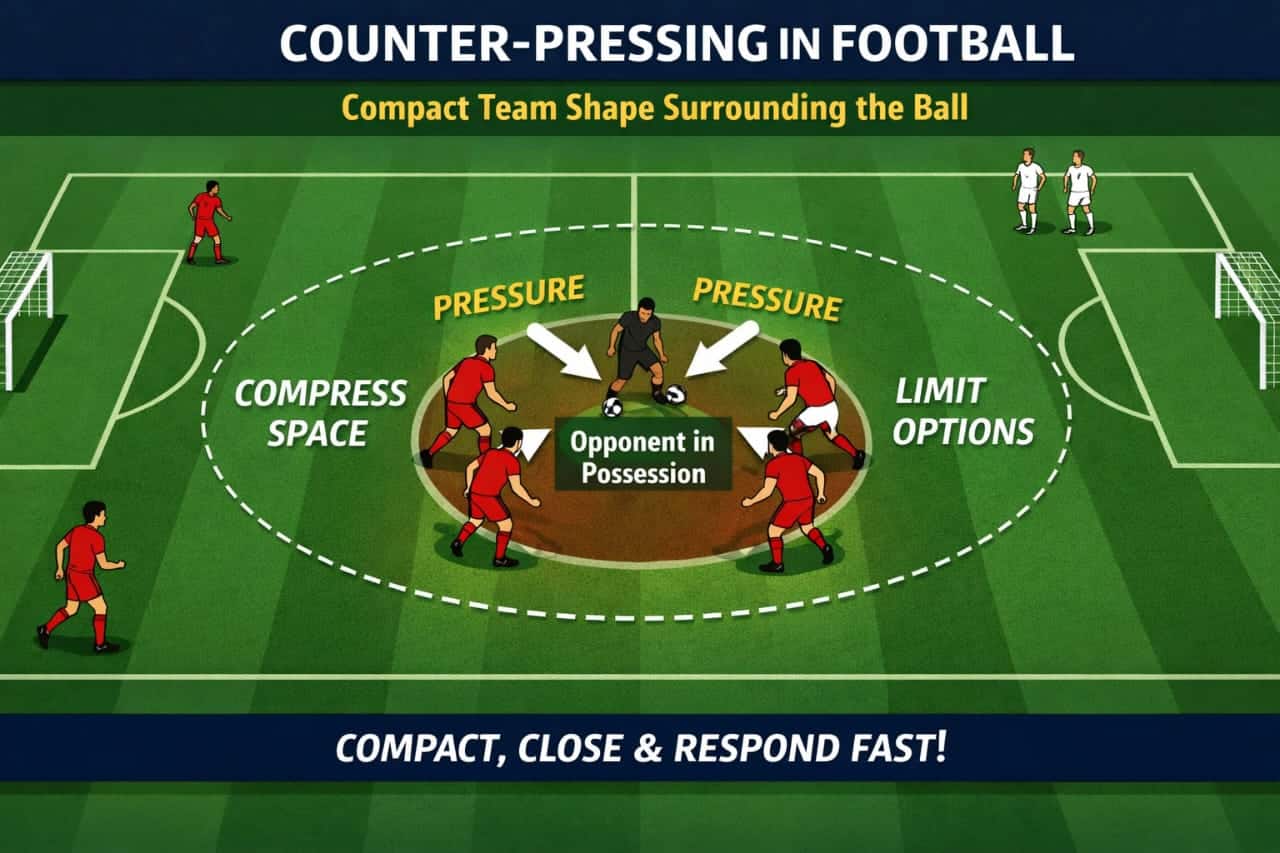
The ability to shift between pressing and defending requires awareness, communication, and discipline, with players tracking runners, closing central spaces, and maintaining compactness.
This recovery phase often determines whether the team prevents danger or allows a clear attacking opportunity.
Counter-pressing is powerful but not always the correct choice, as poor execution or timing can expose the team to significant risk.
If players are too far apart, pressing becomes ineffective and the opponent can bypass it easily, exploiting the gaps between units.
If too many players commit forward, defensive balance is lost, creating opportunities for fast counter-attacks.
If the opponent already has control and clear passing options, pressing may open space rather than apply pressure.
Teams must constantly assess the situation, as counter-pressing is conditional rather than automatic.
This balance is explored further in low block vs high defensive line in football, where teams adjust their approach based on context.
One of the greatest advantages of counter-pressing is the attacking potential created immediately after regaining possession, as the opponent is often disorganized and vulnerable.
This creates a brief window where attacking actions are more effective, with defensive lines broken and structure incomplete.
Players can drive forward, combine quickly, or play direct passes into dangerous areas to exploit this moment.
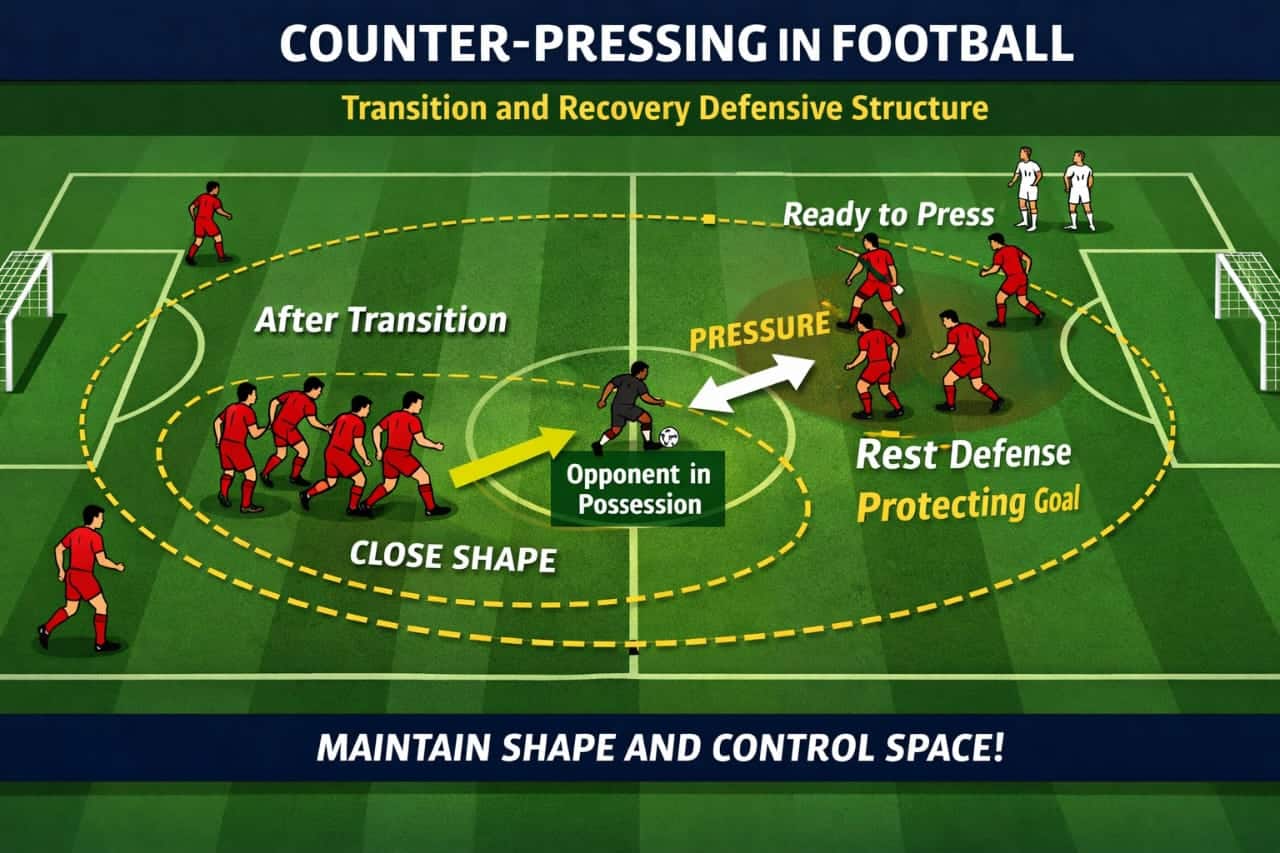
The speed of this transition is critical, as delays allow the opponent to recover and reduce the advantage gained from pressing.
This is why teams train both ball recovery and immediate attacking actions as part of the same tactical sequence.
Even well-organized teams can struggle with counter-pressing if small details are not executed correctly, as success depends on precision and timing.
Poor timing can eliminate the pressing opportunity entirely, while lack of coordination causes the structure to break down.
Incorrect body orientation can open passing lanes instead of closing them, making the press ineffective.
These details may appear minor, but they significantly influence the outcome of pressing situations.
Counter-pressing in football has become central to modern tactical systems because it connects defense and attack into a continuous and dynamic process.
It allows teams to regain possession quickly, maintain pressure, and control the tempo of the game.
By limiting time and space, it reduces the opponent’s ability to build attacks while creating opportunities for the pressing team.
When executed consistently, it transforms transitions into advantages rather than threats.
Teams that master counter-pressing do not simply react to the game—they actively shape how it is played.