Physical Address
MICKYWORLDNG
Physical Address
MICKYWORLDNG

MICKYWORLDNG IS READER-SUPPORTED. WHEN YOU BUY THROUGH LINKS ON OUR SITE, WE MAY EARN AN AFFILIATE COMMISSION AT NO EXTRA COST TO YOU.
The low block and the High Defensive Line in Football represent two contrasting approaches to defending space, controlling territory, and managing risk. While one compresses play close to goal, the other pushes the defensive unit forward to squeeze the pitch. Both systems can be effective. The difference comes down to where teams choose to defend and how the rest of the side is organised around that choice.
Understanding the tactical trade-offs between these models reveals why some teams prefer territorial pressure while others prioritise defensive protection. The choice shapes pressing behaviour, midfield positioning, transition exposure, and even squad recruitment.
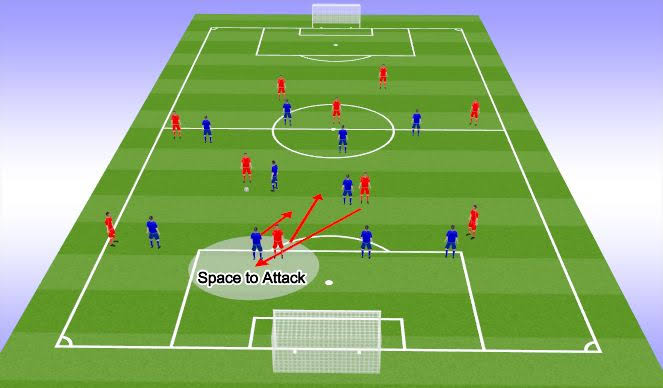
A low block is a defensive structure positioned deep inside a team’s own half, often close to the penalty area. The defensive line drops, the midfield narrows, and vertical spaces are reduced around the box.
The aim is to deny central access and protect dangerous shooting zones. Opponents may control possession, but clear openings are limited.
Teams using a low block often defend in compact shapes such as 4-4-2 or 5-4-1, maintaining short distances between defenders and midfielders.
Atletico Madrid under Diego Simeone offer a well-known example of disciplined low-block defending, prioritising compact lines and rapid counter-attacks over territorial dominance.

This structure encourages opponents to circulate the ball wide or attempt crosses from distance. Patience and concentration are essential, as defending becomes prolonged and physically demanding.
A High Defensive Line in Football refers to defenders holding an advanced position closer to the halfway line when out of possession. Rather than absorbing pressure deep, the team seeks to compress play into midfield areas.
This approach is closely connected to pressing intensity. When forwards apply pressure high up the pitch, the defensive line moves forward behind them to reduce space between units.
For a deeper tactical breakdown of this structure, see our detailed guide on the High Defensive Line in Football.
The objective is territorial control. By defending further from goal, teams attempt to recover possession earlier and prevent sustained opposition pressure.
The most visible difference between a low block and a high line is territory. A low block concedes space in advanced areas, inviting the opponent forward. A high line pushes play into the opponent’s half.
Manchester City, for example, consistently operate with defenders positioned near midfield during structured possession phases. This keeps the team compact and allows immediate pressure after losing the ball.
By contrast, teams built around a low block accept that possession may be limited. The trade-off is a crowded defensive zone designed to reduce clear chances.
A low block rarely involves aggressive pressing in advanced areas. Instead, pressing triggers occur once the opponent enters certain zones. Energy is conserved for protecting the box.
A high defensive line demands coordinated pressing. Liverpool’s most intense pressing periods showed how the front line, midfield, and defense must move together. The defensive line supports the press by stepping forward and narrowing passing lanes.

When pressure is well-timed, opponents struggle to find progressive passes. Without that pressure, however, space behind the line becomes accessible.
Low blocks minimise space behind the defence. The back line remains close to goal, reducing vulnerability to direct balls over the top.
The challenge shifts elsewhere. Space in front of the block increases, allowing opponents to circulate possession and attempt shots from range.
A high defensive line reverses that equation. Space in front is limited due to compactness, but room exists behind the back four. That space can be attacked if pressure fails.
Each structure accepts risk in a different location. One protects depth. The other protects territory.
In a low block, midfielders act as screeners in front of the defence. They track runners, close passing lanes, and protect central areas.
The focus is discipline. Maintaining shape matters more than stepping out aggressively.
Within a high line setup, midfielders must balance pressing with spatial awareness. Arsenal’s structural improvements have shown how holding midfielders play a crucial role in covering channels when full-backs advance.
Failure to adjust quickly can expose the defence to counter-attacks.
Low block teams often rely on counter-attacks. Once possession is regained, quick vertical passes target forwards exploiting space left by advanced opponents.
This approach demands pace and directness in attack.
High-line systems typically focus on counter-pressing. When possession is lost, the nearest players apply immediate pressure to regain control before the opposition can exploit space behind.
Transition behaviour reflects defensive positioning. One approach retreats and counters; the other hunts the ball immediately after loss.
Squad construction differs significantly between the two systems.
Low block setups prioritise aerial strength, positional discipline, and concentration inside the penalty area. Centre-backs must defend crosses and clear second balls consistently.
High defensive lines require pace, anticipation, and comfort defending large spaces. Goalkeepers often operate outside the box to intercept long passes.
Bayern Munich’s long-standing use of an advanced goalkeeper illustrates how personnel choices support structural ambition.
Facing a low block often leads to sustained possession but limited space. Patience becomes crucial, and frustration can build if chances are scarce.
A high defensive line, meanwhile, places opponents under immediate time pressure. Passing decisions must be quick, and mistakes occur more frequently in compressed zones.
The mental demands differ, but both systems test opponents in distinct ways.
No team relies exclusively on one defensive height throughout an entire match. Even sides known for high lines may temporarily drop deeper during specific phases.
Similarly, teams comfortable in a low block may push forward when chasing possession.
The difference lies in the reference point. Some teams default to territorial aggression. Others default to compact containment.
Modern football increasingly rewards teams that can control space rather than simply react to it. Improved athletic conditioning and tactical organisation have made high defensive positioning more sustainable than in previous eras.
At the same time, low blocks remain relevant, particularly against possession-dominant opponents. Tactical flexibility now defines elite coaching.
The Low Block vs High Defensive Line in Football debate is less about superiority and more about context. Each structure redistributes risk differently — either protecting depth or defending territory. Teams that master when to switch between these heights often gain a strategic edge over a full season.
Tags: Low Block, High Defensive Line in Football, Football Tactics