Physical Address
MICKYWORLDNG
Physical Address
MICKYWORLDNG

MICKYWORLDNG IS READER-SUPPORTED. WHEN YOU BUY THROUGH LINKS ON OUR SITE, WE MAY EARN AN AFFILIATE COMMISSION AT NO EXTRA COST TO YOU.
The concept of pressing triggers in football sits at the heart of modern defensive strategy. Rather than chasing the ball endlessly, elite teams wait for specific moments that signal when to apply collective pressure. These cues — technical, positional, or directional — determine when a coordinated press begins.
Pressing is not constant sprinting. It is organised acceleration. The most effective sides recognise patterns in opposition build-up and attack with structure rather than emotion. Understanding pressing triggers in football explains why certain teams regain possession higher up the pitch and sustain territorial dominance.
Pressing triggers are identifiable situations that prompt a team to engage aggressively with the ball carrier. They are rehearsed cues rather than spontaneous reactions.
A poor first touch, a backward pass, a pass toward the touchline, or a receiver facing their own goal can all serve as triggers. When these moments occur, nearby players move simultaneously to close passing lanes and restrict options.
The objective is not simply to tackle. It is to reduce space and time so dramatically that possession becomes unstable.
Pressing without organisation quickly becomes chaotic. If one player steps forward alone, gaps open behind them. The press must function as a collective movement.
This is where defensive height becomes essential. Teams operating with an advanced back line can compress play immediately once the press begins. For a deeper understanding of defensive positioning, see our analysis of the High Defensive Line in Football.
When the defensive unit supports the press by stepping forward, the field shrinks. Opponents are forced into rushed decisions within tight corridors.

One of the most common triggers is the backward pass. When a defender plays the ball back toward their own goal, forwards accelerate to close angles. This moment often signals temporary imbalance in the opponent’s shape.
A heavy touch is another obvious cue. Technical imperfection invites pressure because it delays the receiver’s next action.
Wide passes toward the touchline frequently act as directional triggers. The sideline becomes an additional defender, limiting escape routes and allowing multiple players to surround the ball.
Teams also recognise body orientation. A player receiving the ball facing their own goal is far less dangerous than one facing forward. Pressing begins immediately in these scenarios.
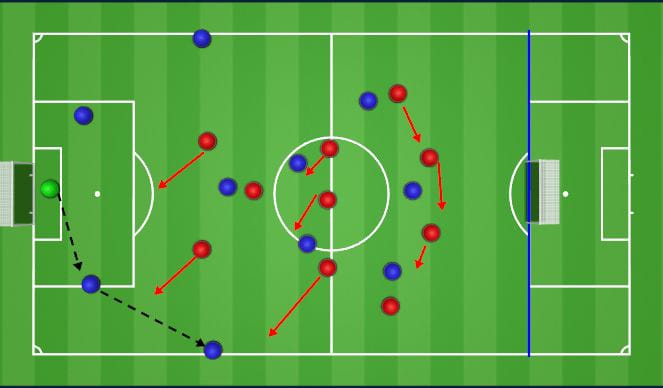
Forcing play wide is rarely accidental. Many pressing systems guide the opposition into specific zones before engaging fully.
Liverpool’s coordinated pressing approach demonstrated how central spaces are screened first. Passing lanes into midfield are blocked, leaving the flank as the only apparent option. Once the ball travels there, two or three players converge.
The pressing trap is less about speed and more about anticipation. Players move before the opponent realises the trap has been set.

Counter-pressing, often referred to as regaining possession immediately after losing it, functions as a transitional trigger. The moment the ball is lost, nearby players close down the carrier before forward passes can be played.
Manchester City frequently demonstrate this pattern. When possession breaks down, the nearest midfielders and forwards react instantly. The goal is to prevent the opponent from lifting their head and identifying long outlets.
Counter-pressing reduces exposure to counter-attacks and sustains territorial control.
Not all pressing occurs high up the pitch. Teams operating in deeper defensive systems also rely on triggers, though the engagement zone differs.
In a low block, pressure often begins once the ball enters a designated area near the defensive third. For a detailed comparison of defensive heights, see our guide on Low Block vs High Defensive Line in Football.
The key difference is territory. High presses aim to regain the ball in advanced areas. Low block pressing prioritises protecting central space and delaying progression.
Midfielders dictate the success of pressing triggers. If they fail to close passing lanes behind the first line of pressure, opponents can bypass the press with one vertical pass.
Elite sides maintain short vertical distances between units. When the front line steps forward, midfielders advance in parallel, ready to intercept loose passes.
This layered movement ensures the press does not collapse after the first wave.
Pressing systems require defenders prepared to hold advanced positions. If the back line remains deep, large gaps appear between units.
An organised high line shortens the pitch and allows defensive players to challenge aerial balls quickly. It also compresses midfield space, making progressive passes harder to execute.
The interaction between pressing triggers and defensive positioning remains one of the defining characteristics of dominant teams.
Effective pressing alters the mental state of opponents. Players under sustained pressure rush passes, misjudge weight, or attempt riskier solutions.
The intention is to accelerate decision-making beyond comfort levels. Pressing triggers exploit predictable reactions.
Over time, the cumulative effect leads to turnovers in valuable areas.
Build-up structures have become more sophisticated. Teams are comfortable circulating possession under minimal pressure. Passive defending often allows organised progression.
Pressing triggers disrupt rhythm. Rather than reacting continuously, teams select precise moments to engage, increasing the likelihood of success.
With improved athletic conditioning and video analysis, coordinated pressing has become a sustainable strategy rather than a short-lived burst of intensity.
Pressing triggers in football are not trends; they are principles rooted in space management and collective timing. Whether applied high up the pitch or closer to goal, they provide structure to defensive aggression.
Teams that master pressing cues control not only where the ball is regained but how quickly transitions unfold. This control influences territory, tempo, and momentum over sustained periods of play.
As tactical systems continue to evolve, the understanding of pressing triggers in football remains essential for any side seeking consistent competitive advantage.
Tags: Pressing Triggers in Football, Football Tactics, High Defensive Line in Football