Physical Address
MICKYWORLDNG
Physical Address
MICKYWORLDNG

MICKYWORLDNG IS READER-SUPPORTED. WHEN YOU BUY THROUGH LINKS ON OUR SITE, WE MAY EARN AN AFFILIATE COMMISSION AT NO EXTRA COST TO YOU.
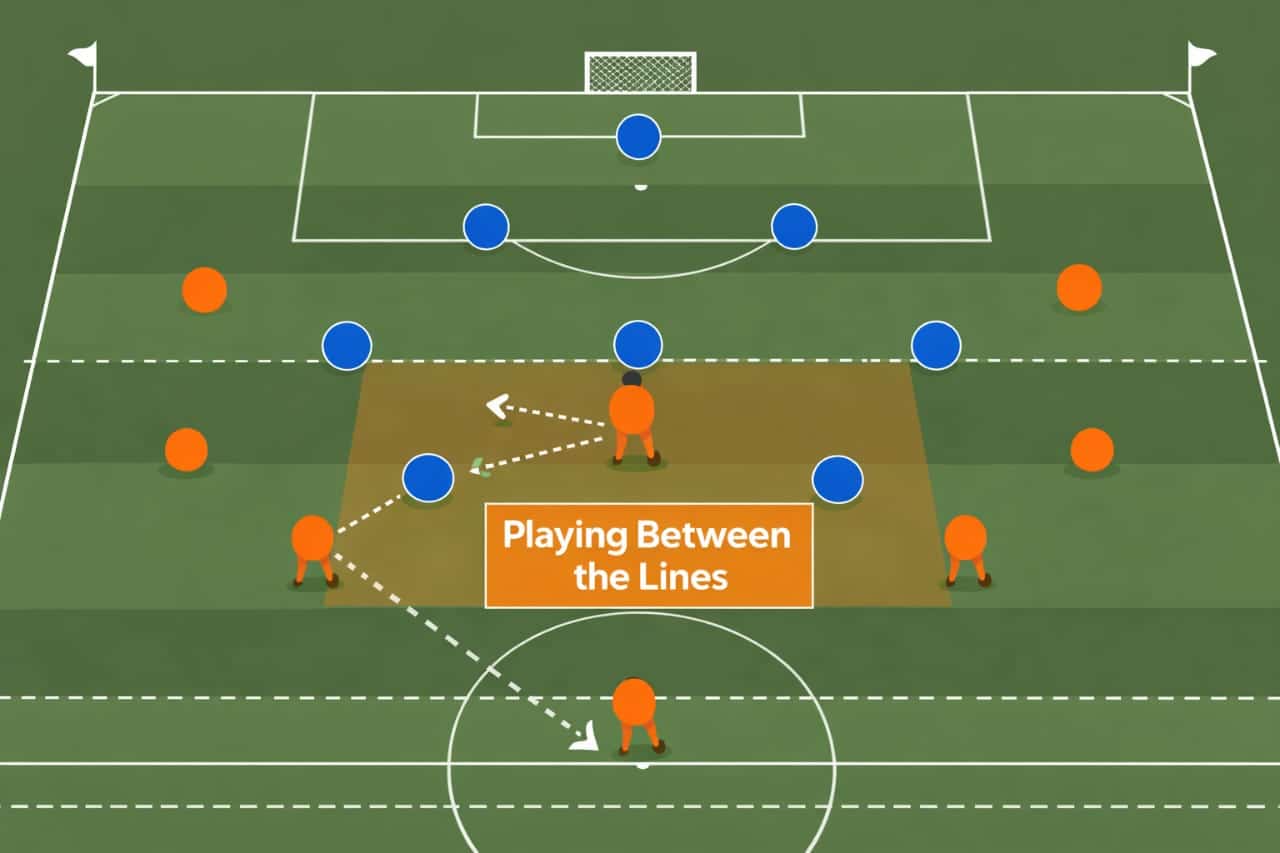
Playing between the lines in football refers to occupying the vertical space between an opponent’s midfield and defensive units, with the intention of receiving the ball in a position that destabilizes the entire defensive structure. This area is often described as the most valuable zone on the pitch because it allows attackers to turn, progress, and create chances with minimal resistance.
Defensive teams organize themselves into compact shapes, typically consisting of a midfield line shielding a defensive line. These two units aim to move together, maintaining short distances both horizontally and vertically. However, no defensive structure can remain perfectly compact at all times.
As the ball moves and players shift, small gaps naturally appear between these lines. These gaps are not static—they constantly open and close depending on positioning, pressure, and timing. The players who can recognize and exploit these moments consistently are the ones who control games at the highest level.
This concept is strongly connected to positional play in football, where teams use structured spacing to stretch defensive units and create vertical separation. By occupying different zones across the pitch, attacking teams force defenders to cover more ground than they can comfortably manage.
To understand how to exploit this space, it is important to first understand why it exists. Defensive structures are built on balance, not perfection. Teams must defend width, depth, and central areas simultaneously, which naturally creates trade-offs.
If a team compresses too tightly between midfield and defense, they risk leaving space in front of the midfield for buildup play. If they stretch to press higher, the distance between lines increases, creating larger vertical gaps. Every defensive decision creates a vulnerability somewhere else.
This constant adjustment is what creates opportunities between the lines. The moment one line reacts to the ball, the connection to the next line can weaken. That brief disconnection is enough for an attacker to receive the ball in space.
It is not about large, obvious gaps. Often, the space is minimal—just enough for a player to receive on the half-turn. But in football, even half a second and a few meters can completely change the outcome of a situation.
When a player receives between the lines, defenders are forced into difficult decisions. A centre-back may step forward to apply pressure, but doing so leaves space behind for runners. A midfielder may drop deeper, but that creates space elsewhere in midfield.
This dilemma is what makes the zone so powerful. It forces defenders to choose between maintaining structure and applying pressure. Either decision carries risk, and attackers are trained to exploit whichever option the defender chooses.
In many situations, defenders hesitate because they are unsure who should engage. That hesitation is often all an attacker needs to turn, pass, or drive forward.
Once the first line of resistance is broken, the entire defensive structure begins to collapse. One successful reception between the lines can eliminate multiple players at once.
Finding space between the lines is not about standing still and waiting for the ball. It requires constant movement, awareness, and intelligent positioning. Players must continuously adjust their position based on the movement of defenders and the location of the ball.
One of the most effective techniques is blindside positioning. Instead of staying directly in a defender’s line of sight, attackers position themselves just outside their vision. This forces defenders to constantly check their surroundings, increasing the chance of losing track of the attacker.
Another key detail is movement timing. Elite players do not arrive in space too early. They move into the gap at the exact moment the pass is about to be played. This makes it extremely difficult for defenders to react in time.
Movement is often coordinated with teammates. For example, a forward dropping deeper can pull a defender out of position, creating space behind. A midfielder can then move into that space at the right moment to receive the ball.
This idea is closely linked to third man runs in football, where coordinated movement between multiple players creates access to spaces that would otherwise remain closed.
Accessing space between the lines is not only about movement; it is also about angles. The player on the ball must have a clear passing lane, and the receiver must position themselves to make that pass possible.
Attackers often adjust their position slightly—just a step to the left or right—to move out of a defender’s cover shadow. This small adjustment can open a passing lane that did not exist a moment earlier.
At the same time, teammates must create supporting angles. Without proper spacing around the ball, it becomes easier for defenders to block passing lanes into the central area.
This interaction between passer, receiver, and surrounding players is what allows teams to consistently access central spaces.
Receiving the ball between the lines is only effective if the player can act immediately. This is where body orientation becomes critical. Before the ball arrives, the player must already be positioned to play forward.
Elite players open their body shape to receive on the half-turn. This allows them to see both the passer and the attacking direction at the same time. It also enables them to take their first touch into space rather than back toward pressure.

Receiving on the half-turn transforms the situation instantly. Instead of controlling the ball and then deciding what to do, the player is already in a position to attack.
If the player receives square or facing their own goal, the advantage is lost. Defenders can close down quickly, and the attacking move slows down.
This is why scanning and preparation before receiving are just as important as the touch itself. The best players make their decisions before the ball arrives.
The ability to receive and progress in one action is directly connected to breaking defensive lines in football. A single well-executed action can bypass multiple defenders and create a clear attacking opportunity.
Timing is what brings all these elements together. Positioning, movement, angles, and body orientation are only effective when executed at the right moment.
If a player moves too early, defenders have time to adjust and close the space. If they move too late, the passing opportunity disappears. The window to receive between the lines is often extremely small.
Elite players synchronize their movement with the ball. They begin their movement as the passer prepares to play the ball, ensuring they arrive at the exact moment the space opens.
This coordination is developed through repetition, understanding of team structure, and awareness of how defensive lines react to different situations.
Playing between the lines is not just an individual ability—it is a collective strategy. Teams must create the conditions that allow players to access this space consistently.
This involves stretching the pitch, creating width to pull defenders apart, and using movement to disrupt defensive positioning. Without these collective actions, the space between the lines becomes much harder to access.
At the highest level, teams do not wait for space to appear. They actively manipulate defensive structures to create it. Every pass, movement, and position is designed with this objective in mind.
When executed properly, playing between the lines becomes one of the most effective ways to control matches, break defensive structures, and create high-quality chances.
At the highest level, teams do not rely on space appearing naturally. They actively manipulate defensive structures to create it. Playing between the lines is not just about finding gaps—it is about forcing those gaps to exist.
This begins with positional structure. By spreading players across the width and depth of the pitch, attacking teams stretch defensive units. Wide players pin full-backs, central players occupy midfielders, and forwards threaten the defensive line. This forces defenders to cover multiple areas at once.
As the defensive shape expands, the connection between midfield and defense becomes harder to maintain. Even a small delay in shifting across the pitch can open a vertical pocket.
In real matches, this space often appears for just a moment before closing again, which is why timing becomes so critical.
One of the most effective ways to create space between the lines is through numerical superiority. By overloading one area of the pitch, teams attract defenders toward the ball.
As defenders shift to deal with the overload, space begins to open elsewhere—often in central zones. This is when the ball is switched or played into the space between the lines.
This concept is closely connected to overloads in football, where teams deliberately create 2v1 or 3v2 situations to force defensive movement.
The key is not just creating the overload, but recognizing when the defensive structure has shifted enough to expose the central gap.
Timing remains critical. If the ball is played too early, the space is not yet open. If played too late, defenders have already recovered.
Another important method for creating space between the lines is positional rotation. Instead of maintaining fixed roles, players interchange positions to disrupt defensive marking.
For example, a midfielder may move wide while a winger moves inside. This forces defenders to either follow their marker out of position or pass them on to a teammate.
Both options create uncertainty for the defender, often leading to hesitation.
That uncertainty leads to temporary disorganization, and within that moment, space appears.
These rotations are not random. They are coordinated movements designed to manipulate defensive spacing. When executed correctly, they create clear passing lanes into central areas.
Forwards dropping deeper is another effective way to open space between the lines. When a forward leaves the defensive line, a centre-back must decide whether to follow.
If the defender follows, space opens behind them. If they hold their position, the forward can receive freely between the lines.
This movement creates a constant dilemma for defenders.
Teams often combine this with forward runs from midfield, creating a layered attacking structure. One player drops to receive, another runs beyond, and the defense is forced to react to both threats at once.
This interaction between depth and movement is a key feature of modern attacking play.
Receiving the ball between the lines is only the beginning. What happens next determines whether the advantage is maintained or lost.
Once a player receives in this zone, they must act quickly. The space is temporary, and defenders will close it rapidly.
There are several effective options:
The choice depends on the situation, but the key principle is speed of execution.
This is where technical quality becomes essential. A clean first touch and quick decision can turn a small positional advantage into a clear goal-scoring opportunity.
This connection between reception and action is explored further in first touch in football, where the ability to control and move the ball in one action determines the speed of play.
Space between the lines rarely remains open for long. As soon as a player receives the ball, pressure arrives from multiple directions.
This makes decision-making under pressure critical.
Players must quickly assess:
These decisions must be made in seconds.
Players who hesitate lose the advantage. Players who act decisively maintain it.
This is why receiving between the lines is often associated with high-level technical and cognitive ability.
The ultimate goal of playing between the lines is not just progression—it is chance creation.
Once the defensive structure is broken, the attacking team has access to dangerous areas. This is where quick combinations, forward runs, and intelligent movement come into play.
Players may combine in tight spaces, play through balls behind the defense, or create shooting opportunities from central positions.
This phase is closely related to 1v1 situations in football, where attackers must beat defenders in isolated scenarios created by earlier positional advantages.
The connection is clear. Playing between the lines creates the conditions. Final actions decide the outcome.

Some of the best opportunities to play between the lines occur during transitions. When possession changes, defensive structures are not fully organized.
Midfield and defensive lines may be disconnected, creating larger gaps than usual.
Teams that recognize these moments can exploit them quickly. A single forward pass into the space between the lines can break the entire defensive structure before it has time to recover.
This is why transition moments are so dangerous. The usual defensive compactness is temporarily lost.
Players who are aware of these situations can take advantage before the opponent reorganizes.
Playing between the lines in football has become a central principle of modern attacking strategy. It combines positioning, movement, timing, and decision-making into a single concept.
Teams that can consistently access this space gain a significant advantage. They can bypass defensive pressure, create central overloads, and generate high-quality chances.
It is not a single action, but a chain of coordinated actions working together.
From creating space to finding it, from receiving to exploiting it, every step must be executed with precision.
When done correctly, playing between the lines transforms possession into penetration, and structure into opportunity.