Physical Address
MICKYWORLDNG
Physical Address
MICKYWORLDNG


MICKYWORLDNG IS READER-SUPPORTED. WHEN YOU BUY THROUGH LINKS ON OUR SITE, WE MAY EARN AN AFFILIATE COMMISSION AT NO EXTRA COST TO YOU.
Breaking defensive lines in football is one of the most important tactical principles in the modern game. At the highest level, matches are rarely decided by random moments. Instead, they are controlled through structure, positioning, and the ability to progress the ball through organized defensive shapes.
Every team defends in lines—whether it is a back four, midfield line, or a compact block. The objective for the team in possession is simple: move the ball from one side of these lines to the other without losing control. However, executing this consistently requires more than just passing ability. It demands coordination, awareness, and tactical understanding.
When a team successfully breaks a defensive line, they immediately access more dangerous areas of the pitch. Defenders are forced to turn, reposition, and react under pressure, often while moving toward their own goal. Over time, these moments create instability in the defensive structure and lead to high-quality chances.
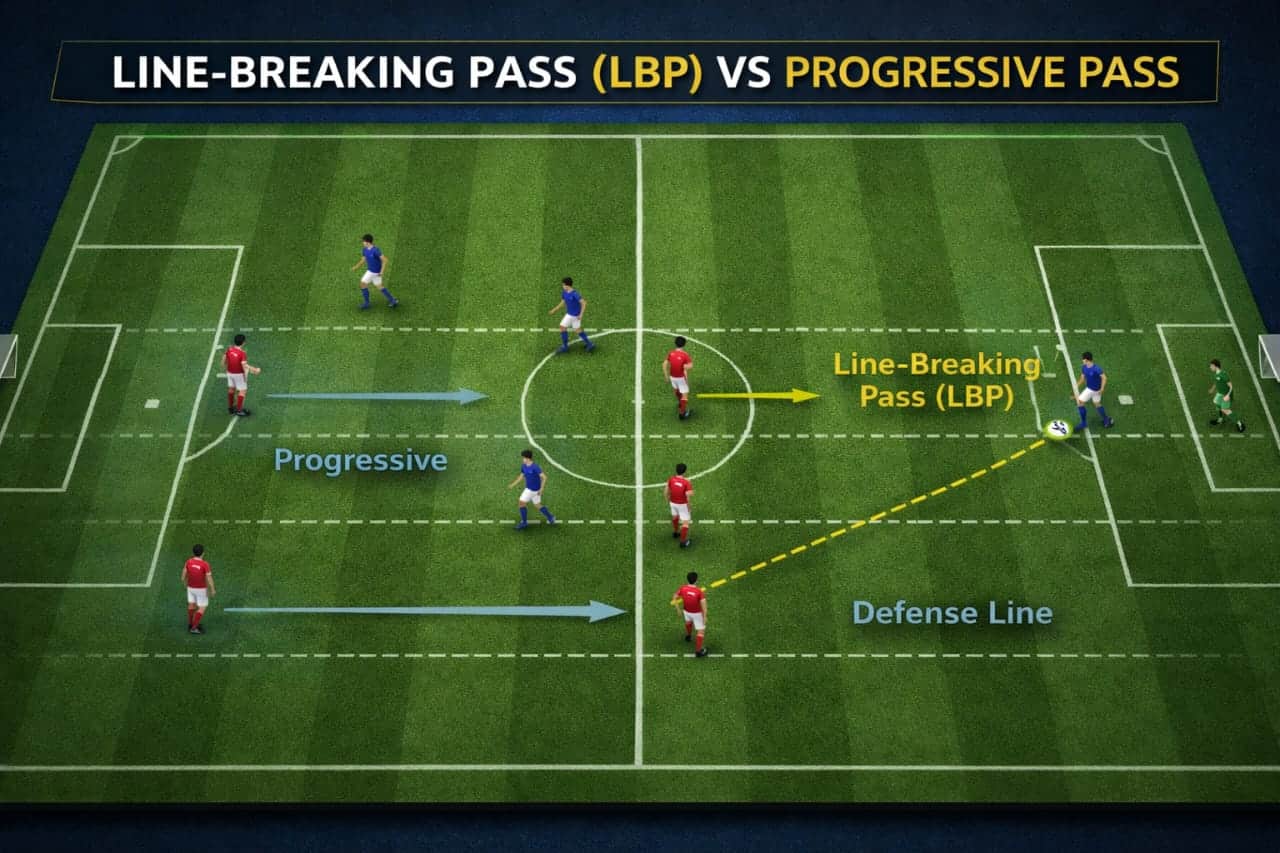
Breaking defensive lines in football refers to the act of progressing the ball past one or more layers of the opposition’s defensive structure. These layers typically consist of forwards pressing high, midfielders controlling central space, and defenders protecting the final third.
The key difference between simple possession and effective progression lies in intent. Not all forward passes are equal. Some passes move the ball forward without disrupting the opponent, while others directly penetrate defensive lines and change the structure of the game.
This is where the distinction between progressive passes and line-breaking passes becomes crucial.
A progressive pass is any pass that moves the ball significantly closer to the opponent’s goal. While useful, it does not always disrupt the defensive shape. Teams can play multiple progressive passes without actually creating a meaningful advantage.
In contrast, a line-breaking pass is far more decisive. It travels through or between defensive lines and reaches a player positioned behind those lines. This type of pass forces the opposition to collapse, rotate, or recover quickly.
The difference is not just distance, but impact. A progressive pass advances territory. A line-breaking pass changes the game state.
Top teams prioritize line-breaking actions because they accelerate attacks and create immediate pressure on the defensive structure. Once a line is broken, the opponent is no longer organized, and space begins to appear in key areas.
Modern football defenses are designed specifically to prevent line-breaking passes. Teams stay compact, reduce space between lines, and position players to block passing lanes. This is why breaking defensive lines consistently is one of the clearest indicators of tactical quality.
There are several reasons why this is difficult:
Because of these challenges, teams cannot rely on direct passes alone. They must use movement, positioning, and coordinated patterns to create the conditions needed for line-breaking actions.
Breaking defensive lines is not just about the player on the ball. It is primarily about the positioning of players off the ball. Without proper structure, passing lanes do not exist.
This is where structured systems like positional play in football become essential. Players are positioned in specific zones to create optimal spacing across the pitch. This ensures there are always vertical and diagonal passing options available.
Good positioning achieves three things:
Without this structure, attempts to break lines become predictable and easy to defend.
One of the most effective ways to break defensive lines is through coordinated movement, particularly third man runs. This pattern involves three players working together to bypass pressure and access space behind the defensive line.
Instead of forcing a direct pass into a crowded area, teams use an intermediate player to create a new passing angle. The third player then arrives into space at the right moment, often unmarked.
This movement is difficult to defend because it shifts the focus of defenders. As they react to the first two players, the third player exploits the space created by that reaction.
This concept is explained further in third man runs in football, where timing and positioning are key to breaking compact defensive structures.
At the highest level, these movements are not random. They are trained patterns designed to create consistent advantages in tight spaces.
Even when the structure is correct, execution still depends on timing. A pass played too early can be intercepted. A pass played too late allows the defense to recover.
Equally important is body orientation. Players receiving the ball must position themselves to face forward whenever possible. This allows them to play quickly and exploit the space created after breaking a line.
Receiving on the half-turn is particularly important. It enables a player to control the ball while already facing the next phase of play, reducing the time needed to make a decision.
These small details often determine whether a team successfully breaks a defensive line or is forced to recycle possession.
When a team breaks a defensive line, the entire structure of the opposition is disrupted. Midfielders are forced to drop, defenders step out of position, and gaps begin to appear between players.
This creates a chain reaction:
At this point, the attacking team has a clear advantage. The focus shifts from building play to creating chances.
Breaking defensive lines consistently is one of the clearest indicators of tactical quality.
One of the most effective ways of breaking defensive lines in football is through the intelligent use of half-spaces. These are the channels between the wide areas and the central zones of the pitch, and they are extremely difficult for defenders to control.
Unlike the touchline or the central corridor, half-spaces offer multiple passing angles. A player receiving in this zone can pass forward, combine inside, or switch play wide. This makes defensive decisions far more complex.
When a player positions themselves in the half-space between the opponent’s midfield and defensive line, they become a constant threat. If they receive the ball facing forward, they can immediately turn and attack the back line.

Top teams use this zone to create diagonal passing lanes that are harder to intercept and more difficult for defenders to read. These angles bypass traditional defensive structures, allowing the ball to travel through lines rather than around them.
By consistently occupying half-spaces, teams stretch the opposition horizontally while also creating vertical penetration options. This combination makes it significantly easier to break compact defensive blocks.
Breaking defensive lines is rarely achieved through static positioning. Movement is essential, and one of the most effective tools is positional rotation.
Players interchange roles to disrupt defensive marking schemes. For example, a winger may move inside while a full-back overlaps, or a midfielder may drop deep to pull an opponent out of position. These rotations create confusion and open temporary passing lanes.
In addition to rotations, teams often create overloads in specific areas of the pitch. By having more players than the opponent in a zone, they increase their chances of progressing the ball through that area.
This is particularly effective in midfield, where a 3v2 situation allows teams to control possession and find the right moment to play a line-breaking pass.
The relationship between overloads and progression is explained further in overloads in football, where numerical superiority becomes a key tool for breaking structure.
While the concept of third man runs is simple, its application at the highest level is extremely sophisticated. Teams use this pattern repeatedly to bypass pressure and progress through lines.

For example, a centre-back may pass into a midfielder who is under pressure. Instead of turning, that midfielder plays a quick one-touch pass to a third player moving into space. This sequence eliminates the pressing player and breaks the midfield line in one movement.
These patterns rely heavily on timing, awareness, and communication. Every player must understand not only their role, but also the movement of their teammates.
In real matches, these movements often look simple, but they are the result of repeated training and precise coordination between players.
The key advantage of this approach is that it avoids direct confrontation. Instead of forcing play through tight spaces, teams manipulate the defensive structure and exploit the gaps that appear.
Another critical aspect of breaking defensive lines is the ability to receive the ball between the opponent’s midfield and defensive units. This area is often referred to as the “pocket” or “zone 14.”
Players operating in this space must have excellent awareness and technical ability. They need to scan constantly, adjust their positioning, and receive the ball under pressure.
Once they receive, their next action becomes decisive. A quick turn, forward pass, or combination can immediately destabilize the defense. However, a poor touch or slow decision allows the opposition to recover.
This is why elite players in these positions are so valuable. They act as connectors between midfield and attack, turning possession into penetration.
Despite understanding the concept, many teams struggle to consistently break defensive lines due to a few common issues:
These problems reduce unpredictability and make attacking play easier to defend. To consistently break lines, teams must combine structure with dynamic movement.
In modern football, breaking defensive lines has evolved beyond simple passing patterns. Teams now use a combination of tactical principles to create consistent advantages.
One major trend is the use of inverted full-backs, who move into central midfield areas to create overloads and additional passing options. This increases control in central zones and improves access to line-breaking passes.
Another trend is the emphasis on rest defense. While attacking, teams maintain a structured shape behind the ball to prevent counter-attacks. This allows them to commit more players forward without losing balance.
There is also a greater focus on tempo variation. Teams alternate between slow build-up and quick acceleration to catch defenses off guard. A sudden increase in speed often creates the perfect moment to break a line.
At the highest level, the difference between average and elite teams often comes down to their ability to progress the ball effectively. Possession alone is no longer enough.
Teams that can consistently break defensive lines control the rhythm of the game, create better chances, and force opponents into uncomfortable positions.
Ultimately, breaking defensive lines in football is about creating superiority—not just in numbers, but in positioning, timing, and decision-making under pressure.
It is the bridge between possession and penetration, and mastering it is essential for any team looking to dominate modern football.