Physical Address
MICKYWORLDNG
Physical Address
MICKYWORLDNG

MICKYWORLDNG IS READER-SUPPORTED. WHEN YOU BUY THROUGH LINKS ON OUR SITE, WE MAY EARN AN AFFILIATE COMMISSION AT NO EXTRA COST TO YOU.
Overloads in football are a central tactical principle used by modern teams to create numerical advantages in specific areas of the pitch. Instead of distributing players evenly, teams deliberately concentrate numbers in key zones to outnumber opponents, increase passing options, and manipulate defensive structures.
This approach allows teams to control possession under pressure and progress the ball more effectively. When a team creates a numerical advantage, the opponent is forced into difficult decisions, often leaving space open elsewhere on the pitch.
Overloads are not random. They are carefully designed through structure, positioning, and coordinated movement. This is why they are strongly connected to systems such as positional play in football, where players occupy specific zones to maintain balance while creating advantages.
An overload occurs when a team has more players than the opponent in a specific area of the pitch. This can be a simple 2v1 on the wing or a more complex 4v3 structure in midfield.
The objective is not just to outnumber the opponent, but to use that advantage to create better passing angles, maintain control, and open space in other areas.
For example, when three players face two defenders, one player will always be free. The defending team must decide whether to press aggressively or hold their shape. Both choices carry risk.
This is why overloads are so effective. They force defenders into situations where they cannot cover every option.
Overloads create constant pressure on defensive organisation. When outnumbered, defenders are required to make quick decisions under pressure.
If they step forward to press, they risk leaving space behind them. If they stay compact, the attacking team can circulate the ball freely.
This creates what can be described as a decision imbalance. The attacking team always has one more option than the defending team can handle.
This is especially effective against teams that rely on structured pressing systems such as pressing triggers in football. When the pressing team commits players forward, the overload allows the attacking side to bypass that pressure quickly.
As a result, overloads are not just an attacking tool, but also a way to control the tempo of the game.
Overloads in football can be created in several ways, depending on the tactical approach of the team.
Numerical Overload: This is the most direct form, where a team simply creates a +1 advantage in an area. For example, three midfielders against two opponents.
Positional Overload: This involves placing players in key zones, such as the half-spaces, where they are difficult to mark. The advantage comes from positioning rather than pure numbers.
Qualitative Overload: This focuses on isolating a highly skilled player against a weaker defender. Even without numerical superiority, the attacking team gains an advantage.
Dynamic Overload: Created through movement, where players arrive into a zone at the right moment to create a temporary advantage. This often involves movements like third man runs in football, where timing and coordination are essential.
Each type of overload serves a different purpose, but all aim to create situations where the attacking team has more options than the opponent can defend.
Central overloads are among the most important in modern football because they allow teams to control the game from midfield.
By outnumbering opponents in central areas, teams can dictate the tempo, maintain possession, and progress the ball through the most dangerous parts of the pitch.
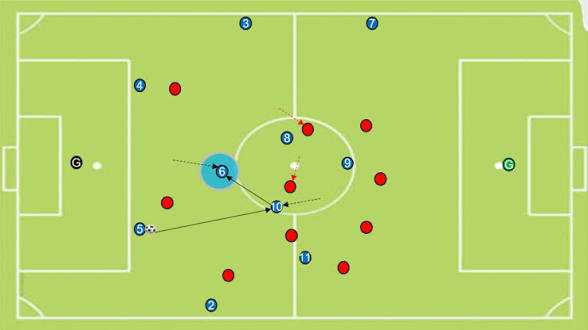
A common structure used to create central overloads is the box midfield. This involves positioning four players in central areas against an opponent’s three.
This 4v3 advantage provides an extra passing option, making it easier to escape pressure and maintain control.
Teams often achieve this by moving full-backs into midfield or dropping attacking players deeper to create additional support.

This structure allows for continuous circulation of the ball, forcing defenders to shift and adjust constantly.
As the defence moves, gaps begin to appear. These gaps can then be exploited through forward passes, runs between lines, or switches of play.
One of the key benefits of overloads is the creation of better passing angles.
When players position themselves correctly, they form triangles and diamonds around the ball. This ensures that the player in possession always has multiple passing options.
These structures make it difficult for defenders to press effectively, as closing one passing lane opens another.
This constant availability of options allows teams to maintain possession even under pressure.
It also reduces the likelihood of mistakes, as players are rarely isolated.
Overloads are not only about creating advantages in one area. They are also used to manipulate the opponent’s defensive shape.
When a team overloads one side of the pitch, the defence is forced to shift across to cover the space.
This movement creates space on the opposite side, which can then be exploited with a quick switch of play.
This is why overloads are often used in combination with width and spacing. By stretching the opponent, teams create gaps that can be attacked.
The ability to move the opposition out of position is one of the main reasons overloads are so effective in breaking down organised defences.
Overloads in football are rarely used in isolation. They are part of a larger tactical framework that includes positioning, movement, and transition control.
In structured systems, players are positioned in a way that naturally creates overloads in different areas of the pitch.
This allows teams to maintain balance while still creating attacking advantages.
The connection between overloads and modern tactical systems highlights how football has evolved from individual actions to coordinated team strategies.
Teams that understand how to create and use overloads effectively are better equipped to control matches and break down defensive structures.
While central overloads help control possession, wide overloads are designed to stretch defensive structures and create space across the pitch.
By concentrating multiple players on one side, teams force the opposition to shift their defensive shape. This movement creates imbalances, particularly on the opposite side, where space often becomes available.
Wide overloads are commonly used to create 3v2 or 2v1 situations near the touchline. These scenarios give the attacking team a clear advantage, allowing them to progress the ball or deliver into dangerous areas.

Modern teams often combine wide overloads with underlapping runs. Instead of running outside, players move into the half-space, making it more difficult for defenders to track their movement.
This creates confusion, as defenders must decide whether to follow the runner or maintain their position. Either choice can open space.
One of the main purposes of wide overloads is to create opportunities for switching play.
Once the defence shifts toward the overloaded side, the attacking team can quickly move the ball to the opposite flank. This area is often less crowded, allowing for more direct attacking opportunities.
This method is particularly effective against teams defending in structured systems such as a low block or high defensive line, where shifting the defensive shape can create significant gaps.
By moving the opponent from side to side, teams can gradually destabilise defensive organisation and create openings.
Modern teams use overloads in more sophisticated ways than simple numerical advantages.
Rotational Overloads: Players rotate positions to create confusion in defensive marking. As players move, new overloads are formed in different areas of the pitch.
Positional Rotations: Full-backs move into midfield, wingers move inside, and midfielders drop deeper. These movements create dynamic structures that are difficult to defend.
False Positions: Players occupy unexpected zones to create overloads in areas where the opponent is not prepared to defend.
These strategies show how overloads have evolved into a more flexible and dynamic concept in modern football.
While overloads are primarily an attacking tool, they must be balanced with defensive structure.
Committing too many players forward can leave the team vulnerable if possession is lost. This is why overloads are closely connected to rest defence in football.
Rest defence ensures that even when players move forward to create overloads, there are still enough players positioned to deal with counter-attacks.
This balance between attack and defence is essential for maintaining control throughout the game.
Overloads provide several tactical advantages that make them a key feature of modern football.
Improved Possession Control: More passing options make it easier to retain the ball under pressure.
Breaking Defensive Lines: Numerical superiority allows teams to bypass defensive structures.
Creating Space: Overloading one area opens space in another.
Flexibility: Overloads can be created in different zones depending on the situation.
These benefits explain why overloads are widely used across different tactical systems.
Despite their effectiveness, overloads also come with risks.
Defensive Exposure: Overcommitting players forward can leave space behind the defence.
Dependence on Coordination: If players fail to move together, the overload becomes ineffective.
Predictability: Repeating the same overload patterns can make them easier to defend.
These risks highlight the importance of timing, discipline, and tactical awareness.
Overloads often work alongside a high defensive line in football, which helps compress space and keep the team compact.
This allows players to stay closer together, making it easier to create overloads and apply pressure.
However, it also increases the importance of structure, as losing the ball can expose space behind the defence.
Overloads in football have become a defining feature of modern attacking systems because they provide a structured way to create advantages.
Rather than relying on individual actions, teams use coordinated positioning and movement to manipulate defensive structures.
This reflects a broader shift in football toward collective organisation and tactical precision.
Overloads in football allow teams to create numerical advantages, control possession, and break defensive structures through intelligent positioning and movement.
By combining central and wide overloads, teams can manipulate opponents, create space, and generate attacking opportunities while maintaining balance.
When executed correctly, overloads provide a reliable and repeatable method for controlling matches and creating consistent attacking threats.