Physical Address
MICKYWORLDNG
Physical Address
MICKYWORLDNG

MICKYWORLDNG IS READER-SUPPORTED. WHEN YOU BUY THROUGH LINKS ON OUR SITE, WE MAY EARN AN AFFILIATE COMMISSION AT NO EXTRA COST TO YOU.
Rest Defence in Football describes how teams organise themselves behind the ball while in possession, ensuring they are prepared to react immediately if possession is lost. Rather than committing every player forward, structured sides maintain a controlled defensive shape that protects space and limits counter-attacking opportunities.
This approach reflects a broader shift in modern football. Attacking and defending are no longer separate phases. The way a team structures itself in possession directly influences how effectively it can respond during transitions.
Teams that neglect this balance often become vulnerable. A single misplaced pass can leave large areas exposed, especially when players are positioned too far from each other. Rest defence reduces that risk by ensuring defensive organisation already exists before possession is lost.
Rest defence is not simply about leaving players behind the ball. It is about how those players are positioned, how they relate to each other, and how quickly they can react when possession changes.
The concept is closely tied to the idea of controlling transitions. In modern football, the most dangerous moments often occur immediately after possession is lost. Teams are temporarily unbalanced, and space can open quickly.
Rest defence addresses this by ensuring that a team is never fully exposed. Even during attacking phases, a structured group of players remains positioned to protect key areas.
This is why rest defence is closely linked to gegenpressing in football. While gegenpressing focuses on winning the ball back immediately, rest defence ensures that if the press fails, the team is still protected.
The speed of modern football has increased the importance of transitions. Attacks develop quickly, and defensive mistakes are punished more frequently.
Teams that push many players forward without structure often struggle when possession is lost. Opponents can exploit open space with direct passes or quick forward runs.
Rest defence solves this by creating a safety net. It ensures that:
Transitions are controlled: Players are already positioned to react immediately.
Counter-attacks are delayed: Opponents are forced to slow down.
Space is protected: Dangerous central areas are covered.
This balance allows teams to attack with confidence while maintaining defensive stability.
Rest defence operates during attacking phases. While attacking players move forward, others position themselves in a way that allows immediate defensive reactions.
These players form a structure behind the ball, often consisting of defenders and deeper midfielders. Their positioning is not passive. They are actively preparing for the next phase.
Their responsibilities can be broken into three key actions.
Immediate pressure: Players close to the ball react quickly to limit the opponent’s time.
Delaying transitions: If the ball is not won instantly, the goal is to slow the attack.
Controlling central space: Players protect central zones, forcing opponents wide.
This layered reaction ensures that transitions are either stopped early or controlled effectively.
The effectiveness of rest defence depends heavily on structure. Teams organise players into shapes that balance coverage, compactness, and flexibility.

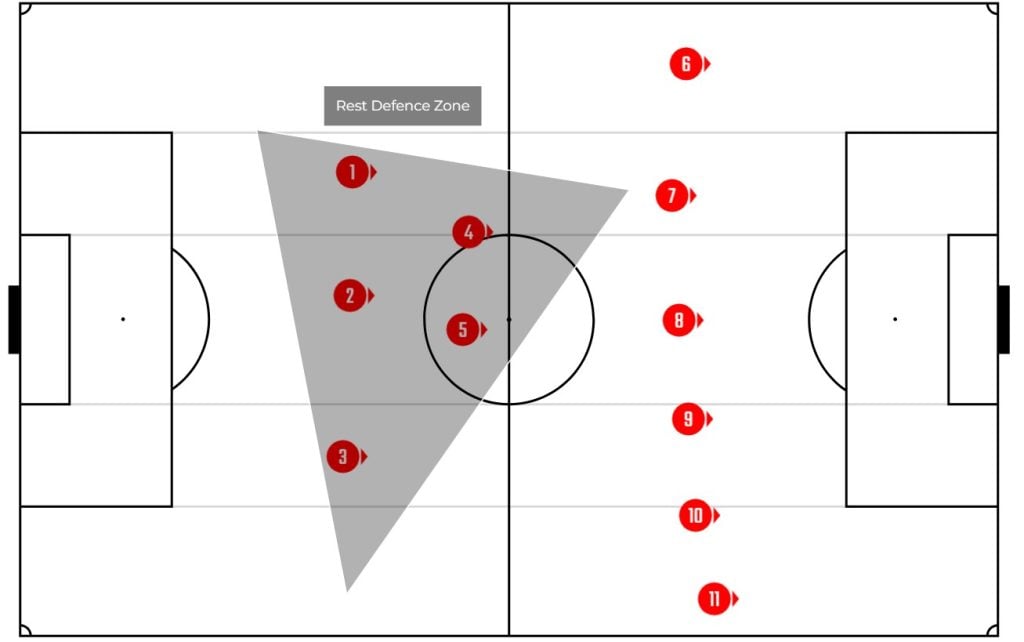
One of the most common structures is the 2-3 shape. In this setup, two defenders remain deeper while three players position themselves ahead, often including a defensive midfielder and inverted full-backs.
This structure allows teams to control central space while maintaining enough depth to deal with long passes.
Another variation is the 3-2 structure, where three defenders stay behind with two midfielders in front. This provides additional protection against multiple attackers.
Teams also follow what is often referred to as the +1 rule. This means maintaining one more defensive player than the number of attackers left forward by the opponent.
These structures are flexible. They adjust depending on the situation, the opponent, and the phase of play.
Manchester City under Pep Guardiola provide a clear example of rest defence in practice. Their structured positioning behind the ball allows them to control counter-attacks effectively while maintaining sustained attacking pressure.
Spacing is one of the most important elements of rest defence in football. Players must remain close enough to support each other while still covering key areas.
If players are too far apart, the structure becomes ineffective. Opponents can exploit gaps and progress quickly.
This is why rest defence is closely linked to midfield compactness in football. Tight spacing ensures that players can react together and maintain control.
Compactness also helps in applying pressure. When players are positioned close to each other, they can surround the ball carrier more effectively.
Rest defence often operates alongside a high defensive line in football. By pushing the defensive line forward, teams reduce the space between lines and maintain compactness.
This allows quicker reactions and makes it easier to control transitions.
However, this approach also increases risk. If the structure is broken, large spaces can open behind the defence.
The goalkeeper plays an important supporting role in rest defence structures. Positioned higher than in traditional systems, the goalkeeper helps cover space behind the defensive line.
This role is closely connected to the concept of the sweeper keeper in football, where the goalkeeper acts as an additional defender.
By providing this support, the goalkeeper allows defenders to maintain a higher position and keep the team compact.
Rest defence requires constant awareness. Players must track the ball, monitor opposition movement, and adjust their positioning accordingly.
Body shape is also important. Players often position themselves side-on, allowing them to react quickly in different directions.
Scanning the field regularly ensures that players can anticipate danger before it develops.
This awareness is what allows teams to remain stable even in unpredictable situations.
The primary purpose of rest defence in football is to control and limit counter-attacks before they become dangerous. Rather than reacting late, teams prepare for these moments in advance through positioning and structure.

When possession is lost, the first objective is to reduce the opponent’s ability to progress quickly. Players closest to the ball apply immediate pressure, while others position themselves to block passing lanes and protect space.
This coordinated reaction ensures that counter-attacks are either stopped early or forced into less dangerous areas.
Central areas are usually prioritised. By blocking central passing lanes, teams force the opponent to play wide, where attacks are easier to control and less direct.
This behaviour is closely linked to pressing concepts, as teams combine rest defence with immediate pressure to disrupt transitions.
Effective rest defence operates in layers. Each layer has a specific function in controlling transitions.
First layer: Immediate pressure on the ball carrier to reduce time and force mistakes.
Second layer: Nearby players block passing lanes and restrict options.
Third layer: Deeper defenders protect space and prepare to deal with forward runs.
This layered structure ensures that even if the first press is bypassed, the team still maintains control.
No system is perfect. When rest defence breaks down, teams can become vulnerable quickly.
The most common issue is poor spacing. If players are too far apart, they cannot support each other effectively. This creates gaps that opponents can exploit.
Another problem is delayed reactions. If players hesitate after losing possession, the opponent gains time and space to progress.
When this happens, the defensive line often has to drop quickly, and midfielders must recover their positions. This transition phase is critical in preventing clear goal-scoring opportunities.
Coordination becomes essential. Without communication and collective movement, the structure collapses.
One of the main risks of rest defence in football is the space left behind the defensive line.
When teams push forward to maintain compactness, they leave space that can be attacked with direct passes or fast runs.
This is why coordination is so important. Defensive lines must move together, maintaining alignment and awareness.
This risk is closely connected to the principles of the offside trap in football, where timing and positioning are crucial in controlling space.
Each player has a specific responsibility within a rest defence structure.
Centre-backs: Maintain depth and control central space. They are responsible for dealing with long balls and forward runs.
Fullbacks: Balance between supporting attacks and maintaining defensive structure. Their positioning can influence how easily opponents escape pressure.
Midfielders: Provide the link between attack and defence. They are often responsible for blocking passing lanes and applying secondary pressure.
Forwards: Even attacking players contribute by applying immediate pressure after losing possession.
These roles are interconnected. The effectiveness of rest defence depends on how well players work together.
Transition control is one of the most important aspects of modern football. Teams that manage transitions effectively gain a significant advantage.
Rest defence plays a central role in this. By preparing for defensive actions during attacking phases, teams can control what happens after possession is lost.
This approach reduces chaos and ensures that transitions are managed rather than reacted to.
Rest defence provides several key advantages that make it essential in modern tactical systems.
Improved defensive stability: Teams are less vulnerable to counter-attacks.
Better transition control: Players can react immediately after losing possession.
Sustained attacking pressure: Teams can commit players forward without losing balance.
Reduced defensive workload: Early intervention prevents dangerous situations from developing.
These benefits explain why rest defence is widely used by structured teams.
Despite its advantages, rest defence is not without limitations.
It requires high levels of coordination and understanding between players. Mistakes in positioning or timing can lead to vulnerabilities.
It also depends on player discipline. If individuals abandon their positions, the structure becomes ineffective.
Physical demands can also be a factor. Maintaining compactness and reacting quickly requires constant movement and awareness.
Teams develop rest defence through structured training sessions that focus on positioning, spacing, and reaction speed.
Small-sided games are often used to simulate transition moments. These exercises encourage players to react immediately after losing possession.
Coaches also emphasise positioning during attacking phases, ensuring that players maintain the correct structure.
Repetition helps players develop automatic responses, making rest defence more effective during matches.
Rest defence in football has become a defining feature of modern tactical systems because it addresses one of the most important aspects of the game: transitions.
As football becomes faster, the ability to control these moments becomes more valuable.
Teams that can manage transitions effectively are better equipped to maintain balance, reduce risk, and sustain pressure.
This makes rest defence not just a defensive concept, but a key part of overall team strategy.
Rest Defence in Football is a structured approach that ensures teams remain protected even while attacking. By maintaining compact positioning, controlling space, and reacting quickly, teams can prevent counter-attacks and manage transitions effectively.
Its success depends on coordination, awareness, and discipline. When executed correctly, rest defence allows teams to attack with confidence while maintaining defensive stability.
As tactical systems continue to evolve, rest defence remains a central principle in how teams balance risk and control in modern football.