Physical Address
MICKYWORLDNG
Physical Address
MICKYWORLDNG

MICKYWORLDNG IS READER-SUPPORTED. WHEN YOU BUY THROUGH LINKS ON OUR SITE, WE MAY EARN AN AFFILIATE COMMISSION AT NO EXTRA COST TO YOU.
Gegenpressing in football describes a tactical approach where a team immediately attempts to win the ball back the moment possession is lost, rather than retreating into a defensive shape. It focuses on exploiting the brief transition phase when the opposition has just gained control but is not yet organised.
This approach has become one of the defining features of modern football. It is built on speed, coordination, and collective moveme…
Gegenpressing in football is a tactical approach where a team immediately attempts to win the ball back after losing possession. Rather than retreating into a defensive shape, players react instantly, applying coordinated pressure around the ball to disrupt the opponent before they can organise their next action.
This approach is built around the idea that the moment of possession loss is also the most vulnerable phase for the opponent. When a team regains the ball, their structure is often not yet set, players may be facing the wrong direction, and passing options may not be fully established. Gegenpressing targets this exact moment.
Instead of defending deeper and allowing the opposition time to build, teams compress space around the ball immediately. This reduces decision-making time and increases the likelihood of forcing errors or winning the ball back in advanced areas.
Gegenpressing is often simplified as aggressive pressing, but the concept is more structured than that. It is not about chasing the ball randomly. It is a coordinated team reaction designed to control space and time immediately after losing possession.
The key principle is that defensive organisation begins at the exact moment possession is lost, not several seconds later. Every player has a responsibility to react instantly, either by applying pressure or by positioning themselves to support the press.
This distinguishes gegenpressing from traditional defensive systems. Instead of dropping into shape and waiting, teams actively try to recover the ball before the opponent can exploit the transition.
At its core, gegenpressing in football is about controlling transitions. Modern football is increasingly defined by moments when possession changes. These transitions often create the most dangerous situations because defensive and attacking structures are temporarily unbalanced.
Gegenpressing attempts to eliminate this imbalance. By reacting immediately, teams aim to prevent the opponent from progressing the ball or launching counter-attacks.
This approach is based on two key ideas:
Time reduction: Opponents are given less time to think and execute decisions.
Space compression: The available space around the ball is reduced, limiting passing options.
When these two elements are combined, the opponent is forced into rushed actions, often resulting in turnovers.
One of the most important aspects of gegenpressing is the immediate reaction after losing the ball. The first few seconds are critical.
During this phase, the opponent has not yet established control. Players may be receiving the ball under pressure, adjusting their body position, or scanning for passing options.
Teams using gegenpressing treat these seconds as an opportunity rather than a defensive setback. Instead of retreating, they increase intensity and close down the ball immediately.
If the ball is not recovered quickly, the team may then drop into a more structured defensive shape. This highlights an important feature of gegenpressing: it is highly time-dependent.
Although gegenpressing is reactive, it still relies on identifiable triggers that increase the likelihood of success. These triggers signal when pressure should be applied with maximum intensity.
For a detailed breakdown of these cues, see pressing triggers in football.
Heavy touch: When an opponent miscontrols the ball, nearby players immediately close down to limit recovery time.
Back to goal: A player receiving the ball while facing their own goal has limited forward options, making them vulnerable.
Touchline pressure: The sideline acts as an additional defender, restricting movement and forcing predictable passes.
Central congestion: When the ball is in a crowded area, multiple players can collapse quickly and block passing lanes.
These triggers are not isolated actions. They are part of a coordinated system where multiple players react simultaneously.
Gegenpressing in football cannot function without the right structural foundation. The positioning of players before possession is lost determines how effective the press will be.
Teams must maintain compact distances between lines. If players are too far apart, it becomes impossible to apply immediate pressure.

One of the key elements is the use of a high defensive line in football. By pushing defenders forward, teams reduce the overall playing space and keep the team vertically compact.
Midfield positioning is equally important. Tight spacing ensures that when possession is lost, players are already close enough to react. This concept is explained further in midfield compactness in football.
The objective is to create a structure where multiple players can engage the ball immediately, while others block passing lanes behind them.
Effective gegenpressing depends on maintaining short distances between players. If players are positioned too far apart, the press becomes fragmented.
Short distances allow players to support each other quickly. When one player presses, others can immediately cover nearby passing options.
This creates a layered structure where the opponent is surrounded rather than chased individually.
Forwards play a crucial role in initiating gegenpressing. They are often the first players to react when possession is lost.
Their job is not only to chase the ball but to direct the press. By adjusting their body position and movement, they can force the opponent into specific areas.
For example, a forward may angle their run to block a central passing lane, forcing the opponent to play wide. This allows teammates to anticipate the next pass and apply pressure.
Timing is essential. Pressing too early or too late can allow the opponent to escape. Forwards must coordinate their movement with the rest of the team.
Midfielders provide the support structure behind the initial press. While forwards apply pressure, midfielders position themselves to intercept passes and win second balls.
They must read the situation quickly, identifying where the ball is likely to go. Their positioning often determines whether the press succeeds or fails.
Midfielders also play a key role in maintaining compactness. By staying close to both forwards and defenders, they ensure that the team remains connected.
This connection allows the team to react as a unit rather than as isolated individuals.
Fullbacks play a critical role in maintaining the width and compactness required for effective gegenpressing in football. When possession is lost, they are often positioned high up the pitch, which allows them to immediately close down wide passing options.
Their positioning helps prevent the opponent from escaping pressure through the flanks. By stepping forward aggressively, fullbacks can pin the opposition near the touchline, where space is limited and passing options are reduced.
However, this aggressive positioning also requires discipline. If the press is broken, fullbacks must recover quickly to avoid leaving large gaps behind them. Their decision-making therefore balances aggression with awareness.
Centre-backs provide the structural foundation behind the press. They are responsible for maintaining a high defensive line that keeps the team compact and reduces the space between defence and midfield.
This positioning allows the team to sustain pressure higher up the pitch. By stepping forward, centre-backs compress the playing area and support the midfield in contesting loose balls.
However, this approach carries risk. If the opponent breaks the press, centre-backs must defend large spaces behind them. Their positioning is therefore closely linked to concepts such as the offside trap in football, where coordination is essential to maintain defensive balance.
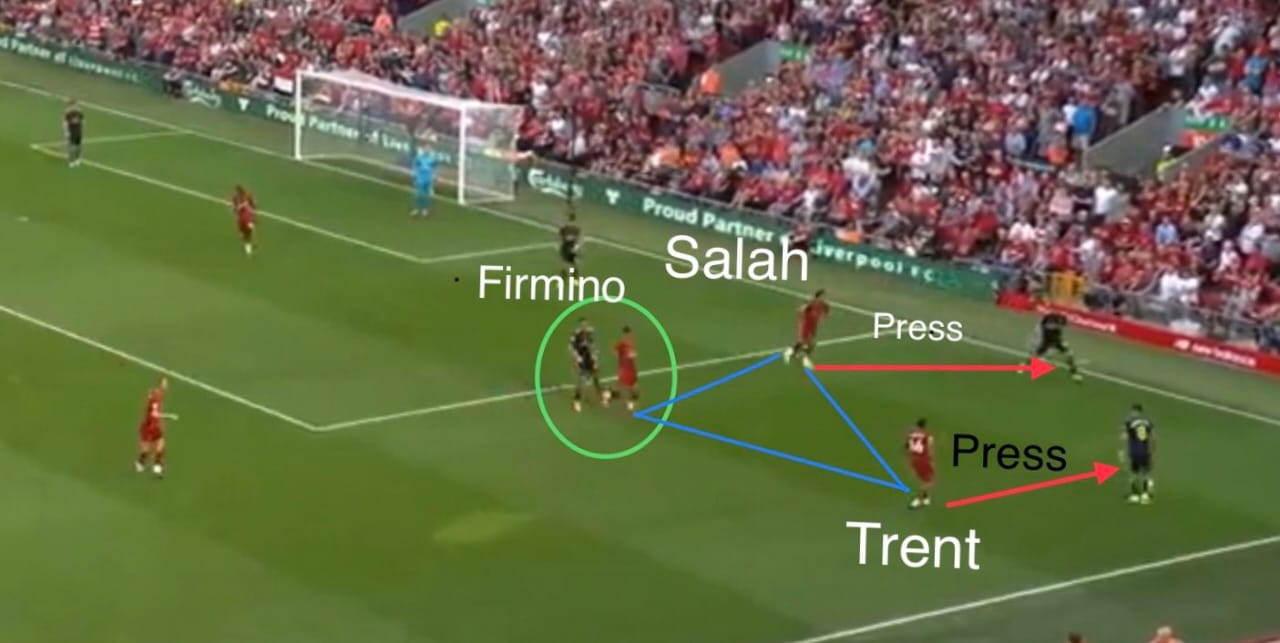
Liverpool under Jurgen Klopp provide one of the clearest examples of gegenpressing in practice. Their coordinated reaction after losing possession allows them to recover the ball in advanced areas and create immediate attacking opportunities.
In modern systems, the goalkeeper plays an active role in supporting gegenpressing structures. Positioned higher than in traditional setups, the goalkeeper acts as a safety net behind the defensive line.
This role is closely connected to the evolution of the sweeper keeper in football, where the goalkeeper is responsible for intercepting long passes and covering space behind the defence.
By providing this additional layer of protection, the goalkeeper allows the defensive line to remain high and compact, which is essential for effective pressing.
Gegenpressing in football is closely linked to how teams structure their build-up play. The positioning of players during possession determines how quickly they can react when the ball is lost.
Teams that maintain compact shapes during build-up are better prepared to counterpress immediately. Short passing distances and close positioning allow players to engage quickly after losing possession.
This connection highlights how attacking structure and defensive reaction are part of the same system. Teams do not switch between attack and defence; they transition seamlessly between both phases.
One of the main advantages of gegenpressing is the ability to recover the ball quickly in advanced areas. This reduces the distance to goal and increases the likelihood of creating scoring opportunities.
Another benefit is the disruption of the opponent’s build-up play. By applying immediate pressure, teams prevent the opposition from establishing rhythm or control.
Gegenpressing also helps control transitions. By reacting instantly, teams can stop counter-attacks before they develop, reducing defensive vulnerability.
Additionally, the constant pressure can have a psychological impact on opponents. Players may become hesitant, leading to mistakes and rushed decisions.
Despite its advantages, gegenpressing carries significant risks if not executed correctly.

Space behind the defence: A high defensive line leaves large areas exposed. If the press is bypassed, opponents can exploit these spaces quickly.
Physical demands: Gegenpressing requires high levels of intensity and energy. Sustaining this over long periods can lead to fatigue.
Coordination dependency: The system relies on collective movement. If one player reacts late or incorrectly, the entire structure can break down.
Exposure to quick transitions: Teams that fail to recover the ball immediately may find themselves vulnerable to fast counter-attacks.
When the press is broken, teams must quickly transition into a defensive shape. This requires rapid recovery runs and strong communication between players.
The defensive line may need to drop deeper to cover space, while midfielders track back to support. This transition phase is critical in preventing counter-attacks.
Teams that fail to manage this transition effectively can be exposed, particularly against opponents who are capable of exploiting open space.
Training gegenpressing involves developing both physical and tactical understanding. Players must be conditioned to react quickly and work as a unit.
Small-sided games are commonly used to simulate transition scenarios. These exercises encourage players to react immediately after losing possession.
Coaches also focus on positioning and spacing during training sessions. By reinforcing compact structures, teams can improve their ability to press effectively.
Repetition is key. Players must develop automatic responses to possession loss, ensuring that pressing actions are instinctive rather than delayed.
One common mistake is pressing individually rather than collectively. Without support, the press becomes ineffective and easy to bypass.
Another issue is poor spacing. If players are too far apart, they cannot apply coordinated pressure.
Timing errors are also critical. Pressing too early or too late can allow the opponent to escape.
These mistakes highlight the importance of structure and coordination in successful gegenpressing systems.
Gegenpressing in football has become a defining feature of modern tactical systems because it aligns with the speed and intensity of the game.
Teams that control transitions gain a significant advantage. By winning the ball back quickly, they can maintain pressure and dictate the tempo of the match.
This approach reflects a broader shift in football, where control is not only about possession but also about how teams respond when possession is lost.
Gegenpressing in football is a complex and structured tactical approach that focuses on immediate ball recovery after possession loss. It requires coordination, compactness, and precise timing.
While it offers significant advantages, including quick ball recovery and attacking opportunities, it also carries risks that must be carefully managed.
Teams that execute gegenpressing effectively can control transitions, disrupt opponents, and maintain dominance in modern football.