Physical Address
MICKYWORLDNG
Physical Address
MICKYWORLDNG

MICKYWORLDNG IS READER-SUPPORTED. WHEN YOU BUY THROUGH LINKS ON OUR SITE, WE MAY EARN AN AFFILIATE COMMISSION AT NO EXTRA COST TO YOU.
The offside trap in football remains one of the most precise defensive tools used within organised systems. Rather than simply reacting to attacking runs, defenders step forward in coordination to leave opponents in an offside position. When executed correctly, it neutralises direct passes and disrupts forward momentum.
In modern tactical structures, the offside trap is rarely isolated from the wider system. It is closely tied to pressing behaviour, defensive height, and compactness between units. Teams that operate with advanced positioning rely heavily on timing and communication to make it effective.
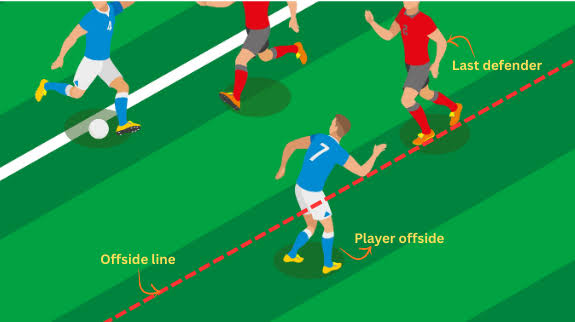
The offside trap is a coordinated defensive movement in which the back line steps forward just before a forward pass is played. The aim is to position attacking players beyond the second-last defender at the moment the ball is delivered.
It demands alignment, awareness of passing cues, and collective timing. One mistimed step can break the trap entirely.
Unlike deep defending, the offside trap encourages proactive engagement. Instead of retreating, defenders move forward to compress space and create positional advantage.

The offside trap functions most effectively within a high defensive structure. Teams that already defend near the halfway line can reduce the space attackers have to accelerate.
This is why the concept closely links to a High Defensive Line in Football. Advanced positioning shortens vertical distances and makes coordinated stepping more effective.
When pressing supports that structure, attackers receive the ball under pressure, increasing the likelihood of mistimed runs or rushed passes.
Successful offside traps depend on reading the passer rather than focusing solely on the runner. Defenders watch body shape, planting foot, and head position to anticipate the forward ball.
The moment the passer prepares to release the ball, the defensive line steps forward together. Communication is constant, but synchronisation is instinctive through repetition.
Teams such as Arsenal have shown how back lines move almost as a single unit when maintaining high defensive positioning.
The offside trap becomes vulnerable if the ball carrier has too much time. Accurate through passes can defeat even a well-timed step.
This is where pressing triggers become essential. Coordinated pressure from forwards and midfielders limits the passer’s options. For deeper insight, see our breakdown of Pressing Triggers in Football.
When pressure compresses space, the offside trap gains greater control over attacking runs.
Teams defending in a low block rarely rely heavily on offside traps. With the defensive line positioned deep, stepping forward aggressively carries less strategic value.
The primary objective in those systems is compactness around the box rather than territorial compression. A detailed comparison is explored in Low Block vs High Defensive Line in Football.
By contrast, sides that prioritise territory and pressing use the offside trap to reinforce defensive height.
Free kicks and wide-area crosses are common moments for deliberate traps. Defensive lines step out together as the ball is delivered, catching runners who move too early.
Open-play transitions also present opportunities. When an opponent attempts a quick vertical pass, defenders can surprise the runner with a sudden step forward.

While effective, the offside trap carries significant risk. If one defender lags behind, the attacker remains onside and may receive the ball in behind.
Inconsistent communication, fatigue, or delayed reaction can break the line. This vulnerability explains why training repetition is critical.
Elite teams mitigate this risk through disciplined spacing and constant rehearsal.
Goalkeepers operating behind an advanced defensive line must remain alert. A sweeper-style presence provides insurance if the trap fails.
Positioning slightly outside the penalty area allows quick intervention against direct passes. This coordination reduces the danger of isolated one-on-one situations.
Repeatedly catching attackers offside can alter behaviour. Forwards may delay runs, reducing attacking sharpness. Hesitation slows momentum.
Conversely, a successful through ball after breaking the trap can boost attacking confidence. The mental balance between risk and reward remains constant throughout matches.
Despite improvements in attacking movement and video analysis, the offside trap in football continues to play a central role in organised defensive systems.
Its relevance is rooted in structural coordination. As long as teams defend high and press collectively, stepping forward in unison remains a practical method of controlling depth.
Modern football rewards compactness and territorial pressure. The offside trap supports those goals by turning defensive alignment into an active tool rather than a passive reaction.
The offside trap in football is most effective when embedded within a broader system built on pressing intensity and defensive cohesion. It is not merely a trick to catch attackers unaware, but a calculated extension of defensive height.
When teams synchronise their pressing triggers, maintain a high line, and communicate consistently, the trap becomes an efficient method of controlling space behind the defence.
Across tactical evolutions, the principle remains clear: coordinated movement can defend territory just as effectively as individual duels.
Tags: Offside Trap in Football, High Defensive Line in Football, Football Tactics