Physical Address
MICKYWORLDNG
Physical Address
MICKYWORLDNG

MICKYWORLDNG IS READER-SUPPORTED. WHEN YOU BUY THROUGH LINKS ON OUR SITE, WE MAY EARN AN AFFILIATE COMMISSION AT NO EXTRA COST TO YOU.
First touch in football is one of the most misunderstood aspects of the game. Many see it as a basic technical skill, but at elite level, it is something far more powerful. It is the moment where space is created, pressure is avoided, and decisions are executed before defenders can react.
The difference between average players and elite players is often not speed, strength, or even creativity—it is what they do in the first second after receiving the ball. That single moment determines whether the team progresses, keeps possession, or loses control.
It often looks simple on the surface, but that simplicity comes from constant awareness and preparation before the ball arrives. They rarely take an extra touch to “settle” the ball. Instead, their first touch already moves them into the next phase of play. The ball arrives, and the solution is already unfolding.
This is why first touch is no longer taught as “control the ball.” It is now taught as control the situation.
Football has become faster and more structured. Defensive systems are compact, pressing is coordinated, and space disappears quickly. In this environment, players cannot rely on multiple touches to solve problems.
They must solve problems instantly.
This is where first touch becomes a tactical weapon. It allows players to bypass pressure, manipulate defenders, and create angles before the opponent can adjust.
Instead of reacting to pressure, elite players use their first touch to avoid it entirely.
This idea connects closely with structured attacking principles like positional play in football, where every action must maintain structure while progressing the ball efficiently.
In these systems, a slow or neutral first touch can break the rhythm. A good one, however, keeps everything flowing.
The most important concept behind elite first touch is what happens before the ball arrives.
Top players do not wait to receive and then decide. They scan, analyze, and choose their next action early. By the time the ball reaches them, the decision is already made.
This is why their first touch looks effortless. It is not improvised—it is prepared.
A player might already know:
So when the ball arrives, the first touch becomes a continuation of thought, not the beginning of it.
This ability is what separates players who “control the ball” from those who “control the game.”
At the heart of modern first touch is direction. The ball should not stay where it arrives—it should move to where it is most useful.
This is known as directional first touch, and it is one of the most important skills in elite football.
Rather than stopping the ball, players guide it into space with their first contact. That space could be forward, sideways, or even slightly backward—but it always serves a purpose.

This small movement changes everything.
Instead of being under pressure, the player suddenly has time. Instead of facing a defender, they are already moving away from them. Instead of reacting, they are dictating.
Even a subtle touch—just a meter into space—can completely change the situation.
That is the difference between surviving pressure and escaping it.
Many players focus on how far their first touch travels. Elite players focus on angles.
The direction of the touch matters more than the distance. A small touch at the right angle can open passing lanes, while a longer touch in the wrong direction can invite pressure.
This is where intelligence meets technique. The player must understand where the space is—not just where the ball is going.
For example, a midfielder receiving with pressure behind may take a diagonal touch forward instead of a straight one. That diagonal movement shifts the defender’s angle and creates a passing lane that did not exist before.
These details are subtle, but they define elite performance.
Before the first touch happens, the body must already be prepared.
Body orientation determines what is possible. If a player is facing only the passer, their options are limited. They may need extra touches to turn, adjust, or escape pressure.
But if they are slightly open—able to see both the ball and the pitch ahead—their first touch becomes far more effective.
This is why elite players constantly adjust their positioning before receiving. They are not static—they are always preparing.
That preparation is what makes everything else possible.
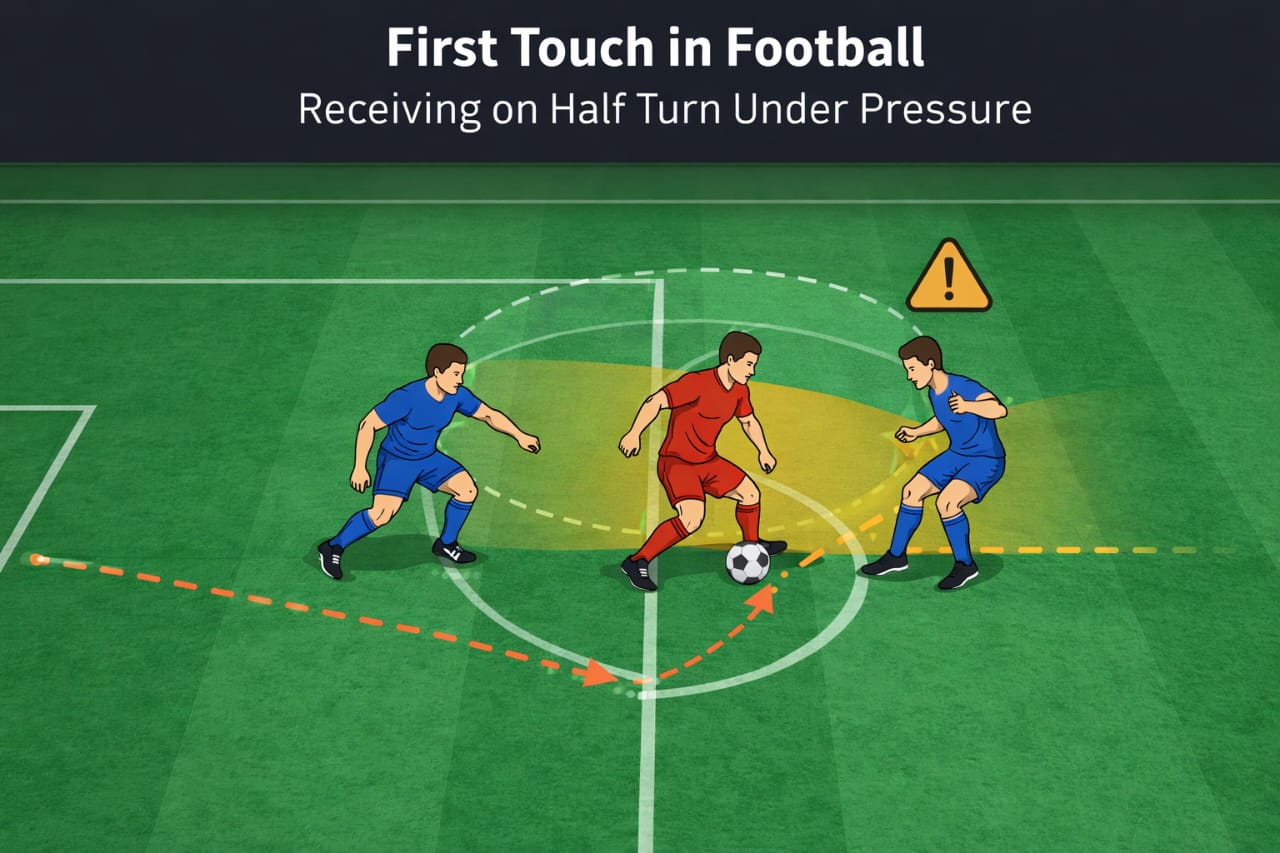
Receiving on the half-turn is one of the clearest examples of how body orientation and first touch work together.
Instead of controlling the ball and then turning, the player does both at the same time. The first touch already moves them into a forward-facing position.
This has a huge impact on the speed of play.
The player can immediately pass forward, drive into space, or combine with teammates. There is no delay, no extra adjustment.
This is especially important when receiving between lines, where space is tight and time is limited. A player who takes too long will be pressed immediately.
A player who receives on the half-turn can exploit that space before it closes.
This is why the half-turn is a key tool in breaking defensive lines in football, allowing teams to move from build-up into attack with minimal touches.
Pressure defines modern football. Teams press high, close space quickly, and force mistakes.
In these moments, first touch becomes even more important.
A poor touch invites pressure. It slows the player down, limits options, and allows defenders to close in.
A good touch does the opposite. It removes pressure before it fully arrives.
This is where techniques like “cushion and move” are essential. Instead of stopping the ball, the player absorbs its speed while directing it into space.
The action is smooth, almost invisible—but incredibly effective.
The defender arrives expecting a duel, but the ball is already gone.
Football is often described as a fast game, but speed is not just about running—it is about thinking and acting quickly.
First touch plays a major role in this.
A clean, purposeful first touch allows the next action to happen immediately. The player does not need extra time to adjust or recover.
This makes the entire sequence faster.
On the other hand, a poor touch slows everything down. It forces hesitation, limits options, and gives defenders time to react.
That is why first touch is often described as a time-creating skill.
It does not literally slow the game, but it gives the player the feeling of having more time than everyone else.
And in elite football, that feeling is everything.
At the highest level, first touch is not just about escaping pressure—it is about creating an immediate advantage.
Elite players do not simply control the ball safely. They use their first touch to move into space that immediately changes the situation for the defense.
This is known as first touch into space, where the player’s initial contact with the ball turns a neutral situation into an attacking one.

Instead of receiving and then deciding, the player accelerates the play instantly. The defender is no longer reacting to a stationary opponent—they are chasing a moving problem.
In real match situations, this often happens in a split second, before defenders can even adjust their positioning.
This type of first touch is especially effective in transition moments, where even a small advantage can lead to a major opportunity.
A well-executed touch into space can:
This is closely connected to attacking patterns like third man runs in football, where movement and timing combine to exploit newly created space.
One of the biggest differences between elite and average players is how quickly they make decisions.
Decision-making speed is not just about thinking faster—it is about setting up the situation correctly.
A good first touch simplifies the next action. It positions the ball in a way that makes the decision obvious.
A poor first touch complicates everything and often invites immediate pressure. It forces the player to adjust, recover, and rethink.
That is why first touch and decision-making are inseparable.
In many cases, the first touch is the decision.
For example, a midfielder receiving between lines may take a touch that automatically opens a passing lane forward. There is no need to hesitate or scan again—the action is already clear.
This is how elite players play quickly without rushing.
Another key aspect of first touch is its ability to manipulate defenders.
Defenders react to movement. If a player takes a predictable touch, the defender can adjust easily. But if the touch is deceptive or unexpected, it forces hesitation.
This is where body feints and disguised touches come into play.
A player may shape their body as if they will move in one direction, then take their first touch in the opposite direction. This creates a moment of imbalance for the defender.
That moment is often enough to create separation before the defender can recover.
This principle is similar to what happens in 1v1 situations in football, where small details in movement and timing determine who wins the duel.
In many cases, the duel is decided before it even begins—through the quality of the first touch.
Modern football is played in increasingly tight spaces, especially in midfield and the final third.
In these areas, players do not have the luxury of multiple touches. They must operate quickly, efficiently, and with precision.
This is where first touch becomes even more decisive.
A good first touch allows the player to operate within small spaces without losing control. It keeps the ball protected while still allowing progression.
A poor touch, however, can immediately lead to turnovers.
This is why players in tight spaces focus on:
These details may seem small, but they are critical at the highest level.
Improving first touch is not just about repetition—it is about context.
Many players practice first touch in isolation, but this does not fully prepare them for real match situations. The key is to train first touch under realistic conditions.
This includes:
One effective method is using directional drills, where players are required to take their first touch into specific areas rather than simply controlling the ball.
Another approach is small-sided games, which naturally create pressure and force quick decision-making.
These environments replicate the demands of real matches, making the skill transferable.
Even talented players struggle with first touch when certain habits are not addressed.
One of the most common mistakes is taking a neutral touch—controlling the ball without improving the situation.
This often leads to unnecessary pressure and limited options.
Another mistake is poor body orientation. If a player is not positioned correctly before receiving, even a technically good touch can become ineffective.
There is also the issue of timing. A delayed or rushed touch can disrupt the flow of play and give defenders an advantage.
Fixing these mistakes requires awareness, repetition, and understanding—not just technique.
At the highest level, the difference between players is often decided in small moments.
The first touch is one of those moments.
It determines whether a player can operate under pressure, maintain tempo, and create opportunities for their team.
Players who master first touch do not just control the ball—they control the rhythm of the game.
They make complex situations look simple through control, awareness, and timing.
And most importantly, they consistently stay one step ahead of the opposition.
In modern football, that is the true value of first touch.