Physical Address
MICKYWORLDNG
Physical Address
MICKYWORLDNG

MICKYWORLDNG IS READER-SUPPORTED. WHEN YOU BUY THROUGH LINKS ON OUR SITE, WE MAY EARN AN AFFILIATE COMMISSION AT NO EXTRA COST TO YOU.
How to improve passing accuracy in football starts with understanding that passing is not just a technical action but a complete skill that combines body position, awareness, and decision-making. Players who consistently pass accurately are not simply better at kicking the ball—they understand when, where, and how to deliver it under different conditions. This deeper understanding allows them to stay consistent even when the game becomes faster and more intense. Instead of reacting late, they prepare early and execute with clarity.
At every level of football, passing accuracy determines how well a team can control possession and progress forward. When passes are clean and precise, the game becomes easier, movements become smoother, and players have more time to make decisions. Teams that pass accurately are able to dominate rhythm and dictate the tempo of the match. This control creates more opportunities to break down opponents and maintain attacking pressure.
However, inaccurate passing creates immediate pressure, breaks team structure, and forces players into defensive situations. This is why improving passing accuracy is one of the fastest ways to improve overall performance. A single misplaced pass can disrupt an entire attacking move and expose the team defensively. Over time, repeated mistakes reduce confidence and limit a player’s influence on the game.
To truly improve, players must go beyond basic repetition and focus on the details that influence every pass, including technique, preparation, and awareness. Training without understanding leads to slow improvement, but focused practice builds real consistency. Players must connect what they do in training with what happens in matches. This is where real development begins.
Many players believe passing accuracy is only about striking the ball correctly, but this is only one part of the process. The quality of a pass is influenced by everything that happens before the ball is even touched. Preparation determines execution, and without it, technique alone is not enough. This is why some players look technically good in training but struggle during matches.
This includes positioning, timing, and understanding the movement of teammates. Without these elements, even technically good players will struggle to maintain consistent accuracy during matches. Football is dynamic, and passing must adapt to constantly changing situations. Players who fail to read these situations often play predictable or ineffective passes.
Passing is also closely connected to decision-making. Choosing the wrong option often leads to poor outcomes, even if the technique itself is correct. A perfectly executed pass to the wrong player or space still results in loss of possession. This shows that accuracy is not just physical—it is also mental.
This is why improving passing accuracy requires a combination of technical skill and game understanding rather than isolated practice. Players must train their awareness alongside their technique. When both develop together, passing becomes more natural and effective. This is what separates average players from reliable performers.
One of the most important factors in passing accuracy is body position before striking the ball. The way a player sets up their body determines the direction, balance, and quality of the pass. Poor body alignment often leads to rushed or misdirected passes. Correct positioning creates control and consistency.
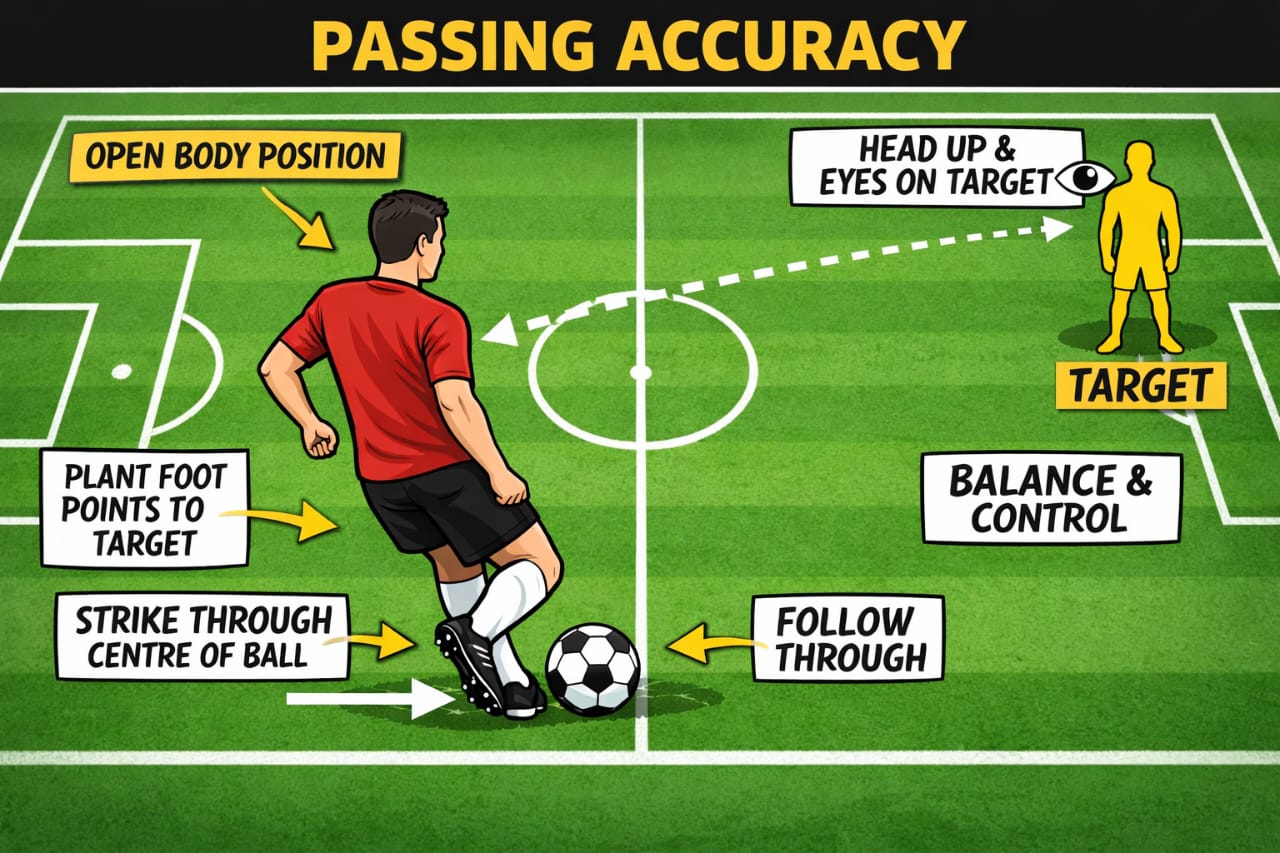
An open body position allows players to see more of the pitch and align their pass more naturally toward the target. This improves both accuracy and speed of execution. Players who open their body can play forward more easily instead of limiting themselves to safe passes. This small adjustment makes a big difference in real matches.
The standing foot should be placed next to the ball, pointing toward the intended direction, while the passing foot strikes through the center of the ball for a clean connection. Balance is key here, as unstable movement often leads to poor contact. Controlled technique produces repeatable results.
These small technical details may seem simple, but they create consistency over time, especially when repeated under realistic match conditions. Mastering these basics allows players to perform under pressure without losing accuracy. This is why top players rarely misplace simple passes.
Passing accuracy is not just about direction—it is also about weight. A perfectly directed pass can still fail if it is too strong or too weak for the situation. The receiver must be able to control the ball comfortably. This is where many players make avoidable mistakes.
Players must learn to adjust the strength of their pass based on distance, pressure, and the movement of their teammate. A short pass requires precision, while a longer pass requires both power and control. Adapting to these situations is what improves consistency.
This becomes especially important when comparing different types of passes, which is explained clearly in short vs long passing in football, where control and timing define effectiveness. Understanding these differences helps players choose the right technique for each situation. This improves both accuracy and decision-making.
Understanding pass weight allows players to deliver the ball in a way that makes it easier for teammates to control and continue the play. This keeps the game flowing and reduces unnecessary pressure. Good passing always considers the next action.
Accurate passing begins with the first touch. Before a player can deliver a pass, they must first control the ball in a way that sets up the next action. A poor setup leads to rushed execution. A good setup creates time and clarity.
A good first touch creates space, improves body position, and gives the player more time to make a decision. This leads to better accuracy and smoother play. Players who control the ball well rarely look under pressure. They appear calm because they are prepared.
On the other hand, a poor first touch forces rushed decisions and often results in inaccurate passes under pressure. This leads to mistakes that could have been avoided with better preparation. Many passing errors actually start from bad control.
This is why developing control is essential for improving passing accuracy at every level of the game. Players must train their first touch as seriously as their passing technique. Both skills work together.
One of the biggest differences between average and advanced players is what they see before receiving the ball. Passing accuracy depends heavily on awareness. Players who do not scan are always reacting late. Players who scan are always prepared.
Players who scan regularly understand where teammates, opponents, and space are located before the ball arrives. This allows them to make faster and more accurate decisions. It also reduces unnecessary touches.
This allows them to make faster and more accurate decisions, reducing the chance of mistakes under pressure. When players know their next action early, execution becomes easier. This is why awareness improves both speed and accuracy.
This concept is explained further in football scanning awareness, where vision and preparation directly influence performance. Players who develop this habit improve rapidly. It is one of the most underrated skills in football.
Even with perfect technique, passing accuracy will suffer if decision-making is poor. Players must learn to choose the right option based on the situation. Football is not just about ability—it is about choices. The wrong choice cancels good technique.
This includes understanding when to play simple passes, when to switch play, and when to take risks. Not every situation requires creativity. Sometimes, the best option is the simplest one.
Good decision-making reduces unnecessary mistakes and helps maintain control of the game. Teams that make better decisions lose possession less often. This leads to better overall performance.
Over time, this awareness becomes automatic, allowing players to execute passes quickly and accurately. This is when passing becomes natural rather than forced. Consistency comes from repetition and understanding.
Improving passing accuracy requires consistent training with the right type of drills. Simple exercises can be very effective when performed with focus and repetition. Quality matters more than complexity. Basic drills done properly bring the best results.
Short passing drills help develop control, timing, and accuracy over small distances, which are essential during matches. These situations happen constantly in games. Mastering them gives players confidence.
Players should also practice passing under pressure, adding movement and decision-making to make training more realistic. Static training does not reflect real match conditions. Movement is key to improvement.
Consistency in training is what turns technique into reliable performance during real game situations. Players who train correctly perform better under pressure. This is the goal of all development.

Many players struggle with passing accuracy because of small but important mistakes that go unnoticed during training. These small issues create big problems over time. Identifying them is the first step to improvement.
These include poor body position, lack of scanning, rushing decisions, and incorrect pass weight. Each of these errors affects the outcome of a pass. Fixing them leads to immediate improvement.
Another common issue is focusing too much on power instead of control, which often leads to misplaced passes. Control should always come before power. Accuracy is more important than force.
Identifying and correcting these mistakes is one of the fastest ways to improve passing accuracy. Small adjustments can lead to big improvements. This is what makes development efficient.
Improving passing accuracy in football also involves developing the ability to play longer passes with control and precision. While short passing builds rhythm, long passing expands the game by switching play and breaking defensive structures. Players who can consistently deliver accurate long passes give their team a major tactical advantage. This ability allows teams to move the ball quickly across the pitch and exploit space more effectively.
Long passing requires a different technique compared to short passing. The player must generate enough power while maintaining control over direction and height. This balance between strength and precision is what separates effective long passers from inconsistent ones. Without control, long passes become unpredictable and easy to intercept.
Vision also plays a critical role in long passing accuracy. Players must identify opportunities early, recognize movement, and execute the pass at the right moment. Delayed decisions often lead to missed chances or inaccurate execution. This is why awareness and scanning remain essential even when playing over longer distances.
Improving long passing is not just about hitting the ball further—it is about delivering it with purpose, accuracy, and timing that benefits the team’s overall structure.
In matches, players rarely have time and space to execute perfect passes. This is why learning how to improve passing accuracy in football must include performing under pressure. Training in comfortable situations does not prepare players for real game demands. Pressure changes everything—time, space, and decision-making.
When under pressure, players must rely on habits built through repetition. This includes quick scanning, proper body positioning, and fast decision-making. Without these habits, accuracy drops immediately. Players begin to rush, panic, or choose the wrong option.
The ability to stay calm in tight situations is what makes passing reliable. Players who remain composed can still execute accurate passes even when being pressed aggressively. This composure allows teams to maintain control instead of losing possession unnecessarily.
Developing this skill requires realistic training that includes opponents, limited space, and time constraints. This prepares players for the intensity of real matches.
Passing accuracy is heavily influenced by positioning and angles on the pitch. Players who position themselves correctly make passing easier for both themselves and their teammates. Good positioning creates better passing options and reduces the risk of mistakes.
Creating angles is one of the most important principles in football. Instead of standing in straight lines, players should move to create diagonal passing lanes. This makes it easier to receive and play accurate passes without pressure.
When players are positioned well, they receive the ball with more time and space. This leads to better control and more accurate passing decisions. Poor positioning, on the other hand, limits options and increases pressure immediately.
Understanding positioning and angles is what connects individual passing ability to overall team performance.
Improving passing accuracy is not about short-term improvement—it is about long-term consistency. Players must repeat correct actions until they become automatic. This is what allows them to perform under pressure without hesitation.
Training must be consistent and focused on quality rather than quantity. Repeating poor technique only reinforces bad habits. Players must pay attention to details every time they pass the ball.
Match application is equally important. Skills developed in training must be applied during real games. This is where true improvement becomes visible. Players who cannot transfer training into matches will struggle to progress.
Consistency comes from combining correct training with real game experience. This is what builds reliable passing over time.
One of the most important aspects of how to improve passing accuracy in football is developing game intelligence. Players must understand not just how to pass, but why they are making each pass. This understanding improves both accuracy and effectiveness.
Game intelligence includes reading the game, anticipating movement, and recognizing patterns. Players who understand the game make better decisions and execute passes more efficiently. They are always one step ahead.
This is closely connected to how to read the game in football, where awareness and anticipation allow players to make smarter decisions before receiving the ball. This reduces pressure and improves execution.
Developing this level of understanding takes time, but it has a major impact on overall performance and consistency.

At its core, how to improve passing accuracy in football is about combining multiple elements into one complete skill. Technique, awareness, decision-making, and positioning all work together to produce consistent results. Focusing on only one area will limit overall improvement.
Players who improve fastest are those who pay attention to details and train with purpose. They understand that every pass matters, whether in training or matches. This mindset leads to steady progress over time.
Accuracy is not built overnight. It develops through repetition, correction, and experience in real game situations. The more a player understands the game, the easier accurate passing becomes.
When all these elements come together, passing becomes natural, controlled, and reliable. This is what allows players to influence the game consistently and perform at a higher level.