Physical Address
MICKYWORLDNG
Physical Address
MICKYWORLDNG

MICKYWORLDNG IS READER-SUPPORTED. WHEN YOU BUY THROUGH LINKS ON OUR SITE, WE MAY EARN AN AFFILIATE COMMISSION AT NO EXTRA COST TO YOU.
How to improve football fitness without the gym is one of the most important things any player must understand if they want to perform consistently at a high level without relying on equipment or structured gym programs. Football is not played in controlled environments like gyms, and the physical demands of the game are completely different from traditional workouts that isolate strength or endurance.
Instead, football requires a combination of explosive actions, constant movement, quick recovery, and the ability to repeat high-intensity efforts over long periods of time. This means your training must reflect real match situations, where actions are unpredictable and constantly changing depending on the flow of the game.
Players who rely only on gym-based training often improve strength but struggle with stamina, speed, and repeated sprint actions during matches because their training does not match real football demands. When done correctly, training without a gym can actually produce better results because it focuses directly on movement patterns used during games.
The key is not just working harder but training smarter by understanding how football fitness works and applying the right methods consistently over time. Once you understand this, your development becomes more structured, and your performance begins to improve in a noticeable way.
Football fitness is not simply about running long distances or being physically strong, but about maintaining performance while repeatedly performing intense actions throughout a match. Players constantly transition between sprinting, jogging, stopping, turning, and accelerating again, which requires multiple fitness qualities working together at the same time.
This includes stamina, acceleration, agility, balance, coordination, and recovery, all functioning as one system rather than separate abilities. Unlike traditional fitness training, football is dynamic and unpredictable, meaning players must react instantly to different situations without losing control or speed.
A player might sprint forward to press, stop suddenly, change direction, and accelerate again within seconds, all while staying balanced and aware of their surroundings. This constant variation is what makes football physically demanding and why generic fitness training is not enough.
Training must replicate these conditions if you want your fitness to translate into real performance on the pitch. Without this understanding, players often train hard but fail to see results during actual matches.
Many players believe that improving fitness requires access to a gym, but this idea comes from misunderstanding what football fitness actually involves. While gyms can improve strength, they do not fully prepare players for the movement patterns, speed, and recovery demands of real matches.
Football fitness is built through movement, intensity, and repetition rather than isolated exercises, which is why on-pitch training is more effective. Without a gym, players can focus entirely on sprinting, changing direction, and accelerating quickly between actions that mirror real gameplay.
These are the exact physical demands experienced during a match, and training in this way improves efficiency, coordination, and overall match readiness. It also reduces unnecessary bulk that may slow down movement or affect agility during high-speed situations.
Players who train this way often develop more functional fitness, meaning their physical ability directly improves their performance on the pitch. This is what truly matters when it comes to football development.
To improve effectively, you must understand the key components that make up football fitness and how each one contributes to your overall performance. Ignoring even one of these elements can limit your ability to perform consistently during matches and reduce your effectiveness on the pitch.
Stamina allows you to maintain energy levels throughout the match without a drop in performance, while acceleration and speed help you react quickly and reach the ball before your opponent. Agility ensures you can change direction efficiently, and recovery allows you to repeat high-intensity actions without fatigue slowing you down.
These components are not separate but work together in every moment of the game, which is why they must be trained as a system rather than individually. When trained correctly, they create a balanced and complete player capable of performing at a high level consistently.
This is what separates players who can maintain performance for 90 minutes from those who struggle as the game progresses. Football fitness is about sustainability, not just short bursts of effort.
In real matches, players rarely move at a constant pace, instead performing short bursts of high intensity followed by periods of lower activity. This pattern requires both aerobic endurance to sustain effort and anaerobic power to perform explosive actions during key moments.
The ability to recover quickly between these actions is what defines true football fitness, often referred to as repeated sprint ability. Players who lack this ability begin to lose intensity, make slower decisions, and become less effective as the match continues.
For example, a player may sprint to press an opponent, recover position, and then immediately sprint again to support an attack. This continuous cycle places high physical demands on the body and requires efficient energy use.
Training must replicate this pattern if you want to improve, which is why interval-based training is far more effective than traditional long-distance running.
One of the biggest mistakes players make is focusing too much on long-distance running instead of high-intensity efforts that reflect real match situations. While endurance is important, football is primarily a high-intensity sport that requires explosive actions rather than steady pacing.
This means the quality of training is more important than the quantity, as short, intense sessions are often more effective than long, slow runs. High-intensity training improves your ability to perform under pressure and recover quickly between actions.
This directly reflects what happens during matches, where players must repeatedly perform explosive movements without losing effectiveness. Training at the correct intensity prepares your body for these demands and improves overall performance.
Players who understand this concept train smarter and see better results over time compared to those who focus only on volume.
Football fitness is not purely physical, as movement and positioning play a major role in how much energy a player uses during a match. Players who move intelligently cover less unnecessary distance and conserve energy for important moments.
This is why players who understand how to play football better often appear fitter because they position themselves efficiently and anticipate situations early. This reduces the need for constant recovery sprints.
Good positioning allows players to stay involved in the game without overexerting themselves, which improves both performance and endurance. It also helps maintain consistency throughout the match.
This shows that fitness is not just about running more but about running smarter and understanding the game at a deeper level.
Training alone allows players to focus fully on their development without depending on teammates or structured sessions that may limit repetitions. This leads to more touches, more movement, and more opportunities to improve specific fitness components.
Players who follow structured solo sessions, like those explained in how to train football alone, develop stronger habits and better consistency over time. This consistency is what drives long-term improvement.
Training alone also allows you to control intensity and focus on your weaknesses without distraction, making your sessions more effective. Over time, this leads to faster progress compared to relying only on team training.
This is how serious players separate themselves and build a strong foundation for performance.
Before moving into advanced drills, it is important to build a strong foundation that supports long-term development and reduces the risk of injury. This foundation includes proper running mechanics, balance, coordination, and basic conditioning.
Players should focus on how they move, not just how fast they move, as efficient movement reduces wasted energy and improves performance. Small details like posture and control can have a big impact.
Developing this foundation ensures that your training is effective and prepares your body for higher intensity work. Without it, progress will be limited and inconsistent.
Once this base is established, you can move into more advanced training metho
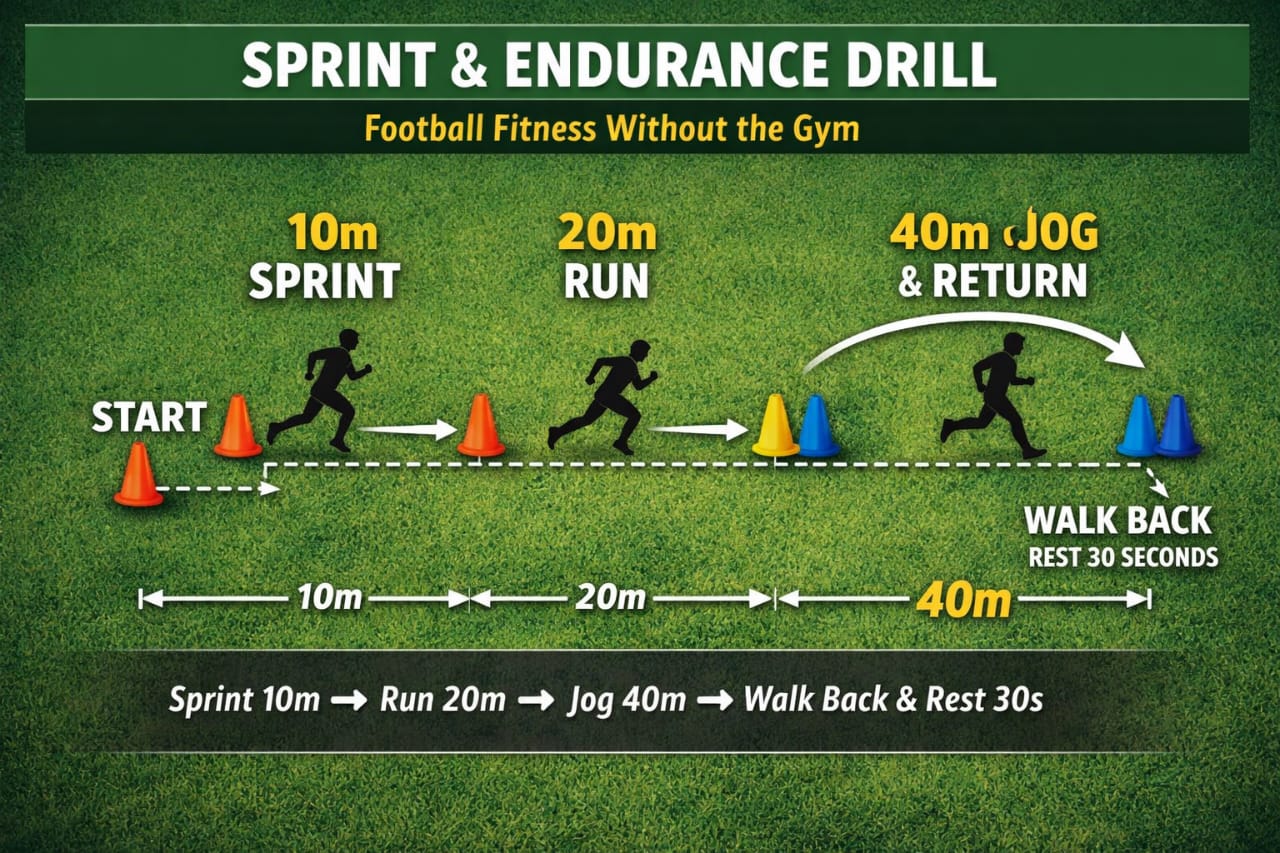
To fully understand how to improve football fitness without the gym, you must train sprinting in a way that reflects real match situations rather than relying on basic running drills. Football is built on explosive actions where players accelerate quickly, stop suddenly, and repeat these movements continuously throughout the game.
This is why repeated sprint training is essential, as it improves both your speed and your ability to recover quickly between high-intensity efforts. Instead of running long distances, you should focus on short, powerful sprints followed by brief recovery periods that mimic match conditions.
A simple but effective method is sprinting at maximum intensity for 10 to 20 seconds, resting briefly, and repeating the cycle multiple times within a session. This type of training develops your ability to maintain performance even as fatigue builds during the game.
Players who train this way become more explosive, more consistent, and more effective in key moments where speed and reaction time make the difference.
Agility is a crucial part of football fitness because the game constantly requires players to change direction quickly while maintaining balance and control under pressure. Unlike straight-line running, agility training prepares your body for unpredictable movements that happen in real match situations.
This includes turning sharply, stopping suddenly, accelerating in different directions, and reacting to opponents or space on the pitch. These movements are essential for both attacking and defending, especially in tight areas where quick reactions are required.

Using simple cone drills or markers, you can create patterns that force you to move in multiple directions at different speeds while staying in control. The focus should always be on movement quality, balance, and quick transitions rather than just speed.
Players who improve their agility become more unpredictable, harder to defend against, and more efficient in their movements, which directly improves their overall performance.
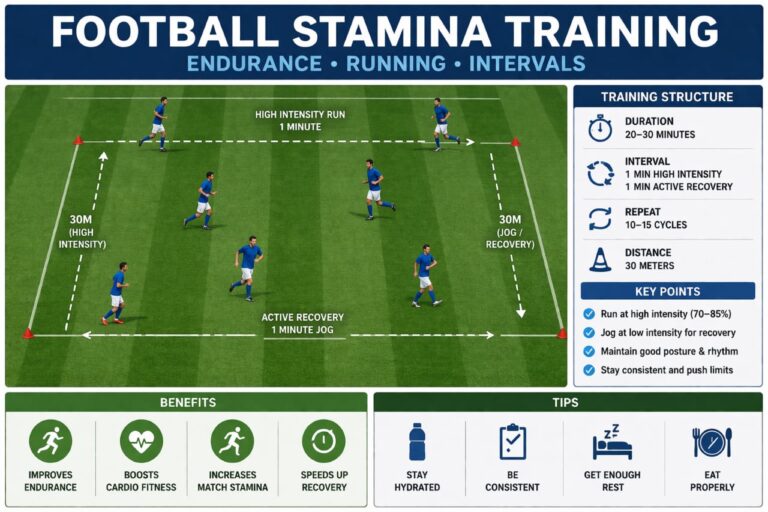
Stamina in football is not about running continuously at a steady pace but about maintaining performance through repeated bursts of activity followed by recovery periods. This is why interval running is one of the most effective ways to build football-specific endurance.
Interval training combines short periods of high-intensity running with lower-intensity recovery phases, which closely reflects the physical demands of a match. This helps your body adapt to the stop-start nature of football.

A simple session might involve sprinting for 15 to 30 seconds followed by jogging or walking before repeating the cycle multiple times. This improves both your cardiovascular endurance and your ability to recover quickly between actions.
Players who train this way can maintain higher intensity levels for longer periods, giving them an advantage during the later stages of matches when others begin to tire.
One of the most effective ways to improve football fitness is by combining physical training with technical actions using the ball, rather than separating the two completely. This ensures your development directly translates into match performance.
For example, you can combine sprinting with passing drills, dribbling patterns, or movement exercises that force you to make decisions while physically fatigued. This simulates real game situations where both physical and mental demands are present.
This approach trains your body and your brain at the same time, improving your ability to perform under pressure and make better decisions during matches. It also increases the efficiency of your training sessions.
Players who adopt this method improve faster because their training becomes more realistic, purposeful, and directly connected to how football is actually played.
To see consistent improvement, you need a structured weekly routine that balances intensity, recovery, and progression rather than training randomly without a clear plan. Structure is what turns effort into results.
You can divide your week into sessions focused on sprinting, agility, and stamina while allowing time for recovery between high-intensity days. Each session should have a clear objective and controlled intensity level.
This type of structure helps your body adapt gradually and reduces the risk of burnout or injury while maintaining steady improvement. Consistency over time is more important than occasional intense sessions.
Players who follow structured routines develop better discipline, improve faster, and perform more consistently during matches.
Improving football fitness is not just about how hard you train but also about how well you recover between sessions, as recovery is where your body adapts and becomes stronger. Without it, progress becomes limited.
Simple habits such as proper hydration, stretching, and quality sleep can significantly improve your performance and allow you to train at a higher level consistently. These factors are often overlooked by many players.
Recovery also reduces fatigue, improves muscle function, and lowers the risk of injuries that can interrupt your progress. This allows you to maintain consistency in your training.
Players who take recovery seriously are able to sustain high performance levels over time and continue improving without setbacks.
Many players fail to improve their fitness because they focus on the wrong type of training or ignore key principles that affect performance.
One common mistake is relying too much on long-distance running, which does not reflect the high-intensity nature of football.
Another mistake is training without intensity. Low-effort sessions do not prepare the body for real match conditions where speed and quick reactions are required.
Some players also ignore recovery, which leads to fatigue and reduces performance over time.
Improvement comes from training smart, maintaining intensity, and allowing the body to recover properly between sessions.
At its core, how to improve football fitness without the gym is about applying the right training methods that reflect real match demands rather than relying on traditional fitness approaches. Everything must connect to the game.
This includes sprinting, agility, stamina, recovery, and decision-making all working together to improve your performance on the pitch. Training each component in isolation is not enough.
Players who understand this approach develop better movement, higher endurance, and stronger consistency during matches, allowing them to perform at a higher level for longer periods.
This complete approach to fitness is what separates serious players from those who struggle to keep up with the demands of the game.