Physical Address
MICKYWORLDNG
Physical Address
MICKYWORLDNG

MICKYWORLDNG IS READER-SUPPORTED. WHEN YOU BUY THROUGH LINKS ON OUR SITE, WE MAY EARN AN AFFILIATE COMMISSION AT NO EXTRA COST TO YOU.
How to play one-two passes in football is one of the most effective ways to break defensive lines, create space, and speed up attacking play. The one-two pass, also known as the wall pass, allows players to bypass opponents using quick combinations, intelligent movement, and precise timing rather than relying only on individual dribbling ability.
At every level of football, from academy development to professional matches, the ability to execute one-two passes consistently can transform how a team attacks. It allows players to move the ball quickly through tight spaces while forcing defenders into difficult decisions. When done correctly, it creates immediate advantages because defenders struggle to track both the ball and the runner at the same time.
However, mastering this technique requires more than just passing the ball and running forward. It depends on understanding movement, angles, timing, and awareness before the action even begins. Without these elements, one-two passes become predictable and easy to defend.
To truly improve, players must break down each part of the movement and understand how they connect together during real match situations.
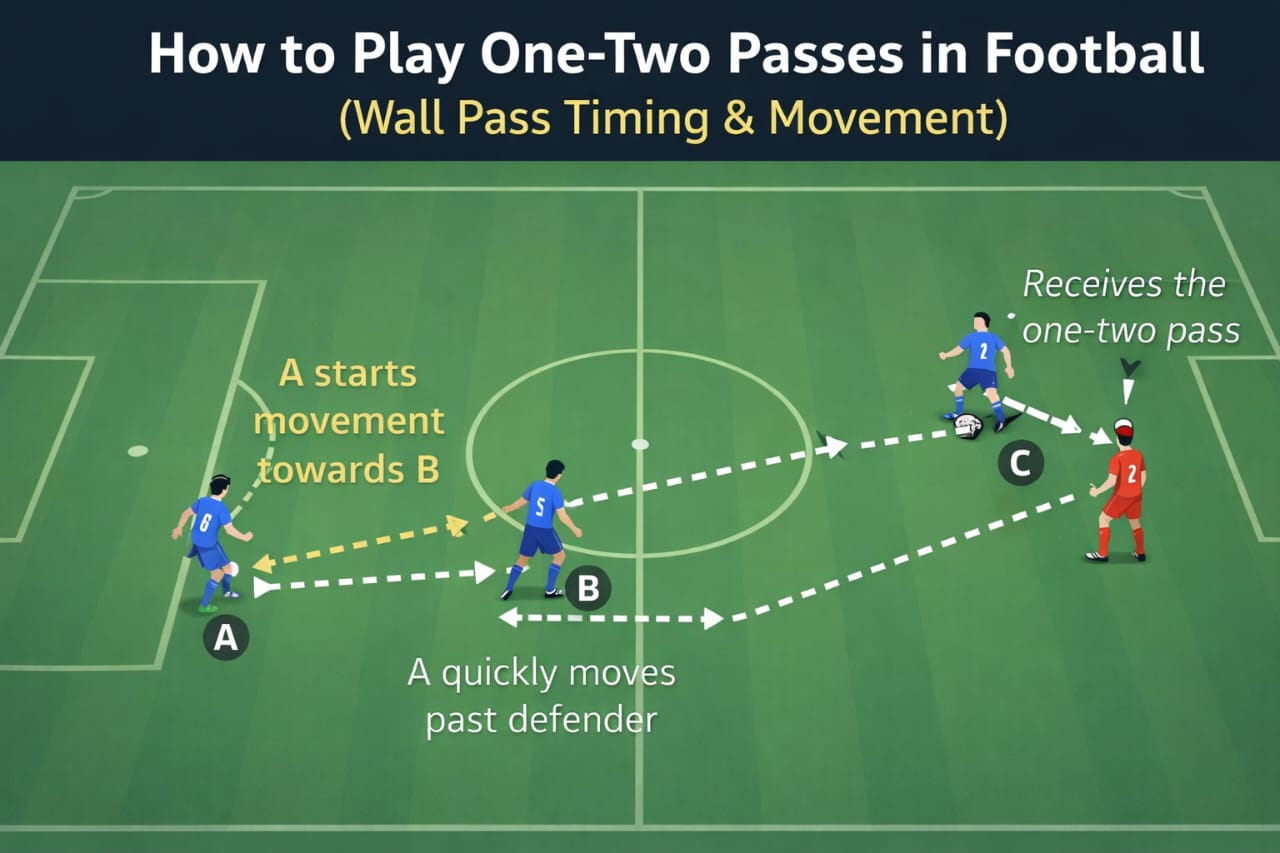
The one-two pass involves two players working together to bypass a defender using a quick combination. Player A starts the action by passing the ball to Player B and immediately making a forward or angled run into space. The success of this first action depends on the quality and timing of the initial pass.
Player B then returns the ball, usually with one touch, into the path of Player A’s run. This return pass must be accurate, well-weighted, and timed perfectly to match the movement of the runner. If the return pass is delayed or misplaced, the entire move breaks down.
This simple interaction becomes much more powerful when executed at speed because it reduces the defender’s reaction time. The faster the combination, the harder it is to defend, especially in tight areas.
In more advanced situations, this pattern evolves into combinations involving additional players, which is closely connected to movements explained in third man runs in football, where timing and support create even more attacking options.
The key is to initiate the run at the exact moment the pass is played, ensuring that the defender is forced to react rather than anticipate. This creates a small window of opportunity that can be exploited immediately.
Equally important is the timing of the return pass. The supporting player must release the ball quickly, often with one touch, to maintain the rhythm of the movement and prevent defenders from recovering their position.
When both players synchronize their actions perfectly, the one-two pass becomes extremely difficult to stop, even against organized defensive structures.
The most important part of the one-two pass is what happens after the initial pass is made. Many players make the mistake of watching their pass instead of moving immediately, which eliminates the effectiveness of the combination.
Explosive movement into space is what creates the advantage. This movement should be sharp, direct, and purposeful, targeting areas where the defender cannot easily follow.
Angles also play a key role here. Instead of running in a straight line, players often benefit from making curved or diagonal runs that create separation and open passing lanes.
This type of intelligent movement is closely linked to concepts explained in how to create space in football, where positioning and timing determine how effectively a player can receive the ball.
The supporting player in a one-two pass must position themselves correctly to execute the return pass efficiently. This means maintaining an open body shape that allows them to see both the ball and the runner at the same time.
Good support angles make it easier to play quick one-touch passes without needing extra adjustments. Players who receive the ball in poor positions often take too many touches, slowing down the entire move.
Body orientation also affects the direction and quality of the return pass. Receiving side-on allows players to guide the ball into space rather than simply returning it straight back.
These small details improve speed and accuracy, making the combination more fluid and harder to defend.

One of the main reasons teams use one-two passes is to break through defensive lines quickly. Instead of trying to dribble past defenders, players can use quick combinations to move around them.
This is especially effective against compact defenses where space is limited. The quick exchange forces defenders to make decisions under pressure, often leading to gaps that can be exploited immediately.
By combining speed, timing, and movement, players can progress the ball into dangerous areas without needing excessive touches.
When executed consistently, one-two passes become a powerful tool for controlling attacking transitions and creating goal-scoring opportunities.
Many players struggle with one-two passes because of simple mistakes that disrupt the flow of the movement. One of the most common issues is standing still after passing the ball, which removes the entire purpose of the combination.
Another mistake is poor timing, either moving too early or too late. Both situations make it easier for defenders to anticipate and intercept the pass.
Inaccurate passing is also a major problem. If either pass lacks precision or correct weight, the move breaks down immediately.
By identifying and correcting these mistakes, players can significantly improve their ability to execute one-two passes effectively in real match situations.
As players improve their understanding of how to play one-two passes in football, the basic version naturally evolves into more advanced variations that are used to break stronger and more organized defensive systems. These variations are not just about speed, but about intelligence, disguise, and coordination between multiple players in tight spaces.
One of the most effective variations is the use of a third player, where the ball is not returned directly to the original passer but instead redirected to another runner. This creates unpredictability because defenders often expect the ball to go back to the first player, leaving space for a different movement to be exploited.
Another variation involves changing the angle of the return pass. Instead of playing the ball straight into the runner’s path, the supporting player can slightly redirect the pass into a new lane, forcing defenders to adjust quickly and often creating more separation.
These advanced patterns increase the difficulty for defenders because they must track multiple movements at once while also reacting to quick passing combinations.
The effectiveness of one-two passes depends heavily on where they are used on the pitch. In deeper areas, they are often used to escape pressure and progress the ball forward without taking unnecessary risks.
In midfield zones, one-two passes help players move through tight spaces where defenders are closely positioned. The quick exchange of passes creates small openings that can be used to advance play or switch the direction of attack.
In the final third, the one-two pass becomes even more dangerous because it can be used to break defensive lines and create goal-scoring opportunities. A well-timed wall pass around the edge of the penalty area can completely eliminate a defender and open a clear path toward goal.
This ability to adapt the same concept across different areas of the pitch is what makes the one-two pass such a valuable tool in modern football.
Understanding when to use one-two passes is what separates good players from intelligent players. but knowing when to use them is what separates good players from intelligent players. Not every situation requires a quick combination, and forcing it can lead to unnecessary turnovers.
The best moments to use a one-two pass are when a defender is tight and focused on the ball carrier. This creates an opportunity to exploit the space behind them with a quick run and return pass.
Players must also assess the positioning of teammates and opponents before attempting the combination. If the passing lane is blocked or the supporting player is not ready, it is often better to choose a safer option.
Over time, this decision-making becomes instinctive, allowing players to recognize opportunities quickly and execute the right action without hesitation.
Speed is what makes the one-two pass so effective. The quicker the ball moves, the less time defenders have to react and adjust their position. This is why one-touch passing is often used during these combinations.
One-touch play removes unnecessary delays and keeps the rhythm of the attack flowing. It also forces players to think ahead, as they must decide what to do before receiving the ball.
However, speed should not come at the expense of accuracy. Players must balance quick execution with control to ensure that passes remain precise and effective.
When speed and accuracy are combined, the one-two pass becomes extremely difficult to defend, especially in high-pressure situations.

Improving one-two passing requires structured training that focuses on timing, movement, and coordination. Simple drills can be highly effective when performed with the right intensity and attention to detail.
One effective drill is the diamond passing pattern, where players move the ball around a shape while incorporating one-two combinations. This helps develop rhythm, awareness, and quick decision-making.
Another useful exercise is small-sided games that encourage quick passing and movement. These scenarios replicate match conditions, forcing players to use one-two passes under pressure.
Combination drills involving three or more players also help improve understanding of movement patterns, especially when introducing variations such as third-man runs and angled support.
Successful one-two passes depend on communication between players. This communication can be verbal, such as calling for the ball, or non-verbal, such as eye contact and body language.
Players who understand each other’s movements are able to execute combinations more smoothly and with greater confidence. This understanding often develops through consistent training and playing together regularly.
Anticipation is another key factor. Supporting players must recognize the intention of the ball carrier and position themselves accordingly before the pass is made.
This level of coordination makes the one-two pass more natural and reduces hesitation during key moments in the game.
Even at higher levels, players can struggle with one-two passes if certain details are ignored. One common mistake is overcomplicating the move, trying to force combinations when simpler options are available.
Another issue is poor spacing between players. If players are too close or too far apart, the timing and effectiveness of the pass are affected significantly.
Defenders can also read predictable patterns if players repeat the same movements without variation. This is why adding creativity and variation is important at advanced levels.
By refining these details, players can maintain the effectiveness of one-two passes even against strong defensive opposition.
One-two passes are not isolated actions—they are part of a larger tactical structure that includes movement, positioning, and teamwork. When integrated properly, they enhance the overall attacking style of a team.
Teams that use quick combinations effectively often control the tempo of the game and create more scoring opportunities. This is because they are able to move the ball efficiently while maintaining structure.
The relationship between passing and movement is what makes these combinations so powerful. Each action creates the next, forming a continuous flow of play, especially when combined with concepts explained in short vs long passing in football, where control, timing, and execution determine how effective each pass becomes.
This connection between players is what ultimately allows teams to break down defenses and maintain attacking pressure.
Mastering how to play one-two passes in football gives players a powerful advantage because it allows them to combine technical ability with tactical intelligence. It transforms simple passing into a dynamic tool for creating space and breaking defensive lines.
By focusing on timing, movement, support angles, and decision-making, players can consistently execute effective combinations in different areas of the pitch.
The key is repetition and understanding. The more players practice these movements in realistic scenarios, the more natural they become during matches.
Once these habits are developed, one-two passes become instinctive, allowing players to play faster, think quicker, and contribute more effectively by creating space, breaking defensive lines, and controlling the tempo of the game.