Physical Address
MICKYWORLDNG
Physical Address
MICKYWORLDNG

MICKYWORLDNG IS READER-SUPPORTED. WHEN YOU BUY THROUGH LINKS ON OUR SITE, WE MAY EARN AN AFFILIATE COMMISSION AT NO EXTRA COST TO YOU.
How to shield the ball in football is one of the most important skills for maintaining possession under pressure, allowing players to stay in control even when opponents are close and aggressive. It is not just about strength, but about intelligence, positioning, and timing. Players who understand this skill can slow the game down, protect possession, and make better decisions in tight situations. This ability becomes a major advantage as the level of competition increases and space becomes more limited.
Players who understand how to use their body effectively can protect the ball, slow the game down, and create better options for their teammates. This ability becomes even more important in tight spaces where quick decisions are required. Instead of losing possession immediately, they gain time to assess their surroundings and choose the best option. This is what allows teams to maintain control and build attacks more effectively.
At higher levels, defenders are faster and more physical, which means poor shielding will lead to immediate loss of possession. This is why top players rely on technique rather than force to stay in control. Strength alone is not enough when facing intelligent defenders who understand positioning and timing. Proper technique ensures consistency even under intense pressure.
To master shielding, players must focus on key details such as body shape, balance, arm usage, and awareness of pressure. These elements work together to create a complete skill rather than isolated actions. Ignoring any of these factors reduces effectiveness and increases risk. Mastery comes from combining all these details into one controlled movement.
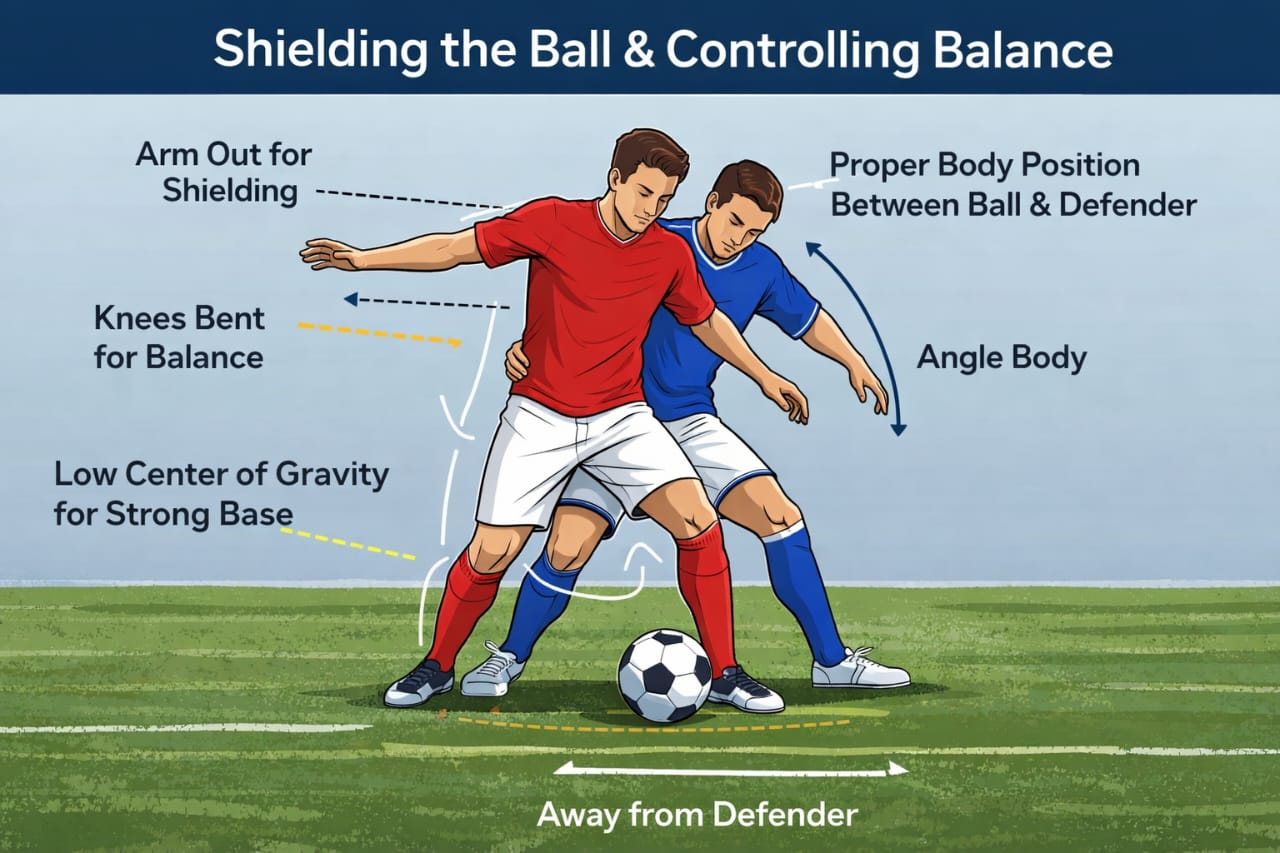
The foundation of shielding starts with body position. Players must place their body between the opponent and the ball, making it difficult for the defender to reach through. This positioning creates a natural barrier that protects possession without needing excessive force. It also allows the player to stay in control of the situation instead of reacting late.
A side-on stance is the most effective way to do this because it allows you to protect the ball while still seeing the pitch and your next option. This improves both awareness and decision-making during the game. Players who face square often limit their options and become easier to press. The correct stance gives flexibility and control.
This positioning also helps you react quickly, whether you need to pass, turn, or carry the ball forward. Being prepared for multiple actions makes shielding more effective in real match situations. It reduces hesitation and allows smoother transitions between actions. This is what makes the skill practical during games.
Good body position reduces risk and gives you control over the situation instead of reacting late. Players who consistently apply this principle lose possession less often. Over time, this becomes a habit that improves overall performance. It is one of the key fundamentals of ball retention.
Balance is what allows shielding to work under pressure. Without it, even a small push from a defender can lead to losing the ball. Players who maintain balance are able to stay composed and control the situation. This is especially important in physical contests where stability determines success.
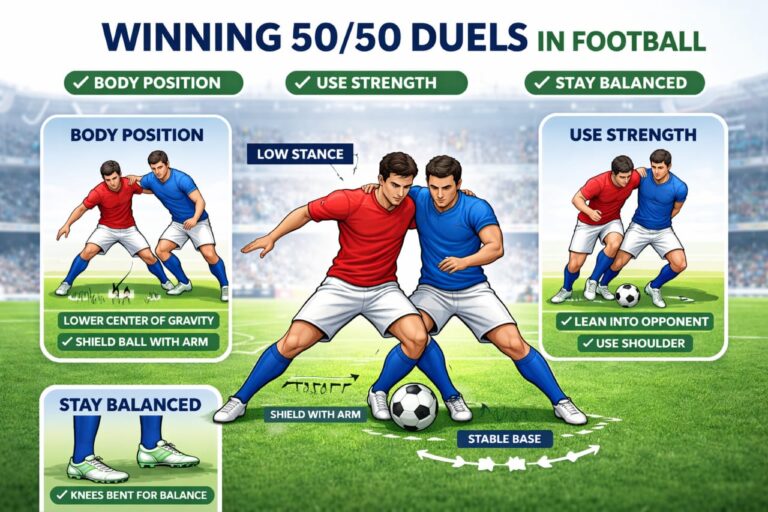
Players should lower their center of gravity by bending their knees and spreading their feet slightly to create a strong base. This position makes it harder for opponents to disrupt their balance. It also improves reaction speed when adjusting to pressure. A stable base is essential for consistent performance.
This makes it easier to absorb contact and stay stable while protecting the ball. Instead of being pushed off the ball, the player remains in control and maintains possession. This ability is crucial in midfield and attacking areas. It allows players to operate effectively in tight spaces.
A strong base also allows you to adjust quickly when the defender changes direction or applies more pressure. This flexibility improves defensive resistance and overall control. Players who lack balance often struggle in these situations. Developing this habit leads to better results over time.
Arm usage plays a key role in shielding, but it must be controlled and intelligent to avoid fouls. The arms are not used to push, but to maintain space and awareness. This helps players stay in control without breaking the rules. Proper use of the arms improves both balance and positioning.
By extending your arm slightly, you can feel where the defender is and maintain a safe distance from them. This gives you valuable information about their movement and pressure. It allows you to react early instead of being surprised. Awareness is a key part of effective shielding.
This gives you better awareness and helps you react before the defender makes a move. Early reactions reduce mistakes and improve control under pressure. Players who react late often lose possession. Timing and awareness are essential in these situations.
Using your arms correctly adds another layer of control without relying on unnecessary physical force. It makes shielding more efficient and less risky. Over time, this becomes a natural part of the player’s movement. It improves both confidence and consistency.
The position of the ball in relation to your body is just as important as your overall stance when shielding. If the ball is exposed, it becomes easy for defenders to win it. Keeping it protected is the main priority. This requires awareness and proper positioning.
You should always keep the ball on the foot furthest from the defender, increasing the distance they must cover to reach it. This small adjustment makes a big difference in protecting possession. It reduces the chances of interception. It also improves control under pressure.
This makes tackles more difficult and gives you more time to make your next decision. Time is one of the most valuable advantages in football. Players who create time are able to perform better. This is why shielding is so important.
Over time, this habit becomes automatic and significantly improves ball protection. Players no longer need to think about it consciously. It becomes part of their natural game. This is when real improvement happens.
Shielding is most effective when used under real match pressure, where decisions must be made quickly and accurately. Training alone is not enough if it is not applied in games. Players must learn to handle pressure in real situations. This is where the skill becomes valuable.
Instead of rushing, players should stay calm, use their body to protect the ball, and wait for support or space to appear. This patience prevents unnecessary mistakes. It allows the team to maintain structure. It also improves overall control of the game.
This is closely related to playing under pressure in midfield, where composure and positioning determine success. Players who master this skill perform better consistently. They are able to handle difficult situations with confidence.
Players who stay composed under pressure are able to control the game and reduce unnecessary mistakes. This makes them more reliable and effective. Teams benefit greatly from players who can maintain possession. It improves overall performance.
Shielding begins before contact, and this is where the first touch becomes important in setting up the situation. A poor first touch creates immediate pressure. A good one creates control and space. This is why it is so important.
A good first touch positions the ball correctly and allows you to prepare your body for incoming pressure. This preparation reduces mistakes and improves decision-making. It also gives you more time. This is a key advantage.
This creates time and space, making it easier to protect the ball effectively. Players who control the ball well rarely panic. They remain calm under pressure. This improves overall performance.
This connection between control and protection is explained further in first touch in football, where preparation shapes every action. Players who master this improve quickly. It is a key development area.
Many players struggle with shielding because of small mistakes that affect their control and balance. These mistakes often go unnoticed. However, they have a big impact on performance. Fixing them leads to quick improvement.
Standing upright, poor body positioning, and lack of awareness make it easier for defenders to win the ball. These issues reduce control and increase risk. Players must correct these habits early. This improves consistency.
Another common mistake is relying too much on strength instead of using technique and positioning. Strength alone is not reliable. Technique provides consistency. This is what players must focus on.
Fixing these details quickly improves how effective you are at protecting the ball during games. Small changes lead to big improvements. This is how players develop over time.

Shielding the ball is not the final action—it is often the preparation for the next movement. Once a player has successfully protected the ball, the next step is knowing when and how to turn away from pressure. This decision must be made quickly, based on the position of the defender and the available space around you.
Good players do not rush the turn. They wait for the right moment when the defender commits or shifts their weight in the wrong direction. This creates a small window of opportunity that can be used to escape pressure effectively.
Turning requires balance, awareness, and control. If done correctly, it allows the player to move from a defensive situation into an attacking one within seconds. This transition is what separates average players from more advanced ones.
When mastered, turning after shielding becomes a powerful tool for progressing play and breaking defensive pressure.

Timing is one of the most important elements in shielding and escaping pressure. It is not enough to protect the ball—you must also recognize the exact moment to act. Moving too early allows the defender to recover, while moving too late increases pressure.
Players who understand timing are able to control the tempo of the situation. They decide when to hold the ball and when to release it. This gives them an advantage over defenders who rely purely on reaction.
This timing is often developed through experience and repetition. The more situations a player faces, the better they become at recognizing patterns and reacting correctly.
In high-level football, this ability to control timing is what allows players to operate effectively under constant pressure.
Shielding is used differently depending on where you are on the pitch. In defensive areas, the focus is on safety and maintaining possession without taking unnecessary risks. Players must protect the ball and make simple decisions.
In midfield, shielding becomes more dynamic. Players often use it to control tempo, wait for support, or create passing angles. This is where awareness and scanning become extremely important.
In attacking areas, shielding is often used to hold up play, bring teammates into the game, or create space for a shot or pass. Forwards use this skill to maintain pressure on the defense.
Understanding how shielding changes based on position helps players apply the skill more effectively during matches.
Shielding is closely linked to decision-making. Holding the ball too long can slow the game down unnecessarily, while releasing it too early can waste an opportunity. The key is knowing what the situation requires.
Players must constantly assess their options while shielding—whether to pass, turn, or continue protecting the ball. This requires awareness of teammates, opponents, and space.
Good decision-making turns shielding into a productive action rather than just a defensive one. It allows players to maintain control while still progressing play.
This balance between control and progression is what makes the skill effective at higher levels.
In many situations, defenders will apply strong physical pressure to win the ball. Players must be prepared to handle this without losing balance or control. This is where strength and technique work together.
Instead of resisting force directly, good players use their body position to absorb and redirect pressure. This makes it easier to stay in control without overexerting themselves.
Maintaining composure under physical contact is essential. Players who panic often lose the ball, while those who stay calm can control the situation.
This ability becomes even more important in competitive matches where physical intensity is high.
Improving shielding requires focused training that simulates real match situations. Simple drills can be very effective when performed with the right intensity and awareness.
Players can practice shielding by working in pairs, applying controlled pressure while maintaining possession. This helps develop balance, positioning, and confidence.
Small-sided games are also useful because they create constant pressure and force players to make quick decisions. These situations replicate real match conditions.
Consistency in training is what turns shielding into a reliable skill during competitive games.
Many players lose possession when attempting to turn because they do not read the situation correctly. Turning into pressure instead of away from it is one of the most common mistakes.
Another issue is poor balance during the turn, which makes it easier for defenders to win the ball. Players must stay low and controlled when changing direction.
Rushing the movement also reduces effectiveness. Without proper timing, even a technically correct turn can fail under pressure.
Correcting these errors improves both confidence and effectiveness in tight situations.
Confidence plays a major role in how well a player can shield the ball. Players who are unsure tend to rush decisions or avoid contact, which leads to losing possession.
Confidence is built through repetition and understanding. The more a player practices shielding in realistic conditions, the more comfortable they become.
Over time, shielding becomes automatic. Players no longer hesitate—they react naturally based on the situation.
This confidence allows them to stay calm under pressure and make better decisions consistently.
At its core, how to shield the ball in football is about control, awareness, and intelligent use of the body. It is not just a physical skill, but a tactical one that influences how a player performs under pressure.
Players who master shielding are able to protect possession, control the tempo of the game, and create opportunities for themselves and their teammates. This makes them more effective in every position on the pitch.
The key is consistency in applying the fundamentals—body position, balance, timing, and awareness. These elements must work together in every situation.
When these habits are developed, shielding becomes a natural part of the player’s game, allowing them to stay in control under pressure and consistently protect possession at any level of the game.