Physical Address
MICKYWORLDNG
Physical Address
MICKYWORLDNG


MICKYWORLDNG IS READER-SUPPORTED. WHEN YOU BUY THROUGH LINKS ON OUR SITE, WE MAY EARN AN AFFILIATE COMMISSION AT NO EXTRA COST TO YOU.
Playing under pressure in midfield is one of the most demanding aspects of modern football. In central areas of the pitch, space is limited, time is restricted, and decisions must be made instantly. Unlike wide areas where players can escape along the touchline, midfielders operate in zones surrounded by opponents from multiple directions.
This means every action—before receiving, during control, and after releasing the ball—must be executed with precision. The difference between losing possession and progressing play often comes down to details that happen within seconds.
At the highest level, midfielders are not judged purely on technical ability. They are judged on how they behave under pressure—how quickly they scan, how intelligently they position themselves, and how efficiently they make decisions.
In tight spaces, football becomes less about physical speed and more about cognitive speed. The player who processes information faster gains control of the situation.
This is why playing under pressure is not a single action. It is a chain of connected actions that begin before the ball arrives.
In modern football, midfield has become the primary zone where pressing battles are decided. Teams that can operate under pressure in this area gain control of possession and dictate the rhythm of the game, while those that struggle are forced into reactive play.
Midfield is the most complex zone on the pitch because it is constantly active. Every phase of play passes through it.
Players in this area are surrounded not just by opponents, but by multiple lines of pressure. A midfielder might receive the ball with one opponent pressing from behind, another closing from the side, and a third blocking the forward passing lane.
This creates what can be described as “multi-directional pressure.” Unlike defenders who often see the whole field in front of them, midfielders must constantly deal with pressure they cannot see.
Because of this, the margin for error is extremely small. A heavy touch, a delayed pass, or a poor body angle immediately results in loss of possession.
In these situations, time is compressed. Players do not have the luxury to think after receiving—they must think before.
This is closely related to how players operate when playing between the lines in football, where awareness of space and pressure determines whether a player can turn or must release the ball.
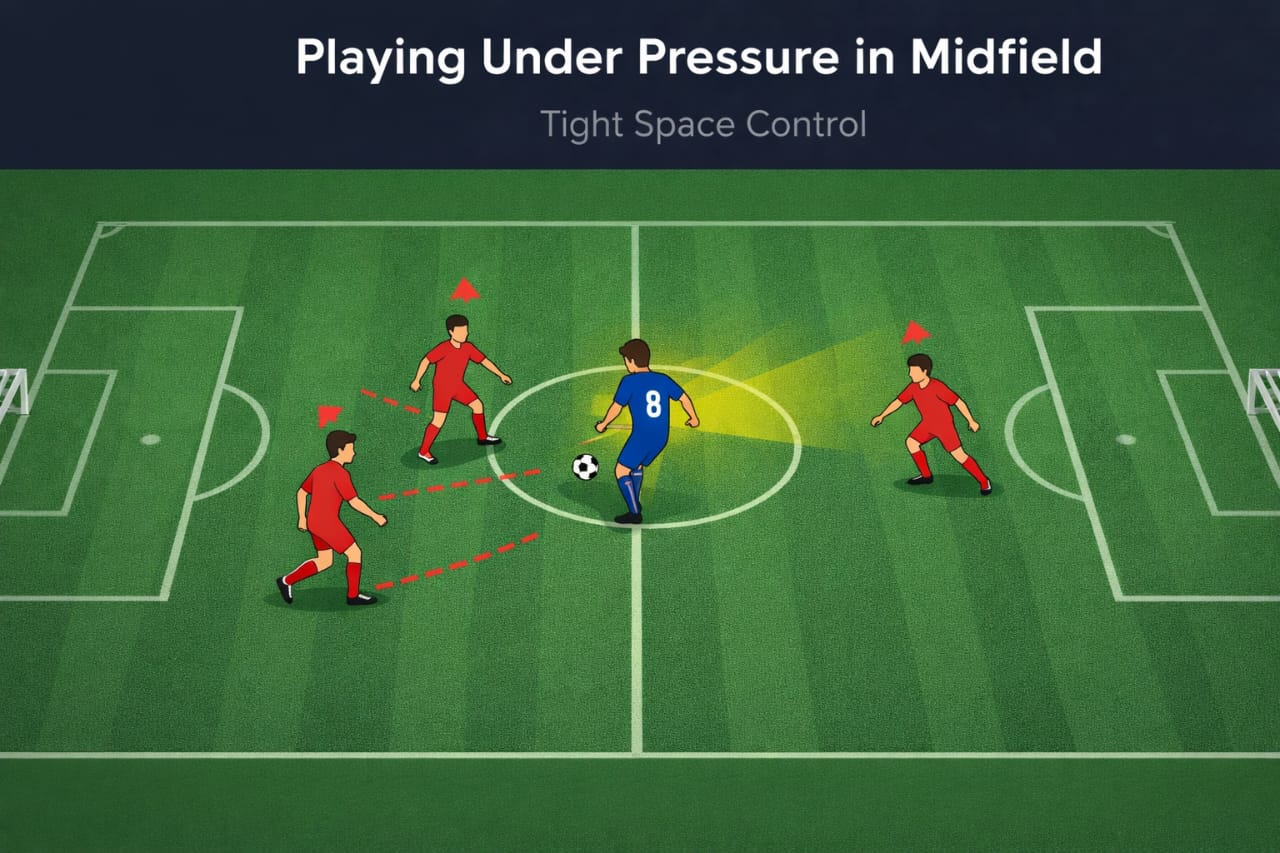
Scanning is often described as looking over the shoulder, but at the highest level, it is much more than that. It is a continuous process of information gathering.
Elite midfielders do not scan once—they scan repeatedly. Before the ball is played, as it travels, and just before receiving, they update their understanding of the situation.
This allows them to build a mental picture of the pitch. They know where teammates are positioned, where defenders are closing from, and where space exists.
There are typically two key scanning moments. The first scan gives a general overview of the surroundings. The second scan, just before receiving, focuses on immediate pressure.
This second scan is critical because it determines the next action. It tells the player whether they have time to turn, whether they must play one-touch, or whether they need to protect the ball.
Without scanning, the player reacts late. With scanning, the player acts early.
This difference is what separates players who survive under pressure from those who control it.
However, awareness alone is not enough if the player is not positioned correctly to act on that information.
Body orientation is one of the most overlooked aspects of midfield play, yet it is one of the most important.
The way a player positions their body before receiving determines how many options they will have after receiving.
The ideal position is the half-turn. This allows the player to see both the source of the pass and the space ahead.
Receiving in a closed position limits options. The player must take additional touches to adjust, which gives defenders time to press.
But receiving in an open position changes everything. It allows immediate progression, either through a forward pass or by carrying the ball into space.
Body orientation also influences the defender’s behavior. A player who is open invites less aggressive pressure because they can escape quickly.
This is not just technical—it is tactical. It changes how the entire situation unfolds.

In midfield, the first touch is not simply about controlling the ball. It is a decision.
At elite level, this decision is made before contact with the ball, allowing the player to execute their next action without hesitation.
The direction of the first touch determines whether the player escapes pressure or runs into it.
Top midfielders use their first touch to manipulate space. They move the ball away from defenders, often into areas that were identified during scanning.
This creates what can be called “micro-space”—small pockets of room that allow the next action to happen.
A poor first touch removes these options. It reduces time and invites immediate pressure.
This is why the first touch must be connected to both awareness and body orientation. It is not an isolated skill.
It is part of a sequence.
This same principle is essential in understanding how teams beat a high press in football, where the first action often determines whether pressure is broken or sustained.
Decision-making in midfield is about speed, clarity, and simplicity.
Players do not have time to evaluate multiple complex options. They must identify the best available option immediately.
This is why elite midfielders simplify the game. They do not force difficult actions when simple ones are available.
Sometimes the correct decision is to play one-touch and move. Other times, it is to turn into space and carry the ball forward.
The key is choosing the right action at the right time.
This ability comes from experience and repetition. The more situations a player faces, the faster they recognize patterns.
Over time, decision-making becomes automatic.
One of the most advanced concepts in midfield play is viewing pressure as information rather than a threat.
When a defender presses, they reveal something. They show where space is.
If pressure comes from behind, space is likely in front. If pressure comes from one side, space exists on the opposite side.
Elite midfielders use this information to their advantage. They do not panic—they interpret.
This is what allows them to stay calm in tight situations.
Instead of reacting to pressure, they use it to guide their next action.
This shift in perspective is what separates players who struggle under pressure from those who control it.
At first glance, top midfielders seem to have more time than everyone else. In reality, they do not.
The difference is that they prepare earlier.
They scan before receiving. They position their body before the ball arrives. They decide before they touch the ball.
This sequence gives them an advantage over opponents who are reacting instead of anticipating.
As a result, they appear calm even in the most intense situations.
They are not faster physically—they are faster mentally.
And in midfield, that is what defines control.
Individual ability allows a midfielder to survive pressure, but combinations allow them to escape it consistently. In tight central areas, holding onto the ball for too long increases risk. The most effective solution is often to move the ball faster than the opposition can react.
This is where short passing combinations become essential. Quick one-touch or two-touch exchanges shift the point of pressure and force defenders to constantly adjust their positioning.
As the ball moves, the defensive structure stretches. Small gaps begin to appear between players, and these gaps are what midfielders look to exploit.
The most effective pattern in these situations is the use of a third player. Instead of passing directly into pressure, the ball is played to a nearby teammate who quickly redirects it to another player positioned in space.
This movement breaks the immediate pressure and allows the receiving player to face forward.
The speed of this sequence is critical, as even a small delay allows defenders to recover their positions.
These patterns are closely connected to third man runs in football, where coordinated timing and positioning create solutions that individual actions alone cannot achieve.
One of the most difficult actions in midfield is turning under pressure. This requires precise timing, awareness, and control.
Not every situation allows a player to turn. The decision depends on the angle of pressure and the amount of space available.
If the defender is tight and positioned correctly, attempting to turn can lead to immediate loss of possession. In these moments, the safer option is to release the ball quickly.
However, when there is even a small gap, elite midfielders recognize the opportunity to turn.
This is where body orientation and first touch become critical. By receiving on the half-turn and directing the first touch into space, the player can bypass the defender in a single movement.
Once the turn is completed, the situation changes completely. The midfielder now has time, space, and forward options.

In tight midfield areas, space rarely exists naturally. It must be created.
One of the most effective ways to create space is through movement before receiving. By adjusting their position slightly, players can move away from direct pressure and create a passing lane.
Another method is using teammates to manipulate defenders. When one player moves, defenders follow. This creates space for another player to receive.
This constant movement ensures that the ball carrier always has options.
It also makes pressing more difficult. Defenders are forced to track multiple movements, which increases the chance of mistakes.
Space in midfield is not given—it is created through intelligent positioning and timing.
Midfielders are responsible for controlling the tempo of the game. This becomes even more important under pressure.
Tempo is not just about playing fast. It is about knowing when to speed up and when to slow down.
In some situations, quick passing is needed to escape pressure. In others, holding the ball and allowing teammates to reposition is the better option.
Elite midfielders understand this balance. They do not rush unnecessarily, but they also do not delay when action is required.
This control over tempo allows teams to maintain possession and dictate the rhythm of the game.
It also reduces mistakes, as players are not forced into rushed decisions.
A midfielder’s ability to play under pressure depends heavily on the support around them.
Teammates must provide clear passing options at different angles and distances. Without this support, even the most skilled player will struggle.
Good teams create triangles and diamonds around the ball. This ensures that there is always a safe option available.
These structures ensure constant passing options while forcing defenders to cover multiple angles at once, increasing the difficulty of pressing effectively.
These shapes also make it easier to play through pressure, as the ball can be moved quickly between players.
Distance is important here. If players are too close, they attract the same pressure. If they are too far, the pass becomes difficult.
The balance between spacing and support is what allows midfielders to operate effectively under pressure.
This is closely linked to first touch in football, where control and quick execution determine whether possession is maintained or lost.
Even experienced players make mistakes under pressure, but most of these errors come from the same issues.
One of the most common problems is lack of scanning. Without awareness, players are caught off guard and lose the ball quickly.
Poor body orientation is another issue. Receiving in a closed position limits options and slows down decision-making.
Holding onto the ball for too long also increases risk. In tight spaces, delays allow defenders to close down and reduce available options.
Another mistake is forcing passes into crowded areas. Instead of playing safely and maintaining possession, players attempt risky passes that lead to turnovers.
Correcting these mistakes requires repetition and understanding. Players must develop habits that allow them to operate effectively under pressure.
In modern football, the ability to play under pressure in midfield is what separates elite players from the rest.
Teams rely on these players to maintain control, progress the ball, and connect different phases of play.
When a midfielder can operate effectively in tight spaces, the entire team benefits. Possession is maintained, attacks are built more efficiently, and pressure is turned into opportunity.
On the other hand, when midfielders struggle under pressure, the team becomes unstable. Possession is lost more frequently, and defensive transitions become more common.
This is why playing under pressure in midfield is not just an individual skill—it is a central part of how teams function.
Those who master it do not just survive in tight spaces — they turn them into moments of control and progression.