Physical Address
MICKYWORLDNG
Physical Address
MICKYWORLDNG


MICKYWORLDNG IS READER-SUPPORTED. WHEN YOU BUY THROUGH LINKS ON OUR SITE, WE MAY EARN AN AFFILIATE COMMISSION AT NO EXTRA COST TO YOU.
Understanding how to beat a high press in football is not simply about avoiding mistakes under pressure. It is about turning one of the opponent’s biggest strengths into a weakness, because when a team presses high, they commit players forward, reduce space around the ball, and attempt to force errors close to goal, but in doing so they inevitably leave space elsewhere on the pitch.
The core idea is simple: pressure creates space, but the difficulty lies in accessing that space under time pressure, with limited passing options, and often with your back to play, which is why beating a high press is less about speed and more about structure, positioning, and decision-making.
At elite level, teams do not panic against a press because they prepare for it in advance, and in modern football, where high pressing has become one of the most widely used defensive strategies, this preparation is essential for maintaining control under pressure.
Teams at every level now use pressing to control territory, force mistakes, and dominate possession, which makes the ability to beat the press not just useful but essential for any team that wants to play out from the back effectively.
Every player understands their role within the structure, knowing where the next pass is before receiving the ball, while every movement is designed to manipulate the opponent’s shape and create solutions under pressure.
A high press works by compressing space around the ball while blocking central passing lanes, often forcing play wide where the pressing team can trap the ball carrier using the touchline as an additional defender.
This means the build-up team must constantly identify where the free player is, because if no free player exists the structure is wrong, and if the structure is correct the press can always be broken.
This is where organization becomes critical, as teams rely on clear build-up shapes to create numerical superiority in the first phase, and without this structure the press becomes overwhelming and predictable mistakes begin to appear.
To beat a high press consistently, it is necessary to understand why it is effective, because pressing is not random running but coordinated movement designed specifically to remove passing options and limit decision-making time.
The first line of pressure, usually forwards, works to block passing lanes between center-backs and midfielders, using curved runs rather than straight ones to force the ball into controlled areas.
Behind them, midfielders step forward aggressively to mark potential receivers, creating a chain reaction where each pass becomes progressively riskier and more difficult to execute.
What makes this system dangerous is not only the physical pressure but also the psychological effect it creates, as players begin to rush, first touches become heavier, and decisions shift from proactive to reactive.
This is why composure becomes a tactical tool, because teams that remain calm under pressure maintain their structure, while those that panic lose organization and become easier to control.
Breaking the press is therefore not about escaping one opponent, but about disrupting the entire pressing system and creating a moment where control shifts.
One of the most effective strategies in beating a high press is to invite it deliberately, as elite teams do not avoid pressure but instead draw opponents forward to create space elsewhere.
This process begins with controlled circulation across the back line, where center-backs move the ball side to side, encouraging opposition forwards to step higher and commit to the press.
As this happens, the structure of the pressing team begins to stretch, increasing distances between players and creating small but important gaps within the system.
These gaps are the key to breaking the press, but they exist only for a brief moment, which means recognizing and exploiting them requires precise timing and awareness.
If the ball is played too early, the press remains compact and effective, while if it is delayed too long, the ball carrier becomes trapped under pressure.
The success of baiting the press therefore depends on identifying the exact moment when pressure turns into vulnerability and acting immediately.
Body orientation plays a major role in this process, as players must receive already facing forward, allowing them to accelerate play instantly, which connects closely with principles explained in positional play in football.
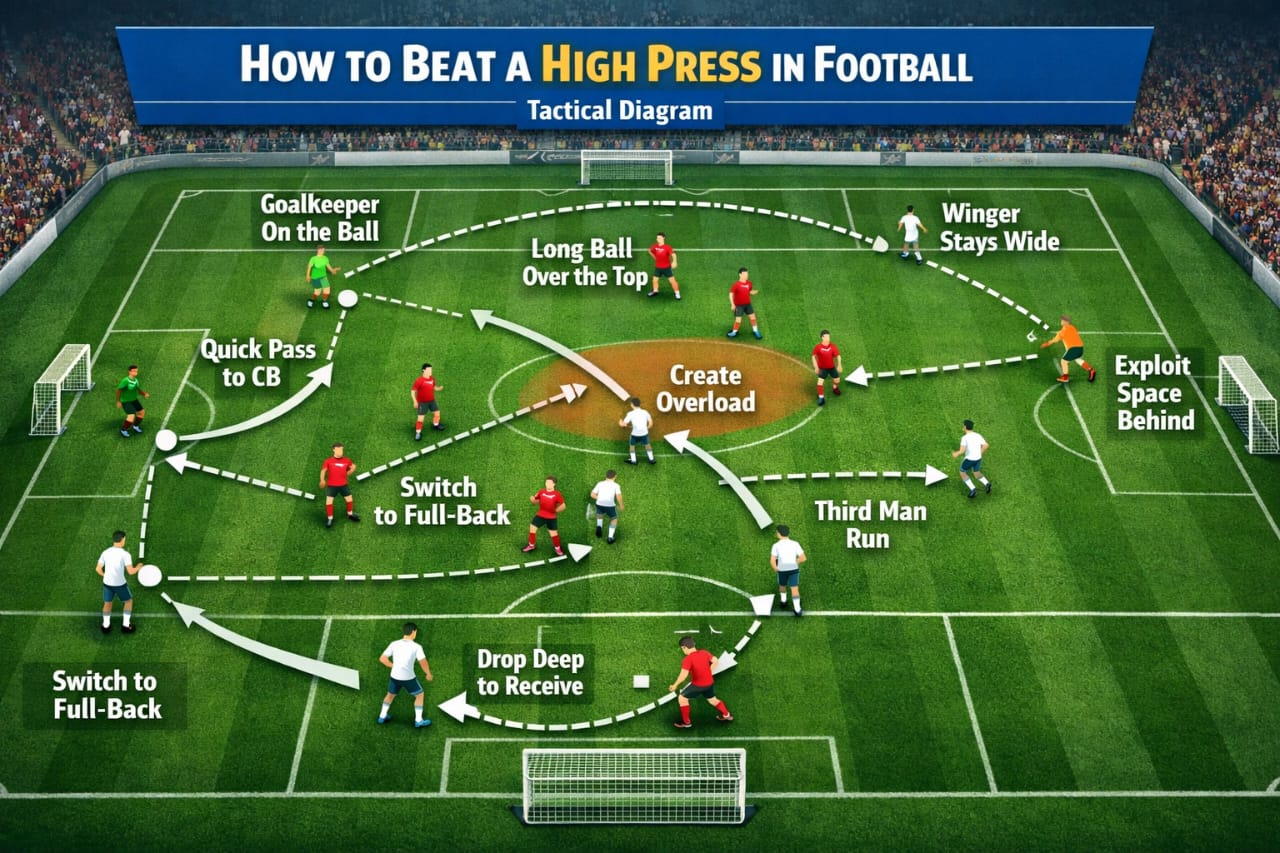
Structure is the backbone of press resistance, because without it players become isolated and easy to mark, while with it the team gains control over space and passing options.
Most teams use variations of a 3-2 or 2-3 build-up shape when facing a high press, ensuring there is always an extra player compared to the opponent’s first line of pressure.
For example, if two forwards press two center-backs, the goalkeeper becomes the spare player, while if three players press, a midfielder may drop to create a back three and restore balance.
This constant adjustment ensures numerical superiority at the point of pressure and forces the pressing team to either commit more players or leave space elsewhere on the pitch.
Spacing within this structure is equally important, as players must remain close enough for safe passing but far enough apart to stretch the opponent and create gaps.
Angles of support also determine success, since straight passing lanes are predictable and easy to intercept, while diagonal angles create multiple options and force defenders to reposition constantly.
Once the first line is broken, the next objective is to attack the space between midfield and defense, where concepts from playing between the lines in football become essential.
The modern goalkeeper plays a crucial role in breaking the press, as they are no longer just shot-stoppers but key contributors in build-up play.
By positioning correctly, goalkeepers create an additional passing option, turning numerical disadvantages into advantages and forcing the opposition to make difficult decisions.
If the opposition chooses to press the goalkeeper, they leave another player free, while if they hold their shape, the goalkeeper gains time and space to dictate play.
Beyond simple passing, goalkeepers are responsible for switching the point of attack, quickly moving the ball from one side to the other to expose weaknesses in the pressing structure.
They must also recognize when to go long, understanding when short build-up becomes too risky and when direct progression is the better option.
This decision-making under pressure is what separates effective build-up teams from those that struggle to escape pressing systems.
The positioning of the goalkeeper influences the entire structure, as small adjustments in distance can create better angles and increase circulation speed, often determining whether the team escapes pressure cleanly.
Passing alone does not break a press, because without intelligent off-ball movement even the best structure becomes static and predictable.
Players must constantly adjust their positions to create passing lanes, whether by dropping deeper, moving wider, or rotating positions with teammates to disrupt marking systems.
One of the most effective movements is dropping into blind spots, which are areas just outside the defender’s line of sight and therefore difficult to track consistently.
Timing is critical in these movements, as moving too early allows defenders to adjust, while moving too late removes the passing option entirely.
Rotations between players create further disruption, forcing defenders to decide whether to follow or hold their positions, both of which introduce uncertainty.
This uncertainty is what ultimately breaks pressing structures, although movement and structure must still be supported by calm decision-making under pressure.
Patience is one of the most overlooked aspects of beating a high press, as teams often rush to escape pressure and end up making mistakes.
However, pressing cannot be sustained indefinitely, because it requires energy, coordination, and constant movement, which naturally leads to small gaps appearing over time.
Patient teams recognize this and wait for the right moment, circulating the ball, maintaining structure, and avoiding unnecessary risks until opportunities emerge.
When those opportunities appear, they act quickly and decisively, combining patience with sudden acceleration to exploit weaknesses.
This balance between patience and speed defines successful build-up, as playing too slowly allows the press to recover, while playing too quickly increases the risk of errors.
Mastering this rhythm is what allows teams to consistently break high pressing systems and maintain control.
Against aggressive man-oriented pressing systems, direct passing options are often removed, leaving players tightly marked and seemingly without solutions.
In these situations, the third-man principle becomes one of the most effective ways to bypass pressure without confronting it directly.
The ball is played to a nearby teammate, who immediately redirects it to a third player positioned outside the pressing line, allowing the team to break pressure in a single sequence.
This relies on timing and awareness, as the pressing team shifts toward the ball and creates blind spots where the third player can move into space.
Once the ball reaches this player, the dynamic changes completely, as the press is broken and the player can face forward with time and space.
This pattern connects closely with third man runs in football, where coordinated movement creates advantages that static positioning cannot achieve.

Beating a high press does not always mean playing through it, as the most effective teams understand when to use short build-up and when to go long.
Short build-up is effective when numerical advantages exist, allowing teams to circulate the ball, create angles, and progress through structured play.
However, when the opponent presses aggressively with tight marking, short options can disappear quickly, making forced passes risky and often leading to turnovers.
In these moments, long distribution becomes the better solution, as it bypasses multiple players and moves the game into less congested areas.
The objective is controlled progression rather than random clearance, with long passes directed into specific zones where teammates are ready to compete for second balls.
Winning the second ball is essential, as it determines whether possession is maintained or lost, and allows teams to launch immediate attacks.
The key is not choosing one method over the other, but recognizing which solution the situation demands.

Breaking the press is only the first step, because the real advantage comes immediately after escaping pressure when the opponent’s structure is at its weakest.
During a high press, defensive lines stretch and midfield support becomes disconnected, creating large spaces between midfield and defense once the first line is bypassed.
Players must act quickly in these moments, as receiving the ball in these areas allows teams to turn and attack before the opponent can recover.
This phase is closely linked to playing between the lines in football, where positioning and timing are critical.
Speed of decision-making determines success, as delays allow defenders to recover, while quick actions lead to clear attacking opportunities.
Forward runs must also be coordinated, with wide players stretching the pitch and central players attacking space at the right moment.
Beating a high press requires consistent training under realistic conditions, as theoretical understanding alone is not enough.
Positional rondos are highly effective, forcing players to operate in tight spaces while improving awareness, quick passing, and composure under pressure.
Structured build-up drills simulate pressing scenarios, helping teams practice creating angles, supporting the ball carrier, and progressing through different zones.
Adding constraints such as limited touches or reduced space increases difficulty and improves decision-making speed.
Players must also learn to recognize cues, understanding when to play short, when to go long, and when to reset based on the situation.
This adaptability allows teams to respond to different pressing styles rather than relying on a single approach.
Even well-structured teams can struggle against high pressing systems when key details are ignored or executed poorly.
Poor spacing is one of the most common issues, as players who are too close become easy to mark, while those too far apart disconnect the structure.
Lack of movement further compounds the problem, leaving passing lanes closed and isolating the ball carrier under pressure.
Forcing passes under pressure is another major mistake, as risky decisions often lead to turnovers in dangerous areas.
Communication is also essential, with players needing to constantly share information about pressure, space, and available options.
Correcting these mistakes requires repetition, clarity, and attention to detail in both training and matches.
Teams that master how to beat a high press in football gain more than defensive stability, as they create attacking opportunities directly from moments of pressure.
By escaping the press, they force opponents into defensive transitions with disorganized structures and exposed spaces.
This shifts the balance of the game and forces the pressing team to reconsider their approach, reducing the effectiveness of their strategy over time.
Ultimately, beating the press is not just about avoiding danger but about creating advantage and controlling the game through intelligent structure and decision-making.
Teams that understand this do not simply survive pressure—they use it as a pathway to dominate the match.