Physical Address
MICKYWORLDNG
Physical Address
MICKYWORLDNG

MICKYWORLDNG IS READER-SUPPORTED. WHEN YOU BUY THROUGH LINKS ON OUR SITE, WE MAY EARN AN AFFILIATE COMMISSION AT NO EXTRA COST TO YOU.
How to stay onside in football is one of the most important skills for any attacking player because it directly affects your ability to receive the ball and create goal-scoring opportunities. Many players struggle with offside not because they lack speed or technique, but because they misunderstand timing, positioning, and awareness of the defensive line.
At higher levels of football, defenders are organized, disciplined, and constantly working together to catch attackers offside. This means learning how to stay onside in football is not just about reacting, but about reading the game before the pass is even played and understanding defensive behavior.
Players who consistently stay onside are not guessing. They are observing the defensive line, recognizing patterns, and adjusting their movement based on what they see. This is why intelligent attackers always appear one step ahead, even without touching the ball frequently.
The key to improving lies in understanding that offside decisions are made at the exact moment the ball is played, not when you receive it. This small but critical detail changes everything about how attackers should move, position themselves, and time their runs in real match situations.
To consistently master how to stay onside in football, players must combine movement, awareness, and decision-making into one action that happens quickly under pressure.
To improve how to stay onside in football, you must understand how the offside rule works in real match situations, not just memorize the definition. A player is offside if any part of their body that can score is beyond the second-to-last defender at the exact moment the ball is played.
This means positioning alone is not enough. What matters is your position at the exact second your teammate makes contact with the ball, which requires sharp focus and awareness of both the passer and the defensive line.
One important detail many players ignore is that you can still be onside even if you are ahead of the ball, as long as you are not beyond the second-to-last defender. This is why understanding spacing and defensive structure is essential.
When players fully understand this rule, they stop hesitating and start moving with confidence. This confidence allows them to attack space more aggressively without constantly worrying about being caught offside.
In modern football, where defensive lines are higher and more coordinated, understanding how to stay onside in football becomes even more important because small mistakes are punished immediately.
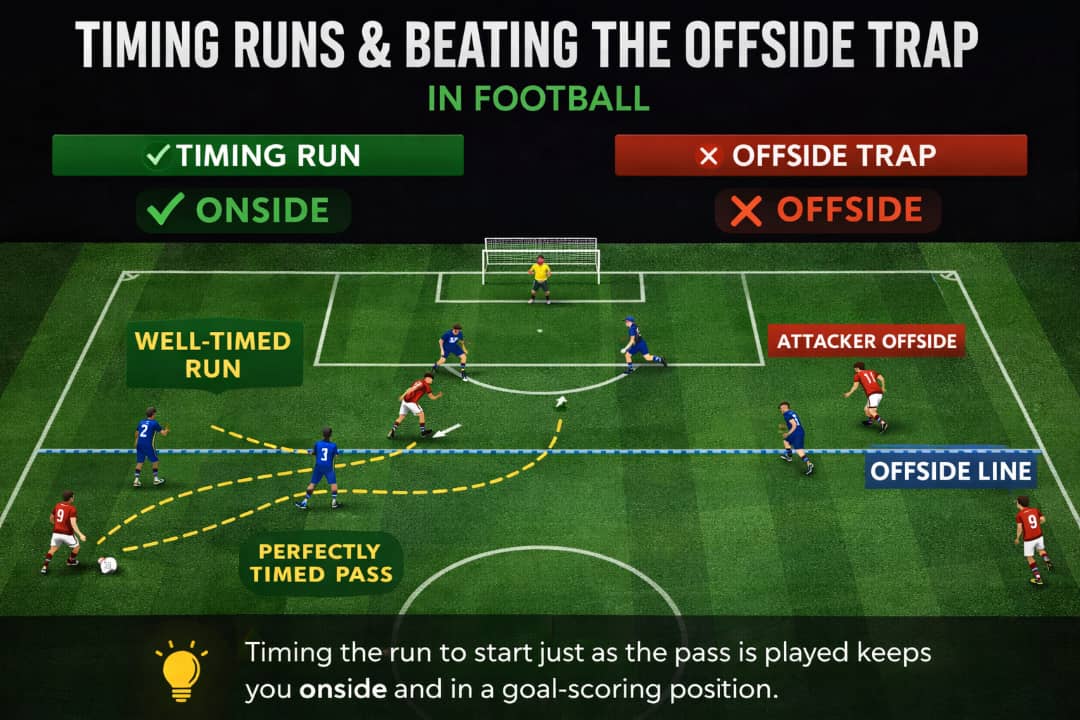
The most important part of how to stay onside in football is timing your run correctly. Good timing allows you to move into space at the exact moment the pass is played, giving you a clear advantage over defenders without breaking the offside rule.
Many attackers make the mistake of running too early because they focus only on the space ahead of them. However, experienced players delay their movement slightly, staying level with the defensive line before accelerating at the right moment.
This delay creates separation because defenders are often stepping forward to push the line up. By waiting and then accelerating, attackers can break through the defensive line without being caught offside.
It is not just about speed, but about coordination between the passer and the runner. The best attackers understand the body language of their teammates and use it as a trigger to start their run.
This movement principle is closely connected to concepts explained in creating space in football, where timing and positioning determine how effective a player becomes without the ball.
Another critical factor in how to stay onside in football is awareness of the defensive line. Players must constantly scan their surroundings to understand where defenders are positioned before making any forward movement.
Scanning helps players adjust their position in real time, ensuring they remain level with the last defender while preparing to attack space behind them. Without this awareness, even well-timed runs can still result in offside decisions.
Top attackers do not look at the ball only. They split their attention between the passer, the defensive line, and the available space, allowing them to make better decisions in tight situations.
A practical habit is to check the defensive line multiple times before making a run. This builds a mental map of the pitch and helps players move with precision rather than guesswork.
This ability is directly linked to concepts explained in football scanning awareness, where vision and preparation improve decision-making and overall performance.
Curved runs are one of the most effective ways to master how to stay onside in football while still attacking space behind defenders. Instead of running straight toward goal, players move diagonally or in an arc to remain onside longer.
This movement allows attackers to stay behind the defensive line while building momentum. As soon as the pass is played, they can accelerate into space without crossing the offside line too early.
Curved runs are especially effective against teams that use an offside trap. When defenders step forward together, straight runs are easier to catch, but curved runs make it harder to judge timing accurately.
By adjusting the angle of your run, you force defenders to make decisions under pressure, which increases the chance of mistakes and creates more attacking opportunities.
Mastering curved movement is a key step in improving how to stay onside in football, especially when playing against organized defensive systems.

Imagine a midfielder receives the ball with time and looks up to play a forward pass. As an attacker trying to apply how to stay onside in football, your first instinct might be to sprint immediately into space.
However, experienced players do the opposite. They stay level with the last defender, watching both the ball and the defensive line while waiting for the exact moment the pass is about to be played.
As the midfielder swings their leg to pass, the attacker explodes into space. This perfect timing allows them to stay onside while gaining a step advantage over the defender.
The difference between being onside and offside in this situation often comes down to a fraction of a second, which is why patience and awareness are more important than speed alone.
These small but important details are what separate average attackers from players who consistently stay onside and create dangerous goal-scoring opportunities.
Learning how to stay onside in football becomes even more important when facing teams that use the offside trap as a defensive strategy. The offside trap works when defenders move forward together at the right moment, forcing attackers into an offside position before they can receive the ball.
To beat this, attackers must avoid predictable movement. Straight runs are easier to read and time for defenders, which is why intelligent movement is required to break through organized defensive lines consistently.
The key is to stay patient and avoid committing too early. Instead of reacting to space alone, players must react to the timing of the pass, the body shape of the passer, and the movement of the defensive line.
By combining awareness and timing, attackers can turn the offside trap into an advantage, using the defenders’ forward movement against them to create space behind.

Another important part of mastering how to stay onside in football is understanding how your movement connects with your teammates. Football is not played individually, and successful attacking runs depend heavily on coordination between the passer and the runner.
Attackers must read cues from teammates, such as body position, head movement, and passing angles. These signals indicate when a pass is likely to be played and help attackers time their movement more accurately.
Midfielders and defenders also play a role in this coordination. A well-timed pass is just as important as a well-timed run, and when both are synchronized, it becomes extremely difficult for defenders to stop the attack.
This connection between players is what creates fluid attacking play, where movement and passing work together rather than separately.
Double movement is a powerful technique that helps attackers improve how to stay onside in football while creating separation from defenders. Instead of making a single run, players first move in one direction before quickly changing direction to attack space.
For example, an attacker may step toward the ball to draw the defender forward, then quickly spin and run in behind. This movement forces the defender to react and often disrupts their timing when trying to play the offside trap.
This type of movement creates hesitation in defenders, which is enough to gain a small advantage. In football, even a small advantage can lead to a clear goal-scoring opportunity.
Double movements require good timing and awareness, but when executed correctly, they make it much easier to stay onside while still being aggressive in attack.
Many players struggle with how to stay onside in football because of simple but repeated mistakes that limit their effectiveness. One of the most common issues is running too early, which immediately puts the player in an offside position.
Another mistake is focusing only on the ball and ignoring the defensive line. Without awareness of defenders, it becomes impossible to judge the correct moment to move forward.
Some players also fail to adjust their run based on the situation, using the same movement pattern every time. This predictability makes it easier for defenders to anticipate and catch them offside.
Fixing these mistakes requires discipline and repetition. Players must train themselves to delay runs, scan regularly, and adapt their movement based on the position of both the ball and defenders.
At a higher level, mastering how to stay onside in football involves understanding advanced movement patterns such as late runs and third-man combinations. These movements are harder to track and often catch defenders off guard.
A late run involves starting deeper and arriving into space after the initial movement has already happened. This makes it easier to stay onside because the player is not positioned on the defensive line too early.
Third-man runs involve a sequence where the ball is passed between two players before being played into the path of a third runner. This type of movement is unpredictable and makes it difficult for defenders to maintain their line effectively.
This concept is closely related to third man runs in football, where coordinated movement creates space and breaks defensive structure.
One of the simplest but most effective coaching tips for improving how to stay onside in football is this: “Do not run when you see space—run when the pass is about to be played.”
This mindset changes how players approach attacking movement. Instead of reacting too early, they become more patient and controlled, which improves both timing and decision-making.
Coaches often emphasize that awareness is more important than speed. A slower player with perfect timing will be more effective than a fast player who runs too early and gets caught offside repeatedly.
This understanding helps players become more intelligent in their movement, making better decisions and contributing more effectively in attacking situations.
Mastering how to stay onside in football is not just about avoiding mistakes—it is about becoming a more intelligent and effective attacking player. It combines awareness, timing, positioning, and decision-making into one complete skill.
Players who understand these principles are able to move more efficiently, receive the ball in better positions, and create more goal-scoring opportunities for themselves and their teammates.
With consistent practice and attention to detail, staying onside becomes natural. The game slows down, decisions become easier, and attacking movement becomes more effective.
In modern football, where small margins decide games, mastering how to stay onside in football can be the difference between a missed opportunity and a decisive goal.