Physical Address
MICKYWORLDNG
Physical Address
MICKYWORLDNG

MICKYWORLDNG IS READER-SUPPORTED. WHEN YOU BUY THROUGH LINKS ON OUR SITE, WE MAY EARN AN AFFILIATE COMMISSION AT NO EXTRA COST TO YOU.
How to defend 1v1 in football is one of the most important defensive skills every player must master because these situations decide games more than any other moment on the pitch. Whether you are a defender, midfielder, or even a forward tracking back, your ability to control and win individual duels directly affects your team’s stability and success.
At higher levels, 1v1 defending is not about diving into tackles or relying on strength alone. It is about intelligence, positioning, patience, and understanding how to control the attacker before they become dangerous. The best defenders often win the situation before making any tackle at all.
This is why modern coaching focuses on structure and control rather than aggression. Defenders are taught to delay, guide, and reduce risk instead of committing too early and getting beaten easily.
To truly improve, players must understand that 1v1 defending is a process, not a single action. Every movement—from the first step toward the attacker to the final challenge—matters.
The biggest mistake many players make when learning how to defend 1v1 in football is thinking the goal is to win the ball immediately. In reality, the first objective is to control the situation.
Control means reducing the attacker’s options, slowing them down, and forcing them into predictable movements. When this is done correctly, winning the ball becomes much easier and less risky.
This approach is why elite defenders focus on positioning and timing instead of rushing into tackles. By staying patient, they force attackers to make mistakes rather than creating space for them.
Understanding this concept is essential because it shifts defending from reactive to proactive, allowing players to dictate what happens next.
Modern defending is often built around four key actions: shut down, slow down, sit down, and show down. These principles guide how defenders approach every 1v1 situation.
Shut down: Close the distance quickly when the ball is traveling, reducing the attacker’s time and space before they can turn or accelerate.
Slow down: As you get closer, reduce your speed and prepare your body to react. This prevents the attacker from using your momentum against you.
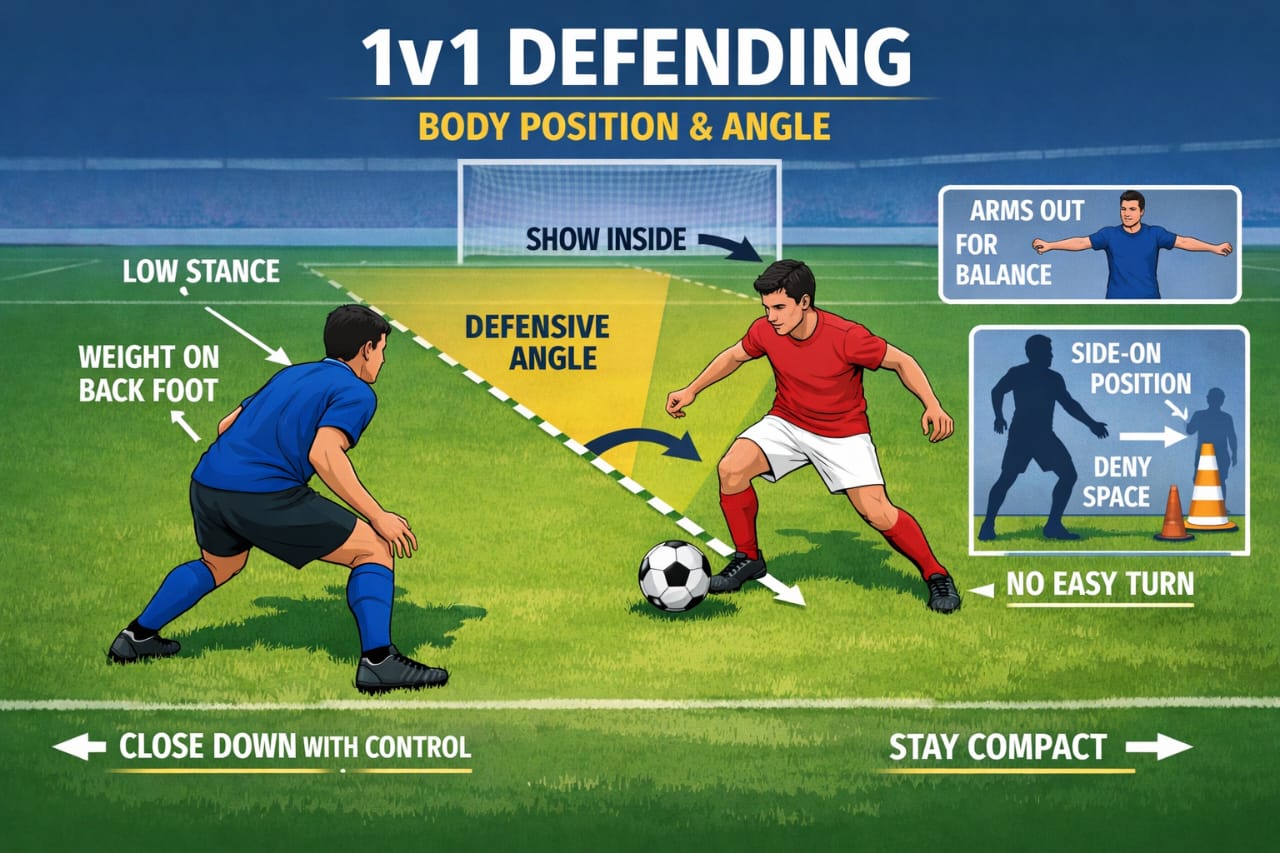
Sit down: Adopt a balanced stance with a low center of gravity, ready to move in any direction without losing control.
Show down: Force the attacker toward a less dangerous area, usually wide or toward support from teammates.
These principles are not separate actions—they flow together in one continuous movement that defines effective defending.
Defenders should adopt a slightly side-on stance, usually at an angle, rather than facing the attacker square. This allows quicker changes of direction and better balance when reacting to movements.
Knees should be bent, weight should be on the balls of the feet, and the body should remain relaxed but ready. This position helps defenders stay agile and responsive instead of stiff and slow.
Good body shape also allows defenders to influence the attacker’s direction, guiding them away from dangerous areas without needing to tackle immediately.
Defending is not just about stopping the attacker—it is about controlling where they go. Angles play a huge role in this process.
By approaching at a slight angle instead of straight on, defenders can block one side of the attacker’s path. This forces the attacker into a predictable direction.
Most defenders aim to guide attackers toward the sideline or into areas where teammates can help. This reduces risk and increases the chances of regaining possession.
This concept is closely linked to positional play in football, where positioning and spacing determine how players control space and movement.
One of the hardest parts of 1v1 defending is managing the distance between you and the attacker. Too close, and you risk getting beaten easily. Too far, and you give the attacker time and space.
The ideal distance is close enough to apply pressure but far enough to react to sudden movements. This balance allows defenders to stay in control without overcommitting.
Good defenders constantly adjust this distance based on the attacker’s speed, skill level, and body position. This adjustment happens naturally with experience.
Distance control is what separates disciplined defenders from reckless ones who dive in too early.
One of the most important lessons in how to defend 1v1 in football is learning patience. Many players lose defensive duels because they try to win the ball too quickly.
By staying patient, defenders force attackers to make decisions under pressure. This often leads to mistakes, heavy touches, or predictable movements.
Patience also allows teammates time to recover and provide support, turning a difficult situation into a manageable one.
This idea is explained further in 1v1 situations in football, where control and timing define success.
Defending becomes much easier when you can anticipate what the attacker is going to do. This comes from observing small details like body shape, speed, and touch.
For example, a heavy touch often signals an opportunity to step in and win the ball. A closed body shape may indicate the attacker will move in a specific direction.
By recognizing these cues early, defenders can react faster and make better decisions without relying on guesswork.
This ability develops over time and is one of the key traits that separates elite defenders from average players.
Timing is everything in 1v1 defending. Tackling at the wrong moment can make the situation worse, while waiting for the right moment can make it easier to win the ball.
Defenders should look for clear triggers before attempting a tackle, such as a poor touch, loss of balance, or limited options for the attacker.
If these triggers are not present, it is often better to delay and maintain control rather than forcing a risky challenge.
This balance between patience and aggression is what defines smart defending at every level of the game.

Defending 1v1 situations in football becomes much easier when you understand that you do not need to win the ball immediately. One of the smartest defensive actions is forcing the attacker into areas where they are less dangerous.
This usually means guiding them toward the sideline, onto their weaker foot, or into zones where teammates can provide support. By doing this, you reduce the number of attacking options available.
Defenders achieve this by adjusting their body angle and positioning slightly to block central or dangerous paths. This creates a natural direction that the attacker is pushed into.
When done correctly, the attacker feels pressured without being tackled, often leading to mistakes or predictable movements.

Not all attackers are the same, which means defenders must adapt their approach depending on the situation. Understanding the opponent is a key part of effective 1v1 defending.
Against fast players, the focus should be on maintaining distance and avoiding getting too tight too early. Speed can punish poor positioning quickly.
Against skillful dribblers, patience becomes even more important. Instead of reacting to every movement, defenders should stay balanced and wait for a clear mistake.
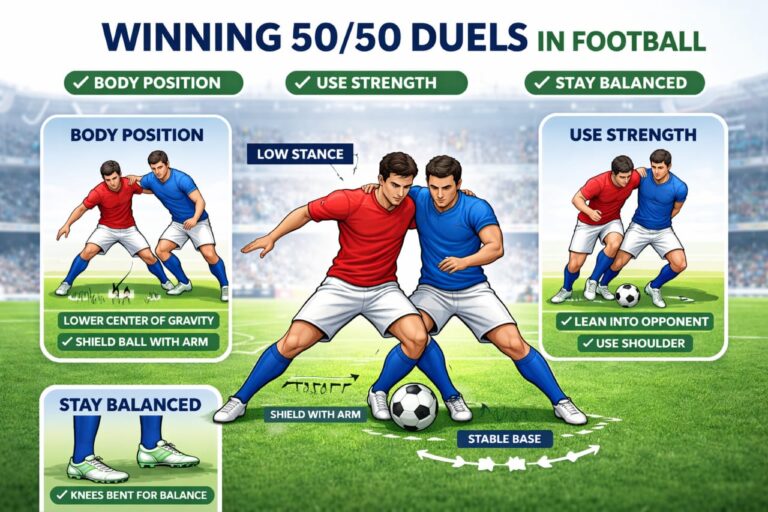
Against physically strong players, body positioning and leverage are key. Staying between the attacker and the goal is more important than trying to win the ball immediately.
Many 1v1 situations happen during transitions, when the team is not fully organized. These moments are often the most dangerous because attackers have space and momentum.
In these situations, the priority is to delay the attacker rather than win the ball instantly. Slowing down the attack allows teammates to recover and rebuild defensive shape.
Good defenders recognize these moments early and adjust their approach, focusing more on control than aggression.
This is closely connected to how to read the game in football, where anticipation helps players react faster and make better defensive decisions.
Defending 1v1 situations changes depending on where you are on the pitch. Inside the penalty box, the risk is much higher, and mistakes are often punished immediately.
Defenders must be more cautious in these areas, avoiding unnecessary tackles that could lead to penalties. Staying on your feet and maintaining control is the priority.
Outside the box, defenders can be slightly more aggressive because the consequences are less severe. However, control and positioning still remain essential.
Understanding this difference helps defenders make smarter decisions based on context rather than reacting the same way in every situation.
Improving how to defend 1v1 in football requires consistent practice with realistic scenarios. Training drills should focus on movement, reaction, and decision-making.
One effective drill is direct 1v1 duels where the defender must close down space and control the attacker without diving into tackles. This builds confidence and discipline.
Another useful method is channel defending, where attackers are forced into specific zones. This helps defenders practice guiding and controlling direction.
Small-sided games also improve 1v1 defending because they create repeated situations under pressure, allowing players to develop awareness and timing naturally.
Even good players make mistakes in 1v1 situations, often due to small errors that can be corrected with awareness and practice.
One common mistake is diving into tackles too early, which allows attackers to easily change direction and bypass the defender.
Another mistake is poor body position, such as standing flat-footed or square, which reduces the ability to react quickly.
Players also struggle when they fail to manage distance properly, either giving too much space or getting too close too soon.
Recognizing these mistakes is the first step toward improving consistency in defensive performance.
At its core, how to defend 1v1 in football is about control, patience, and intelligent positioning rather than aggression or physical strength.
The best defenders understand that winning the duel is not always about tackling—it is about limiting options, forcing mistakes, and staying disciplined throughout the situation.
By combining body position, angles, timing, and awareness, players can consistently handle 1v1 situations with confidence.