Physical Address
MICKYWORLDNG
Physical Address
MICKYWORLDNG

MICKYWORLDNG IS READER-SUPPORTED. WHEN YOU BUY THROUGH LINKS ON OUR SITE, WE MAY EARN AN AFFILIATE COMMISSION AT NO EXTRA COST TO YOU.
How to mark an opponent in football is one of the most important defensive skills every player must understand, yet it is often misunderstood as simply following a player or standing close to them. In reality, marking is about control, awareness, and positioning, allowing defenders to influence the game even before the opponent receives the ball. The best defenders do not just react; they anticipate, adjust, and limit options before danger develops.
In modern football, learning how to mark an opponent in football requires more than basic man-to-man tracking. The game has evolved into a system where players must constantly read situations, combine different marking approaches, and adapt to movement, speed, and tactical structure. This is why understanding tight marking and zonal marking is essential for building a complete defensive foundation.

Tight marking is a key part of learning how to mark an opponent in football because it focuses on directly limiting an opponent’s ability to receive and use the ball effectively. However, tight marking is not just about staying close—it is about maintaining the correct distance, body position, and awareness to control the situation without being easily beaten.
When applying tight marking, defenders must position themselves goal-side while also staying slightly angled to keep both the ball and the opponent in view. This body orientation allows quick reactions whether the attacker checks toward the ball or makes a run in behind. The distance between defender and attacker should constantly adjust depending on the situation, becoming tighter as the ball gets closer and more controlled when the immediate threat is lower.
This concept becomes even more important in 1v1 situations in football, where tight marking determines whether a defender can stop an attacker or gets beaten. Small details such as timing, balance, and patience often decide the outcome, making tight marking a skill that requires both physical ability and tactical intelligence.
Another critical element of tight marking is anticipation. Defenders must read the opponent’s body language, movement patterns, and the passer’s intention. By doing this, they can intercept passes, block passing lanes, or apply pressure at the right moment. This transforms marking from a reactive action into a proactive one, which is essential in modern football.
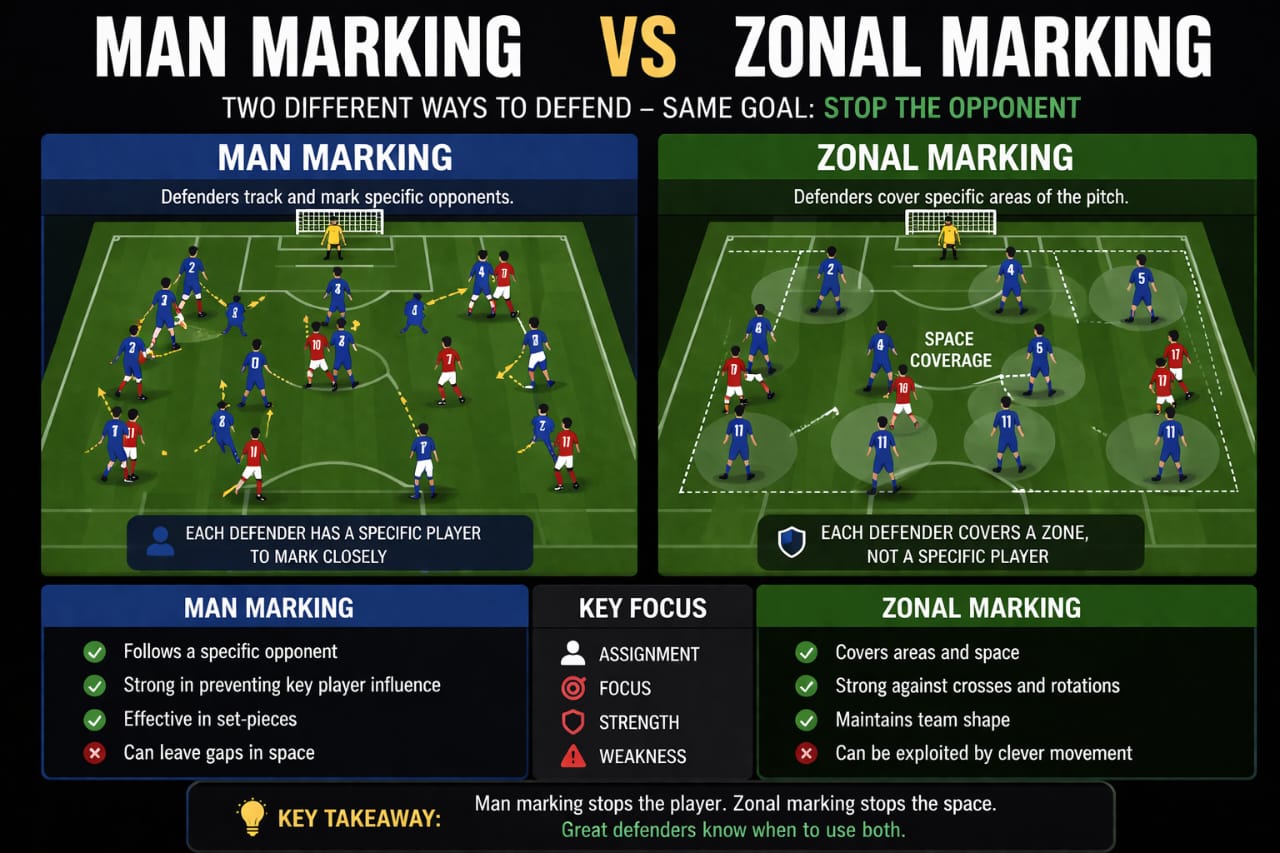
Zonal marking offers a different perspective on how to mark an opponent in football by focusing on controlling space rather than following a specific player. Instead of tracking one opponent everywhere, defenders are responsible for protecting a particular area and reacting to any attacker who enters that zone.
This approach requires strong positional discipline and constant awareness because players must adjust their position relative to the ball and their teammates. Zonal marking is closely connected to principles seen in positional play in football, where maintaining structure and controlling space is key to overall team performance.
The main strength of zonal marking is that it keeps the defensive shape organized and compact. Players are less likely to be dragged out of position, which reduces gaps and makes it harder for opponents to find space. This is particularly effective against teams that rely on movement and quick passing combinations to break defensive lines.
However, zonal marking demands excellent communication and scanning. Defenders must constantly check their surroundings, track runners entering their zone, and coordinate with teammates to avoid leaving spaces open. Without this awareness, zonal systems can quickly break down.

To fully understand how to mark an opponent in football, it is important to recognize the key differences between tight marking and zonal marking. Tight marking focuses on the individual opponent, requiring close attention, physical presence, and constant engagement. Zonal marking, on the other hand, focuses on space, requiring discipline, positioning, and teamwork.
In tight marking, defenders are directly involved in duels, making it effective against dangerous players who need to be neutralized. However, it can also create problems if players are pulled out of position, leaving gaps in the defensive structure.
In zonal marking, defenders prioritize shape and organization, allowing the team to remain compact and balanced. While this reduces individual duels, it requires trust in the system and strong coordination between players to be effective.
Modern football combines both approaches, creating hybrid systems where players switch between tight marking and zonal marking depending on the situation. This flexibility is what allows teams to defend effectively against different styles of play.
These decisions become even more critical during transitions, where defensive structure can quickly collapse. In such moments, ideas linked to counter-pressing in football play a major role, as players must decide whether to apply immediate pressure, mark tightly, or recover into shape.
In modern football, understanding how to mark an opponent in football has evolved beyond rigid systems into flexible, situation-based defending. Teams no longer rely purely on tight marking or zonal marking; instead, they combine both into hybrid systems that allow players to adapt as the game unfolds. This shift is driven by the increasing tactical complexity of football, where attackers constantly rotate positions, create overloads, and disrupt defensive structure.
At the highest level, understanding how to mark an opponent in football has evolved beyond rigid systems into flexible, situation-based defending. Modern teams no longer rely purely on tight marking or zonal marking; instead, they combine both into hybrid systems that allow players to adapt dynamically as the game unfolds. This evolution is driven by the increasing tactical complexity of football, where attackers constantly rotate positions, create overloads, and manipulate defensive structures.
In a hybrid system, defenders must constantly interpret the game. A player may begin by holding a zonal position to maintain structure, but the moment an opponent enters a dangerous area, the responsibility shifts into tight marking. This transition must happen instantly, without hesitation, because even a slight delay can create the space attackers need to exploit. The effectiveness of this system depends not on the system itself, but on the intelligence and awareness of the players executing it.
What makes hybrid marking difficult is the mental demand it places on players. Defenders are required to process multiple pieces of information at once: the position of the ball, the movement of opponents, the shape of their team, and the available space. This constant scanning and decision-making is what separates organized defensive teams from those that easily lose shape under pressure.
Another important aspect of hybrid marking is communication. Players must constantly pass on information, calling out runners, adjusting positioning, and ensuring that responsibilities are clear. Without communication, even the best tactical systems break down because football is too fast for players to rely only on individual awareness.
A key part of understanding how to mark an opponent in football is applying marking principles in 1v1 situations, where individual responsibility becomes critical. In these moments, defenders must stay connected to their opponent while maintaining control, balance, and positioning.
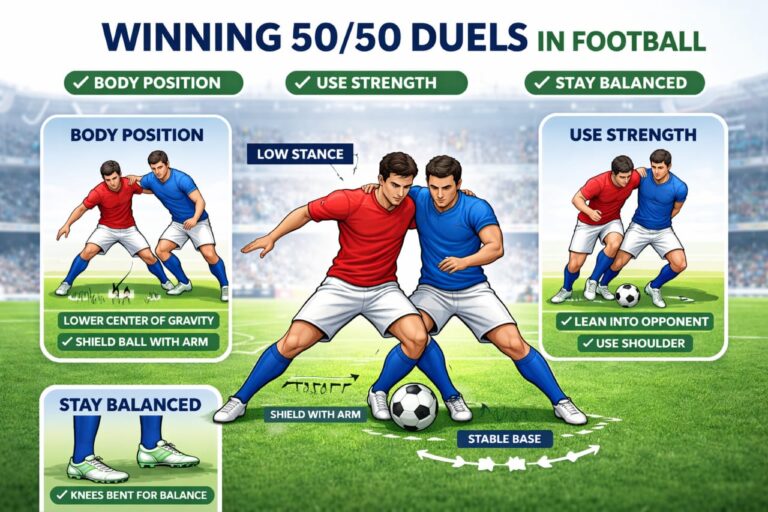
The foundation of strong 1v1 defending begins with body positioning. A defender should adopt a slightly side-on stance, with knees bent and weight balanced, allowing quick reactions in any direction. This positioning is not just about mobility; it is about control, guiding the attacker into less dangerous areas rather than attempting to win the ball immediately.
Distance control is equally critical. Defenders must constantly adjust their spacing relative to the attacker, closing down space without overcommitting. Standing too close invites quick dribbles, while standing too far allows the attacker time to pick a pass or accelerate. The best defenders operate within this balance, applying pressure without losing control.
These principles are deeply connected to concepts explained in 1v1 situations in football, where the smallest details—such as timing, patience, and reading the opponent—determine success or failure. Understanding these moments transforms defending from reactive tackling into controlled dominance.
Patience is perhaps the most underrated quality in 1v1 defending. Many defenders make the mistake of diving into tackles too early, which skilled attackers can easily exploit. Instead, defenders should wait for triggers such as a heavy touch, poor balance, or predictable movement before committing. This disciplined approach reduces risk and increases the chances of regaining possession.
Knowing how to mark an opponent in football also involves understanding the context of the game and applying the correct marking approach at the right time. Tight marking is most effective when dealing with high-impact players who can change the game if given space. By staying close and constantly applying pressure, defenders can disrupt their rhythm and limit their influence.
Zonal marking, however, becomes more effective when maintaining team structure is the priority. Against teams that rely on fluid movement and positional rotations, chasing individual players can lead to defensive disorganization. By focusing on space instead, defenders can maintain compactness and reduce the effectiveness of attacking patterns.
The key lies in recognizing triggers. For example, when the ball is far from goal, maintaining zonal shape is usually the best option. But as soon as the ball enters a dangerous area, defenders must switch to tighter marking to prevent immediate threats. This constant adjustment is what defines intelligent defending in modern football.
Players who fail to recognize these moments often struggle defensively, either by marking too tightly and losing shape or by staying too passive and allowing attackers too much freedom. The balance between these approaches is what allows defenders to remain effective across different game situations.
At higher levels, these decisions are rarely fixed. Players must constantly adjust based on the position of the ball, the movement of opponents, and the defensive structure of the team. This ability to switch between tight marking and zonal marking in real time is what defines intelligent and reliable defenders.
Even players who understand how to mark an opponent in football can become ineffective if they fall into common defensive mistakes that disrupt structure and create opportunities for opponents. One of the most damaging errors is ball-watching, where defenders focus entirely on the ball and lose awareness of their direct opponent or runners entering dangerous spaces.
Poor body positioning is another frequent issue. Defenders who fail to stay goal-side or position themselves correctly make it easier for attackers to receive the ball and turn. Once an attacker is facing forward, the defender is already at a disadvantage, which is why positioning must always be proactive rather than reactive.
Lack of communication is often overlooked but plays a major role in defensive breakdowns. In zonal or hybrid systems, players must constantly communicate to ensure that marking responsibilities are clear. Silence leads to confusion, and confusion leads to space—something attackers are quick to exploit.
Overcommitting is another critical mistake. Attempting to win the ball too aggressively can pull defenders out of position, opening gaps in the defensive line. Modern defending requires patience and discipline, focusing on control rather than reckless challenges.
At its highest level, mastering how to mark an opponent in football is about developing defensive intelligence rather than relying purely on physical ability. Intelligent defenders understand movement patterns, anticipate actions, and position themselves effectively before danger arises.
Scanning is a fundamental habit that separates elite defenders from average ones. Players must constantly check their surroundings, identifying threats, tracking runners, and adjusting their positioning accordingly. This continuous awareness allows defenders to stay one step ahead rather than reacting too late.
Game intelligence also involves understanding team structure and tactical roles. Defenders must know when to step out, when to hold position, and when to pass on marking responsibilities. These decisions are often made in seconds, but they have a significant impact on defensive stability.
Experience plays a major role in developing this intelligence. The more situations a player encounters, the better they become at recognizing patterns and making correct decisions. Over time, these actions become instinctive, allowing players to perform consistently under pressure.
Mastering how to mark an opponent in football requires more than just understanding defensive techniques—it requires a complete awareness of the game, including positioning, timing, communication, and decision-making. Whether using tight marking, zonal marking, or hybrid systems, the goal is always to control space, limit options, and reduce the opponent’s effectiveness.
Modern football demands defenders who can think as well as act, adapting to different situations and maintaining structure under pressure. Players who develop this level of understanding become more reliable, more consistent, and far more difficult to play against.
Ultimately, how to mark an opponent in football is not just about stopping a player—it is about controlling space, reducing options, and maintaining defensive balance. When applied correctly, marking allows teams to stay organized, regain possession, and control the game without relying on last-minute actions.