Physical Address
MICKYWORLDNG
Physical Address
MICKYWORLDNG

MICKYWORLDNG IS READER-SUPPORTED. WHEN YOU BUY THROUGH LINKS ON OUR SITE, WE MAY EARN AN AFFILIATE COMMISSION AT NO EXTRA COST TO YOU.
How to choose the right football formation is one of the most important decisions any coach or team can make, because it directly shapes how a team defends, attacks, and controls the flow of a game.
A formation defines how players are positioned, how they connect, and how the team functions across all phases of play. When the wrong system is used, even talented players can struggle to perform effectively. But when the formation fits the team, it can instantly improve organization, balance, and overall performance.
This is why understanding formations at a deeper level is essential. It is not about copying popular systems—it is about choosing what actually works for your team.
A football formation describes how players are positioned on the pitch, usually expressed in numbers such as 4-3-3 or 4-4-2. These numbers represent the defensive line, midfield structure, and attacking setup, giving a basic idea of how a team is organized.
However, modern football is not static. Formations constantly change depending on whether a team has possession or is defending. For example, a 4-3-3 can transform into a 2-3-5 when attacking, creating overloads and more passing options in advanced areas.
If you want to understand these shifts better, see this full breakdown of football formations explained simply.
The biggest mistake many teams make is choosing a formation first without considering the players they have available. Formations should always be built around player strengths, because tactics only work when players can execute them effectively on the pitch.
For example, if your team has fast wingers and a mobile striker, a 4-3-3 naturally suits your strengths by creating width and attacking space. On the other hand, if you have two strong forwards, a 4-4-2 allows you to use partnerships and direct play more effectively.
Every formation depends on specific player profiles, and understanding these roles is key to making the right tactical decision. A 4-3-3 requires midfielders who are comfortable on the ball and able to control tempo under pressure.
A 4-2-3-1 relies heavily on a creative attacking midfielder who can operate between the lines and link play. Without the right profiles, even the most popular formations will struggle to function properly.
Your formation must reflect how your team wants to play, because structure and style are closely connected in football. If your goal is to dominate possession, formations like 4-3-3 or 4-2-3-1 provide natural passing triangles and control in midfield.
If your team prefers quick transitions, a 4-4-2 offers a more direct approach with two forwards leading counter-attacks. Choosing a system that matches your style ensures your tactics work naturally rather than forcing players into uncomfortable roles.
One of the key decisions when selecting a formation is whether your team focuses on controlling the game or attacking quickly. Control-based teams rely on possession, short passing, and structured movement to dominate the tempo.
Direct teams focus on speed, vertical passing, and exploiting space behind the defense. This decision influences not just formation, but also positioning, spacing, and player responsibilities.
The midfield is the most important area of the pitch, and your formation must ensure you are not outnumbered in this zone. A three-man midfield, like in a 4-3-3, provides better control and passing options during build-up play.
A two-man midfield, as seen in a 4-4-2, offers simplicity but can struggle against teams with numerical superiority. Finding the right midfield balance is critical to maintaining control and stability during matches.
Every formation involves a trade-off between defensive security and attacking flexibility. More defensive systems, such as 5-3-2, provide strong protection but may limit attacking options.
More attacking formations, like 4-3-3, create chances but can leave spaces behind if not well organized. The key is finding a balance that suits your team’s strengths and competitive level.
Football is fundamentally a game of space, and formations are designed to control how that space is used. Some systems focus on dominating central areas, while others stretch the pitch using width.
Understanding how your formation affects space helps create better attacking patterns and defensive organization. This is especially important when preventing opponents from playing between the lines in football, where most dangerous chances are created.
Modern football is dynamic, and teams often adjust their shape depending on the situation. A team may start in a 4-3-3 but become more compact when defending or more aggressive when chasing a goal.
These adjustments allow teams to respond to opponents and game scenarios effectively. This flexibility is what separates tactically strong teams from predictable ones.
There is no single formation that works for every team, because football depends on players, opponents, and context. The best formation is always the one that fits your team’s strengths while minimizing weaknesses.
What works for professional teams may not work at lower levels due to differences in ability and tactical understanding. This is why choosing the right formation is always about adaptation rather than imitation.
To make this more practical, it helps to look at how different formations fit different types of teams and playing styles.
Choosing the right formation becomes much easier when you follow a clear process instead of guessing.
This approach helps you build a formation around your team rather than forcing players into unsuitable roles.
Understanding how to choose the right football formation becomes easier when you look at how different systems fit different types of teams and player profiles. Each formation is built around specific strengths, and using the right one can significantly improve both performance and consistency on the pitch.
The key is not which formation is popular, but which one allows your players to perform their roles naturally and effectively. This is where tactical awareness becomes more important than simply copying systems used by professional teams.

The 4-3-3 is one of the most widely used formations in modern football because it provides balance between attack and control. With three midfielders, teams can dominate possession, create passing triangles, and maintain control of the game’s tempo.
The wide forwards stretch the pitch, creating space both centrally and in advanced areas. This formation is ideal for teams with technically strong players who are comfortable on the ball and capable of maintaining structured build-up play.
However, it requires discipline, especially in midfield, as losing control in this area can expose the defense quickly.
The 4-4-2 is one of the simplest and most structured formations, making it effective for teams that prioritize organization and direct attacking play. With two strikers, it allows for partnerships in attack, making it easier to play forward quickly and create goal-scoring opportunities.
The flat midfield line provides defensive stability and makes it easier to maintain shape without overcomplicating positioning. This formation is particularly effective against teams that dominate possession, as it allows quick transitions and counter-attacks.
However, it can struggle against teams with a strong midfield presence, especially when outnumbered in central areas.
The 4-2-3-1 is one of the most balanced formations, combining defensive stability with attacking creativity. The two defensive midfielders provide protection for the back line while also helping in build-up play.
In front of them, the attacking midfielder plays a crucial role in linking defense and attack, often operating between the lines. This system works best for teams that have a creative player capable of controlling the game in advanced positions.
It offers flexibility, allowing teams to adapt easily between defensive and attacking phases.
The 5-3-2 is designed for defensive stability, with three central defenders providing strong protection against attacks. This formation is effective against teams that rely heavily on wide play, as wing-backs can track movement and provide defensive cover.
At the same time, it allows for quick counter-attacks through two forwards who can exploit space behind the opposition. It is often used by teams that prefer to stay compact and organized while waiting for opportunities to break forward.
However, it requires disciplined wing-backs who can contribute both defensively and offensively.
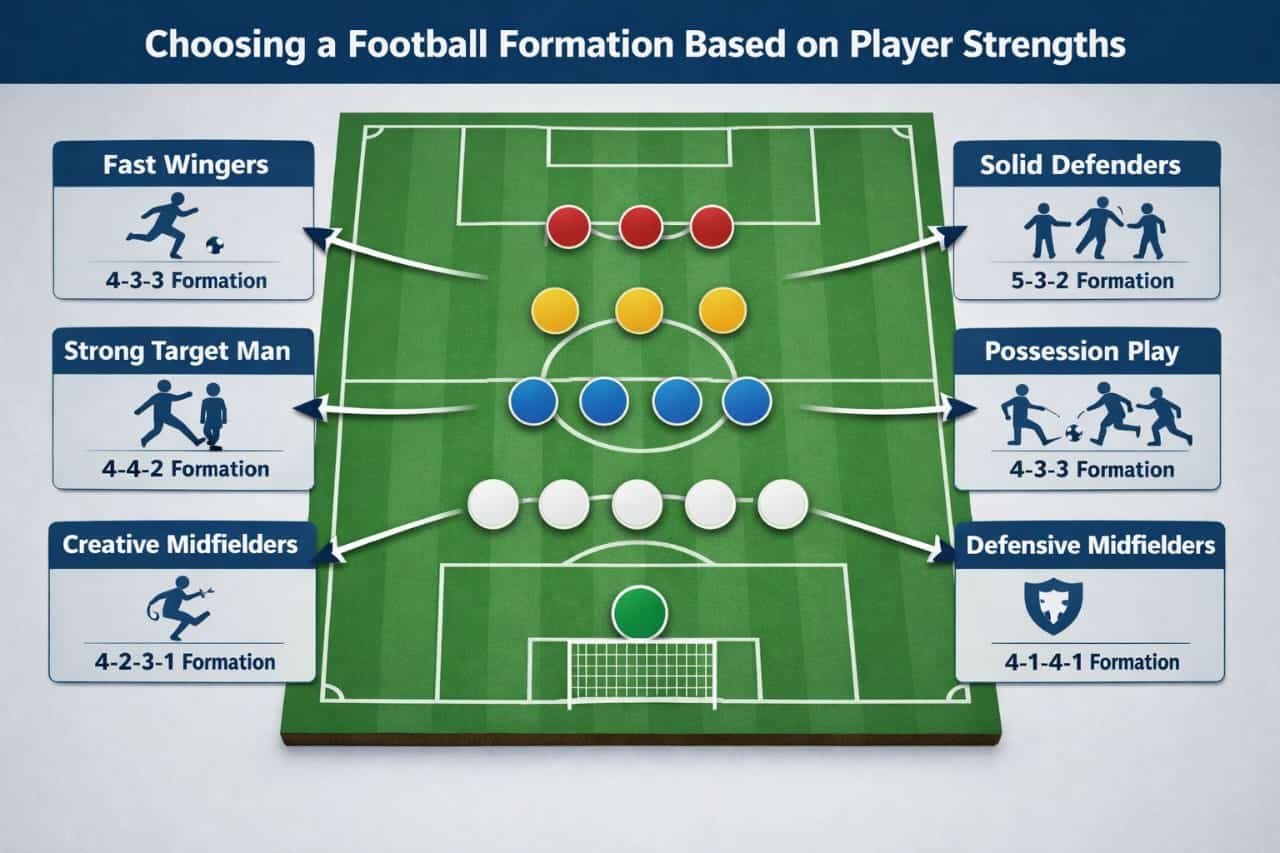
One of the most practical ways to choose a formation is by analyzing the specific types of players available in your squad. Fast wingers naturally fit into wide systems like 4-3-3, where they can exploit space and stretch defenses.
A strong target striker may be more effective in a 4-4-2, where direct play and crosses are common. Creative midfielders thrive in systems like 4-2-3-1, where they have freedom to operate between lines and influence attacking play.
Matching player types with formation structure is one of the most important steps in building a successful team.

Choosing the right formation is not only about your team—it also depends on the opponent you are facing. Against strong attacking teams, a more compact and defensive formation may be necessary to reduce risk.
Against weaker or defensive teams, a more attacking system can help create more chances and maintain pressure. Understanding the opponent’s strengths and weaknesses allows you to make better tactical decisions.
This adaptability is what makes teams unpredictable and difficult to play against.
Modern football is heavily influenced by transitions, and your formation must support both attacking and defensive transitions. When possession is lost, players must quickly reorganize to prevent counter-attacks.
When possession is regained, the team must be ready to exploit space immediately. This is closely linked to counter-pressing in football, where teams aim to win the ball back quickly after losing it.
A good formation supports these transitions without losing structure or balance.
Many teams struggle because they choose formations based on trends rather than understanding their own strengths. Copying professional teams without considering player ability often leads to poor performance.
Another common mistake is ignoring midfield balance, which can result in losing control of the game. Some teams also fail to adapt during matches, sticking to one system even when it is not working.
Avoiding these mistakes is essential for long-term tactical success.
At its core, learning how to choose the right football formation is about understanding players, tactics, and game situations. The best formation is not the most popular one—it is the one that allows your team to perform at its highest level.
When structure, player roles, and tactical ideas align, the team becomes more organized, more confident, and more effective. This is what transforms formations from simple numbers into powerful tactical systems.
Understanding how to choose the right football formation gives you a clear tactical advantage. When your formation matches your players, your style, and the game situation, performance improves naturally. In modern football, success is not about copying systems—it is about applying the right structure in the right context.