Physical Address
MICKYWORLDNG
Physical Address
MICKYWORLDNG

MICKYWORLDNG IS READER-SUPPORTED. WHEN YOU BUY THROUGH LINKS ON OUR SITE, WE MAY EARN AN AFFILIATE COMMISSION AT NO EXTRA COST TO YOU.
Defensive transitions in football represent one of the most critical phases of the modern game. It is the exact moment a team loses possession and must instantly shift from attacking to defending. In this split second, structure disappears, spaces open up, and the opponent has the highest chance to launch a dangerous counter-attack.
This phase is often chaotic because players are no longer in their ideal defensive positions. Full-backs may be high, midfielders spread out, and attackers ahead of the ball. If there is even a slight delay in reaction, the team becomes vulnerable almost instantly.
That is why elite teams focus heavily on defensive transitions. It is not just about defending—it is about reacting faster, thinking quicker, and making the right decision in seconds.
Defensive transitions in football occur the moment possession is lost. The team must instantly reorganize to prevent the opponent from progressing forward quickly.
This phase is different from settled defending. In a structured defensive block, players are compact, organized, and positioned correctly. In transition, however, everything is unstable. Players must react while out of position, making decisions under pressure.
The main objective during this phase is simple: stop the counter-attack as quickly as possible. Teams can achieve this in two main ways—either by pressing immediately or by recovering into shape.
This concept is closely connected to modern tactical structures like positional play in football, where teams maintain balance even while attacking to prepare for defensive transitions.
The few seconds after losing the ball are statistically the most dangerous in football. Opponents exploit disorganization, attack open spaces, and target unbalanced defensive lines.
For example, when a team commits players forward in attack, they leave space behind. If possession is lost, the opponent can immediately attack those spaces before the team recovers.
This is why modern teams emphasize what is known as rest defence—a structure maintained during attacking phases to prepare for defensive transitions. By keeping players positioned behind the ball, teams reduce vulnerability when possession is lost.
You can understand this better through rest defense in football, which explains how teams maintain balance while attacking.
Every team must make a decision immediately after losing the ball. There are only two effective responses:
The choice depends on positioning, player proximity, and tactical setup.
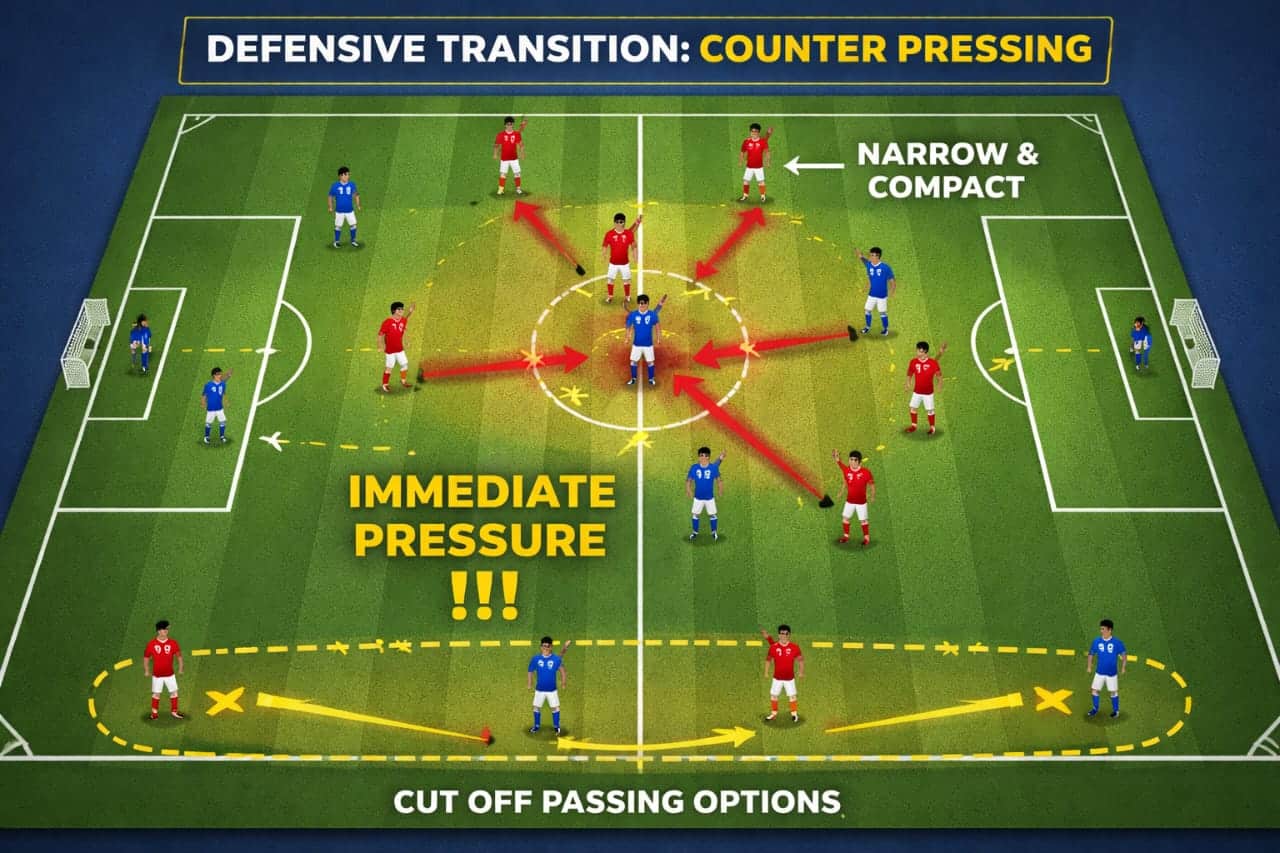
Counter-pressing, also known as Gegenpressing, is the attempt to win the ball back immediately after losing it. Instead of dropping back, players aggressively press the opponent.
The idea is simple: the opponent is also disorganized after winning the ball. By applying immediate pressure, the team can force mistakes and regain possession quickly.
Counter-pressing is most effective when multiple players are close to the ball. This creates situations similar to overloads in football, where teams outnumber the opponent around the ball and increase the chances of winning it back.
However, counter-pressing is not random. It follows specific principles:
When executed correctly, counter-pressing can stop attacks before they even begin and quickly turn defense into attack.
When counter-pressing is not possible—usually because players are too far apart—the team must immediately recover into a defensive shape.
This is known as recovery defending. Instead of pressing aggressively, players sprint back, reorganize, and protect key areas of the pitch.
The focus shifts from winning the ball instantly to delaying the opponent and preventing progression.

Recovery defending is built on discipline and positioning. Players must recognize danger quickly and prioritize protecting central spaces.
This approach is essential when teams are stretched or when the opponent has numerical superiority during transition.
The biggest challenge in defensive transitions is not physical—it is decision-making. Players must read the situation instantly and choose the correct response.
If a team tries to counter-press when players are too far apart, they can be easily bypassed. On the other hand, dropping too early can give the opponent time and space to attack.
This is why elite teams train specific triggers for action. For example:
These small details define whether a team controls transitions or gets exposed.
One of the most overlooked aspects of defensive transitions is what happens before possession is lost.
Teams that are well-structured in attack are naturally better prepared for defensive transitions. Players are positioned in a way that allows immediate pressure or quick recovery.
This is why tactical systems are interconnected. Attacking structure influences defensive stability.
For example, maintaining balance through spacing and positioning ensures that when possession is lost, players are close enough to react quickly.
Without this structure, defensive transitions become reactive rather than controlled, making teams vulnerable to fast counter-attacks.
Modern football often refers to the “first five seconds” after losing possession as the most important phase of defensive transition.
During this period, teams either regain control or fall into defensive chaos.
The objective within these seconds is clear:
Failing to do either gives the opponent time to organize their attack, making defending much more difficult.
This is why defensive transitions are not just a tactical concept—they are a defining factor in how modern football is played at the highest level.
In modern football, stopping counter-attacks is the ultimate goal of defensive transitions in football. Once the opponent breaks the first line of pressure, the situation becomes extremely dangerous, especially if attackers are running into open space.
To deal with this, teams rely on positioning, decision-making, and tactical discipline. It is no longer just about tackling—it is about controlling space, delaying play, and forcing the opponent into less dangerous areas.

The first priority is always to protect central areas. The middle of the pitch provides the most direct path to goal, so defenders and midfielders must quickly close these spaces. By forcing the opponent wide, teams reduce the immediate threat and gain time to recover.
This is closely related to width and depth in football, where controlling space both horizontally and vertically is key to defensive stability.
Another key tactic is delaying the attacker. Instead of diving into tackles, defenders often hold their position, slowing down the attack and allowing teammates to recover. This controlled defending is what separates elite teams from reactive ones.
You can see this clearly in high-level matches—defenders rarely rush in. Instead, they slow the situation down just enough for the rest of the team to recover, turning a dangerous moment into a controlled one.
Top teams do not rely on effort alone—they follow clear tactical principles during defensive transitions. These principles ensure that every player understands their role in chaotic situations.
The moment possession is lost, players must react instantly. There is no time to complain or hesitate. The closest player presses, while others adjust their positions.
Distances between players must remain small. A compact team can control space more effectively and prevent opponents from exploiting gaps.
Players constantly communicate to organize quickly. This is especially important when recovering into shape.
Players must identify dangerous areas—especially central zones and spaces behind the defensive line—and prioritize protecting them.
Pressing must be aggressive but calculated. Overcommitting can open even more space for the opponent.
These principles work together to create a system where chaos is managed rather than feared.
Understanding when to counter-press and when to recover is one of the most important tactical decisions in football.
Counter-pressing should be used when:
Recovery defending should be used when:
The ability to switch between these two approaches is what defines tactically intelligent teams. It is not about choosing one system—it is about applying the right solution at the right time.
Midfielders play a crucial role in defensive transitions because they are often closest to the ball when possession is lost. Their positioning, awareness, and reactions determine whether the team can regain control quickly.
In counter-pressing situations, midfielders are responsible for closing passing lanes and supporting the press. They often act as the second wave, ensuring the opponent has no easy escape.
In recovery situations, midfielders must track runners, protect central spaces, and help rebuild the defensive block.
This is also where movements like third man runs in football become dangerous during transitions, as attackers look to exploit gaps created by disorganization.
A well-positioned midfield can completely neutralize counter-attacks before they develop.
Football continues to evolve, and defensive transitions have become even more structured in recent years. Teams are no longer reacting randomly—they are preparing for transitions before they even happen.
Teams now maintain a defensive structure even while attacking. Typically, 3–4 players remain positioned behind the ball to deal with potential counter-attacks.
Some teams adopt aggressive man-marking immediately after losing possession. Each player presses their nearest opponent, turning the transition into multiple 1v1 battles.
Clubs now use data analysis to identify the best moments to press. Triggers such as poor touches, backward passes, or specific zones are used to initiate pressure.
These developments show that defensive transitions are no longer just reactive—they are planned and optimized.
To master defensive transitions in football, teams use specific training drills that replicate real match situations.
One common method is small-sided games with transition rules. For example, when a team loses possession, they must win it back within a few seconds or immediately drop into shape.
Another effective drill focuses on numerical disadvantages. Defenders are placed in 2v3 or 3v4 situations, forcing them to delay attacks and make smart decisions.
These drills help players develop:
Over time, these habits become automatic, allowing teams to handle transitions more effectively during matches.
Despite its importance, many teams struggle with defensive transitions due to simple but costly mistakes.
Avoiding these mistakes is essential for building a strong defensive system.
Defensive transitions in football are no longer just a phase of play—they are a defining factor in modern tactics. The ability to react instantly, choose the right approach, and control space determines whether a team dominates or gets exposed.
Whether through aggressive counter-pressing or disciplined recovery defending, the objective remains the same: stop the opponent before they can create danger.
Teams that master this phase gain a clear advantage. They not only defend better but can also turn these moments into immediate attacking opportunities.
In today’s game, success is not just about what happens with the ball—but how quickly and effectively a team reacts without it.