Physical Address
MICKYWORLDNG
Physical Address
MICKYWORLDNG

MICKYWORLDNG IS READER-SUPPORTED. WHEN YOU BUY THROUGH LINKS ON OUR SITE, WE MAY EARN AN AFFILIATE COMMISSION AT NO EXTRA COST TO YOU.
Football formations explained simply is one of the most important concepts for understanding how teams play the game. Every team on the pitch is organized in a specific structure that defines how they defend, attack, and control space.
Simple definition: A football formation is how players are arranged on the pitch to create structure in attack and defense. These structures are usually written in numbers such as 4-4-2 or 4-3-3, representing defenders, midfielders, and attackers.
While this may look simple, formations are not just about positioning—they are about how a team functions as a unit. At the highest level of the game, formations determine everything from pressing intensity to build-up play and attacking patterns.
They influence how space is created, how passing lanes are formed, and how teams adapt during different phases of play. Understanding formations is not just for coaches—it is essential for players, analysts, and even fans who want to truly understand what is happening on the pitch.
When people talk about formations, they often think it is just about numbers. But in reality, those numbers only represent the starting structure.
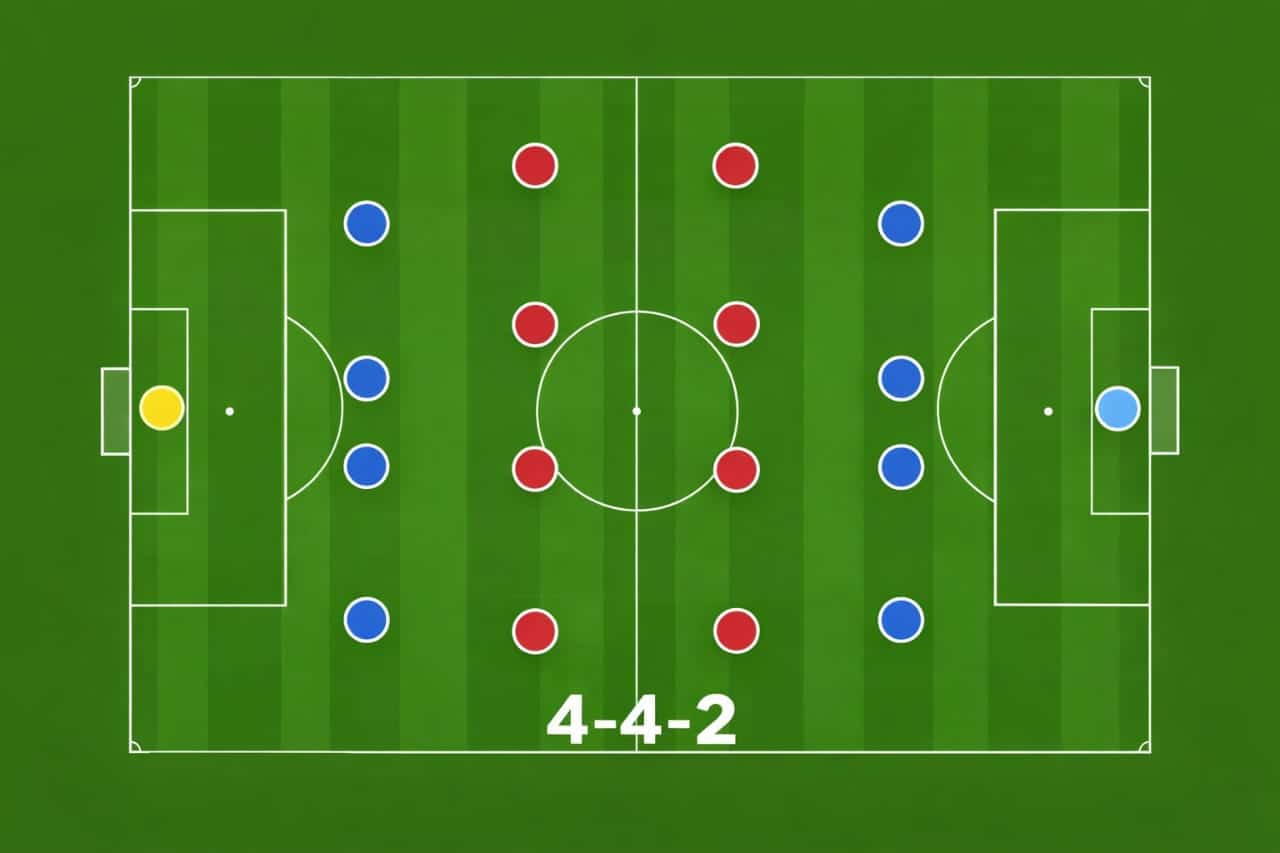
A 4-4-2 formation means:
A 4-3-3 formation means:
However, modern football is far more dynamic. These shapes constantly change depending on whether a team has the ball or not. This is why formations are better understood as structures of space and movement, not just fixed positions.
For example, a team may defend in a 4-4-2 shape but attack in a 3-2-5 structure. This fluidity is what makes modern football tactically complex.
Formations are the foundation of tactical organization. They determine how a team controls space both defensively and offensively. Without a clear structure, players would move randomly, making it impossible to maintain balance.
Formations provide that balance by assigning roles and positioning responsibilities across the pitch. This is closely connected to positional play in football, where players occupy specific zones to create passing options and control the game.
In modern football, controlling space is more important than simply controlling the ball. Teams use formations to create numerical advantages, isolate opponents, and exploit weaknesses. This is why top teams are not just technically good—they are structurally organized.
The 4-4-2 is one of the most traditional and recognizable formations in football. It is built on simplicity, balance, and defensive stability. The structure consists of two clear lines of four players, making it compact and difficult to break down.
Defensively, this formation is extremely strong. The two banks of four reduce space between lines, forcing opponents to play wide instead of through the center. This compactness makes it effective against possession-based teams.
In attack, the 4-4-2 relies heavily on width and direct play. Wide midfielders stretch the pitch, while two strikers provide presence in the box. This creates constant crossing opportunities and allows for quick transitions.
Another key strength of the 4-4-2 is its clarity. Every player understands their role, which makes it easier to maintain organization throughout the match. However, the formation also has weaknesses.
One of the biggest issues is midfield control. With only two central midfielders, teams can be outnumbered against formations like 4-3-3. This creates gaps that opponents can exploit.
Despite this, the 4-4-2 remains highly effective when used with discipline and tactical awareness.
The 4-3-3 is the dominant formation in modern football, especially among teams that prioritize possession and high pressing.

This formation creates a natural midfield triangle, which allows for better ball circulation and control. Unlike the 4-4-2, the 4-3-3 focuses on spacing and angles rather than rigid lines.
The front three players stretch the defensive line horizontally, while the midfield triangle provides passing options in multiple directions. This makes it easier to maintain possession under pressure.
One of the biggest advantages of the 4-3-3 is its ability to create overloads. By positioning players intelligently, teams can outnumber opponents in key areas of the pitch.
This is where movements like third man runs in football become crucial, allowing teams to break defensive lines through coordinated passing and movement.
Defensively, the 4-3-3 is highly effective in pressing. The front three players can press high up the pitch, forcing opponents into mistakes. This aggressive approach helps teams regain possession quickly.
However, the 4-3-3 also has weaknesses. If the midfield is bypassed, the defense can become exposed. The single defensive midfielder plays a critical role in protecting the back line.
If this player is out of position, large spaces can open up.
Understanding the difference between these two formations is essential for grasping modern football tactics. The 4-4-2 is built on structure, discipline, and defensive compactness.
It is ideal for teams that prefer stability and direct attacking play. In contrast, the 4-3-3 is built on fluidity, control, and positional play. It is designed for teams that want to dominate possession and apply pressure.
Another key difference is midfield control. The 4-3-3 has a numerical advantage in midfield, which allows teams to dictate the tempo of the game.
The 4-4-2, on the other hand, sacrifices midfield control for defensive solidity. These differences highlight how formations are not just tactical choices—they define a team’s identity.
One of the most important things to understand is that formations are not static. Teams constantly adjust their shape depending on the situation.
For example, a team may start in a 4-3-3 but shift into a 4-5-1 when defending. Similarly, a 4-4-2 can become a 4-2-4 during attacking phases.
This flexibility is what defines modern football. Coaches design systems that allow players to adapt without losing structure.
As a result, formations are better understood as flexible frameworks rather than fixed systems.
At its core, football formations explained simply is about understanding how teams control space, create opportunities, and prevent threats. Formations provide the structure, but it is the movement, awareness, and decision-making within that structure that truly defines performance.
This is why two teams using the same formation can play completely differently. It is not just about the system—it is about how the system is used.
When you understand formations at this level, football becomes much clearer. You no longer just watch the game—you understand it.
To fully understand football formations explained simply, you must move beyond static diagrams and look at how teams behave in different phases of play. A formation is not a fixed shape—it is a flexible structure that constantly changes depending on whether a team has the ball or not.
In possession, teams expand across the pitch. Players spread out to create width, depth, and multiple passing options. A 4-3-3, for example, can transform into a 3-2-5 attacking structure.
Full-backs push high, midfielders position themselves between lines, and forwards stretch the defensive line. This expansion is not random—it is carefully structured to create space and open passing lanes.
Out of possession, everything changes. The same team may drop into a compact shape like 4-5-1. Wingers fall back into midfield, spaces between players become smaller, and the focus shifts to defensive organization.
This compactness makes it difficult for opponents to play through the middle. Instead, they are forced into wider areas where the attacking threat is reduced.
This constant transformation between attacking and defensive shapes is what defines modern football. The formation you see on paper is only the starting point.
One of the clearest differences between formations appears during build-up play. In a 4-3-3, teams prioritize control.
The structure naturally creates triangles between defenders and midfielders, allowing for short, controlled passing sequences. This makes it easier to progress the ball under pressure.
Players are positioned in a way that always provides at least two passing options. This reduces risk and increases stability.
This structured approach is closely linked to positional play in football, where spacing and positioning are used to dominate possession.
In contrast, a 4-4-2 often adopts a more direct style. Instead of building patiently, teams may play forward quickly toward the strikers.
This approach is effective in transition moments, especially when opponents are not fully organized. However, it can lead to loss of control if the ball is not retained.
Formations also determine how teams press and defend. In a 4-3-3, pressing is aggressive and coordinated.
The front three players initiate the press, closing down defenders and forcing play into specific areas. This high pressing system aims to win the ball quickly.
Because of this, teams using 4-3-3 often dominate territory and control the tempo of the game.
In a 4-4-2, pressing is more compact and controlled. Instead of pressing high, teams often stay in a mid-block and wait for triggers.
This makes the 4-4-2 more defensively stable, as players remain close together and reduce space between lines.
However, it also means less immediate pressure on the ball compared to a 4-3-3. Both systems are effective but reflect different tactical philosophies.
At the highest level, football is about space. Formations are designed to either create space when attacking or reduce space when defending.
The 4-3-3 creates space through width and positioning. Wingers stretch the defensive line, while midfielders position themselves between lines.
This allows teams to break defensive structures more effectively. The 4-4-2, on the other hand, focuses on reducing space.
By maintaining two compact lines of four, it limits the opponent’s ability to play through central areas.
Understanding this difference is key to understanding why teams choose one formation over another.

No team sticks to one formation for an entire match. Modern football requires constant adaptation.
A team may start in a 4-3-3 but shift into a more defensive shape when under pressure. Similarly, a 4-4-2 can become more attacking.
These adjustments are often subtle but have a major impact on the game.
Coaches design systems that allow players to adapt without losing structure. This flexibility separates top teams from average ones.
Formations provide structure, but players bring them to life. Understanding positioning, movement, and timing is essential.
This is why football scanning awareness is so important. Players must constantly assess their surroundings.
Without this awareness, even the best tactical system will fail.
Players who understand space can adapt quickly and make better decisions under pressure.
The choice between 4-4-2 and 4-3-3 depends on context. The 4-4-2 is ideal for teams that prioritize defensive stability and quick transitions.
It is effective against possession-heavy teams because it limits space and forces play wide.
The 4-3-3 is ideal for teams that want to control the game. It allows for better ball circulation and pressing.
Both formations are valuable—the key is using them at the right time.
At a deeper level, football formations explained simply is about understanding how teams organize space, movement, and decision-making. Formations are not rigid systems—they are flexible frameworks.
The real difference between teams is not the formation itself, but how effectively they use it.
Once you understand this, football becomes clearer, more tactical, and far more interesting to watch.