Physical Address
MICKYWORLDNG
Physical Address
MICKYWORLDNG

MICKYWORLDNG IS READER-SUPPORTED. WHEN YOU BUY THROUGH LINKS ON OUR SITE, WE MAY EARN AN AFFILIATE COMMISSION AT NO EXTRA COST TO YOU.
Football positions for beginners form the foundation of understanding how the game is played, structured, and controlled across the pitch. Before learning advanced tactics or complex systems, every player must first understand where they fit on the field, what their role is, and how their movement connects with teammates.
At its core, football is a game of space, structure, and decision-making. Each position on the pitch exists for a reason. When players understand their role within this structure, the game becomes easier to read, easier to play, and far more effective.
For beginners, the biggest mistake is focusing only on the ball. In reality, football is about positioning, awareness, and understanding how all eleven players function together as a unit. This is why learning football positions for beginners is not just about memorizing names like defender or striker—it is about understanding responsibility, movement, and teamwork.
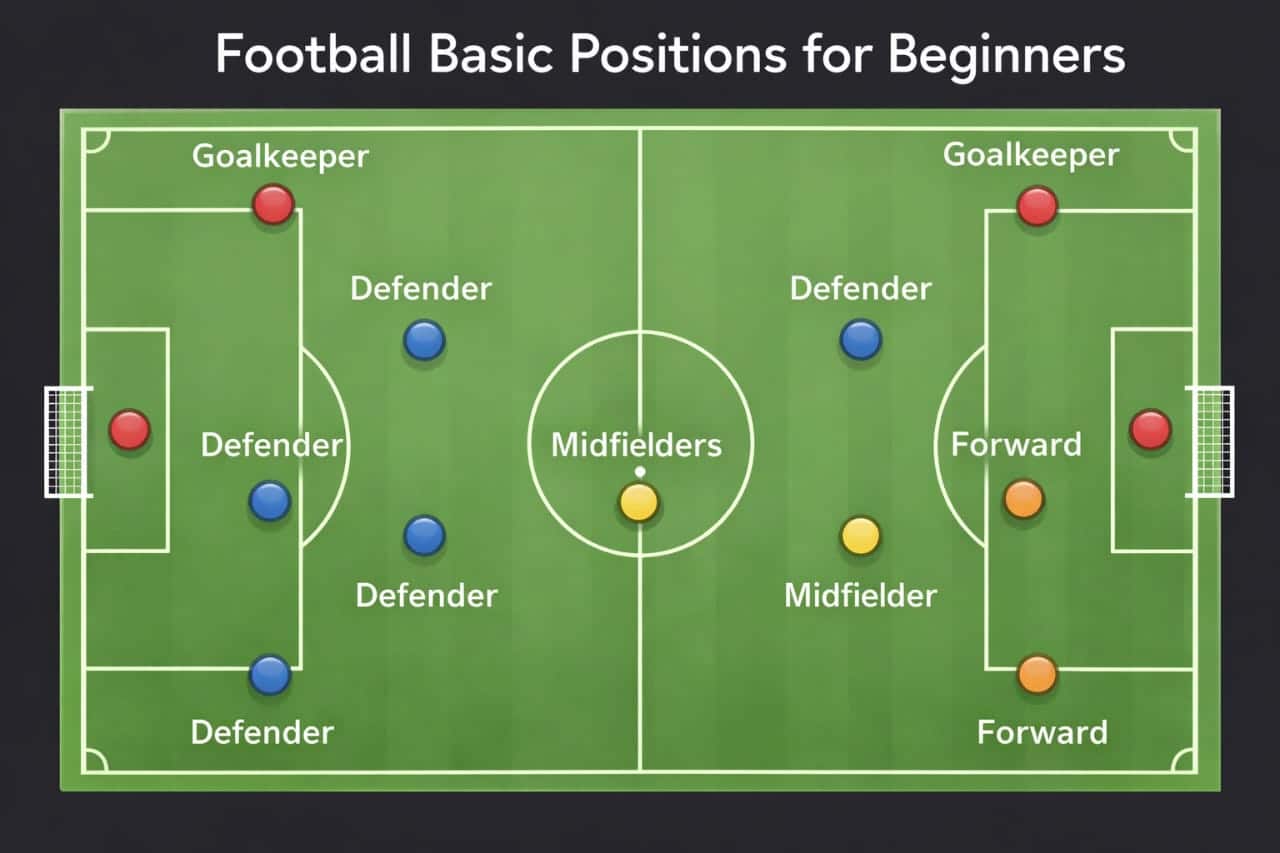
A standard football team consists of 11 players, each assigned a role based on their position on the pitch. These positions are generally divided into four main units: Goalkeeper, Defenders, Midfielders, and Forwards.
Each unit has a specific function, but they are all connected. Football is not played in isolated roles—it is played through coordinated structure. This structure is closely linked to concepts like positional play in football, where spacing and positioning determine how effectively a team controls the game.
The goalkeeper is the only player allowed to use their hands, but their role goes far beyond stopping shots. Modern goalkeepers are responsible for shot stopping, organizing the defense, starting attacks from the back, and distributing the ball under pressure.
At beginner level, understanding positioning is key. A goalkeeper must always adjust their position based on the ball, the opponent, and the angle of attack.
Defenders are responsible for preventing goals, but their role is more structured than simply clearing the ball. There are different types of defenders, including center-backs (central defenders) and full-backs (wide defenders).
Center-backs focus on marking attackers, winning aerial duels, and maintaining defensive shape, while full-backs focus on defending wide areas, supporting attacks on the flanks, and providing width in possession.
Defending is not just about tackling—it is about positioning, timing, and coordination.
Midfielders are often described as the engine of the team. They connect defense and attack, control tempo, and influence both phases of play. There are three main types: defensive midfielder (#6), central midfielder (#8), and attacking midfielder (#10).
Each role has a different responsibility. Defensive midfielders protect the defense and recover possession, central midfielders control the flow of the game, and attacking midfielders create chances and operate in advanced spaces.
This is where understanding space becomes critical, especially when playing between the lines in football, which allows players to receive the ball in dangerous areas.
Forwards are responsible for scoring goals, but their role also includes movement, pressing, and creating space.
Good forwards are not static—they constantly move to create space, drag defenders, and open passing lanes.
Formations organize how players are positioned on the pitch. For beginners, the most common formations include 4-4-2 (balanced and simple structure) and 4-3-3 (focus on attacking width and midfield control).
4-4-2: Balanced and simple structure
4-3-3: Focus on attacking width and midfield control
Formations are not rigid—they change during the game depending on whether the team is attacking or defending. Understanding formations helps players know where they should be and how they should move.
One of the biggest lessons in football is this: positioning matters more than constant movement. Players who are always running without structure often create problems instead of solutions.
Good positioning allows players to receive the ball in space, avoid pressure, and make faster decisions.
This is why even at beginner level, learning positioning early gives a huge advantage.
Football is not about individual roles—it is about connection. Defenders pass to midfielders, midfielders link to attackers, and attackers create chances and finish moves.
Each position supports the other. When one part of the structure fails, the entire system becomes unstable. This is why understanding football positions for beginners is essential for long-term development.
Once players understand positions, the next step is learning how to move and pass within that structure. Football is based on simple principles such as pass and move, creating angles, and supporting the player on the ball.

These movements may look simple, but they form the foundation of all advanced tactics in football. At beginner level, mastering these basics is more important than learning complex systems.
Many beginners struggle not because they lack skill, but because they lack understanding. When a player knows their role, understands positioning, and recognizes simple patterns, the game becomes clearer, and confidence grows naturally from clarity.
Instead of reacting to the game, the player begins to anticipate it. This is the first step toward developing real football intelligence. Once you understand where players operate on the pitch, the next step is learning how they actually perform within those roles. Positions provide structure, but skills and decision-making bring that structure to life.
Understanding football positions for beginners is only one part of development. The next step is mastering the core skills that allow players to function effectively within those positions.
At beginner level, many players rush into advanced techniques, but the reality is simple: football is built on a few fundamental skills executed consistently under pressure.
These include: passing, dribbling, shooting, and ball control.
What separates improving players from struggling ones is not talent—it is how well they execute these basics in real game situations.

Passing is the most used action in football. Every team relies on accurate and well-timed passing to maintain possession and progress the ball.
For beginners, passing is not just about hitting the ball—it is about weight of pass, timing, direction, and decision-making.
A good pass should arrive at the right time, at the right speed, and into the right space.
Many beginners make the mistake of passing directly to a teammate’s feet when they should be passing into space ahead of them. This small adjustment makes a huge difference.
Understanding when to keep the ball moving quickly or when to slow the game down is also important. This concept is explained further in short vs long passing in football, where decision-making determines the effectiveness of each pass.
At higher levels, passing is less about technique and more about awareness and timing.
Dribbling allows players to move with the ball while maintaining control. It becomes especially important in tight spaces and one-on-one situations.
For beginners, the focus should be on keeping the ball close, using both feet, and changing direction quickly.
Dribbling is not about tricks—it is about efficiency. The best dribblers do not always use skills; they use positioning, body movement, and timing to beat opponents.
In many situations, a simple touch in the right direction is more effective than a complex move.
Shooting is often seen as the most exciting part of football, but it is also one of the most misunderstood. Beginners often focus only on power, but effective shooting requires accuracy, timing, and body balance.
There are different types of shots: inside foot (placement), laces (power), and finesse (curve).
However, the most important question is not how to shoot—but when to shoot. Good players recognize the right moment, while others force low-quality attempts.
Ball control is one of the most important but least appreciated skills in football. The first touch determines what happens next.
A good first touch allows a player to escape pressure, set up the next pass, and turn quickly.
A poor first touch creates problems immediately. This is why top players always prepare their body before receiving the ball.
Football is a game of decisions. Every moment requires a choice: pass or dribble, turn or play one-touch, shoot or recycle possession.
For beginners, decision-making is often slow because they react after receiving the ball. But effective players decide before the ball arrives.
This is where awareness becomes critical. Understanding football scanning awareness helps players gather information early, allowing them to act faster and more confidently.
Without this awareness, even technically strong players struggle under pressure.
One of the biggest differences between beginners and advanced players is how often they scan the pitch. Scanning means checking surroundings before receiving the ball.
It helps players understand where pressure is coming from, where teammates are positioned, and where space is available.
Players who scan regularly appear calm because they are prepared. Those who do not scan often panic under pressure.
This habit is essential for improving performance in every position on the pitch.
Every beginner makes mistakes, but understanding them is the first step to improvement.
Common mistakes include ball watching instead of scanning, poor positioning, holding the ball too long, and forcing difficult passes.
These issues are not about ability—they are about awareness and understanding. Fixing them requires repetition, patience, and focus on simple principles.
Improvement in football does not come from doing everything—it comes from doing the right things consistently.
Key steps include practicing basic skills daily, focusing on positioning during games, scanning before receiving the ball, and playing simple and effective football.
Consistency is more important than intensity. Small improvements repeated over time lead to major development.
The goal of learning football positions for beginners and basic skills is not just to play—it is to understand the game.
When players combine positioning, technical ability, and awareness, they begin to control situations instead of reacting to them.
This is when football becomes easier, faster, and more enjoyable.
Every great player starts with the same fundamentals. Understanding positions, mastering basic skills, and developing awareness are the building blocks of long-term success.
There are no shortcuts. Players who focus on these fundamentals early develop faster, make better decisions, and adapt more easily to advanced levels of the game.
In the end, football is not just about talent—it is about understanding, discipline, and consistency.
And it all begins with mastering the basics.