Physical Address
MICKYWORLDNG
Physical Address
MICKYWORLDNG

MICKYWORLDNG IS READER-SUPPORTED. WHEN YOU BUY THROUGH LINKS ON OUR SITE, WE MAY EARN AN AFFILIATE COMMISSION AT NO EXTRA COST TO YOU.
Long balls in football are no longer just emergency clearances or signs of limited technical ability. In modern tactical systems, they have evolved into a deliberate and highly structured method of progressing the ball, especially against aggressive pressing teams. What once looked like a simple long pass is now part of a calculated strategy designed to bypass pressure, exploit space, and create immediate attacking advantages.
This article is part of the Football Tactical Mastery Series.
The return of long balls is directly linked to the rise of high pressing systems in modern football. As teams push higher and compress space aggressively, a new problem emerges—how to progress the ball without taking unnecessary risks in dangerous areas. The solution, increasingly, is to go over the press rather than through it, using vertical progression to bypass pressure entirely.
Instead of playing through pressure, teams are increasingly choosing to play over it. This is not about avoiding build-up play, but about selecting the most efficient route based on the opponent’s structure, ensuring that each decision is made with tactical awareness rather than habit.
Modern football is about solving problems. When short passing becomes risky due to man-oriented pressing, long balls become the solution, which is why direct play is no longer viewed as outdated but instead as a tactical response to how the game has evolved.
High pressing systems are designed to compress space and force mistakes in dangerous areas, with teams pushing forward aggressively to close passing lanes and apply pressure on the ball carrier. However, this approach comes with trade-offs, as committing multiple players forward inevitably leaves space behind the defensive structure.
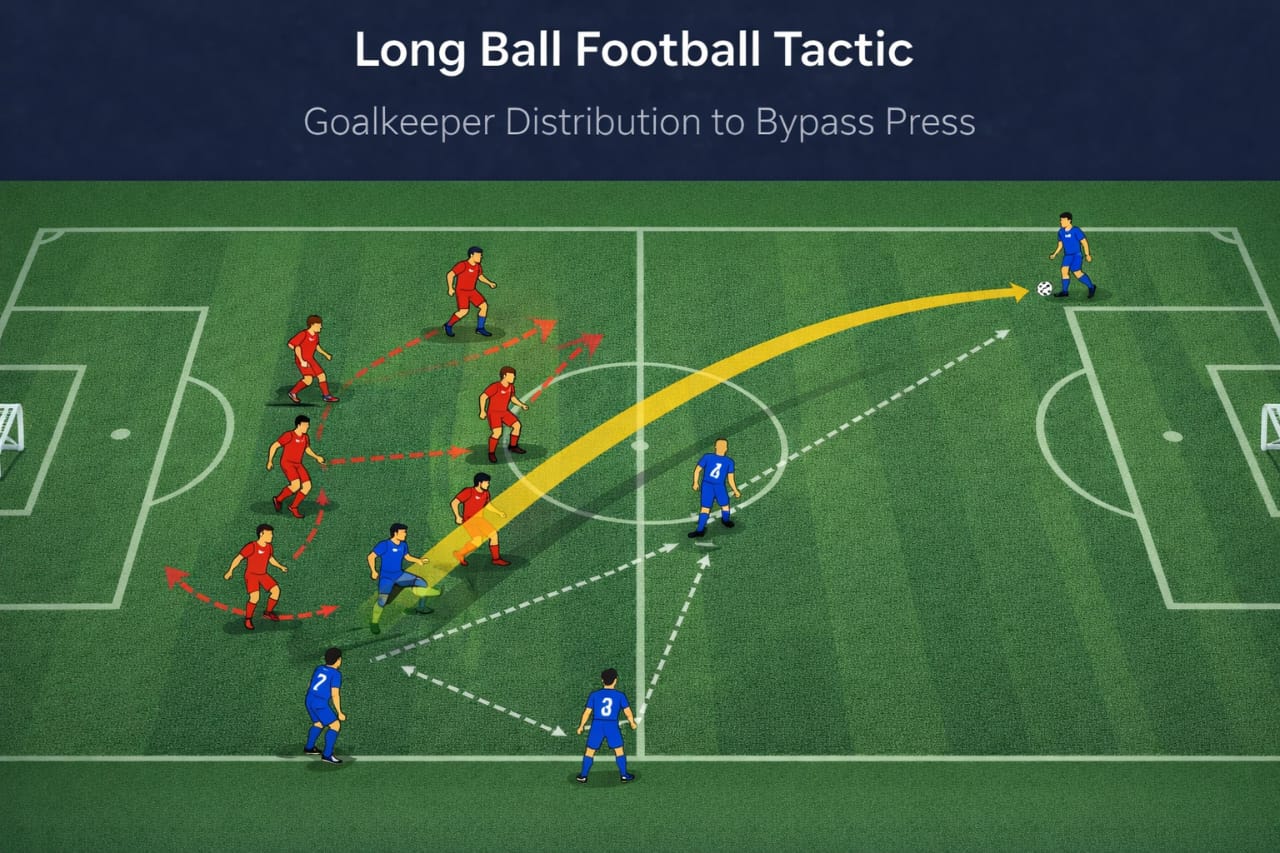
Long balls exploit this weakness by bypassing the entire pressing structure in a single action. Instead of playing through multiple lines of pressure, the ball travels directly into advanced areas where fewer defenders are present, creating immediate advantages and often leading to isolated situations against the defensive line.
This concept is closely connected to how teams beat a high press in football, where bypassing pressure becomes more effective than engaging with it. At the same time, long balls reduce risk in dangerous zones, as losing possession near your own goal against a high press can lead to immediate chances for the opponent.
By playing long, teams avoid these high-risk areas entirely, shifting the game into safer or more advantageous zones while maintaining the potential to attack quickly.
The goalkeeper has become a central figure in modern long-ball strategies, evolving beyond traditional shot-stopping duties to act as a deep playmaker who initiates attacks. With a single pass, the goalkeeper can bypass multiple pressing players and shift the game into the opponent’s half.
This makes distribution a critical tactical weapon, as goalkeepers are often responsible for identifying when to switch from controlled build-up to direct play. This decision is not random but based on reading pressing triggers, teammate positioning, and opponent structure.
Modern goalkeepers vary their distribution deliberately, combining short passes to attract pressure with sudden long balls to exploit the space created. This “bait and exploit” approach forces opponents into difficult decisions, as pressing high increases the risk of being bypassed while staying deep allows controlled build-up.
This dynamic makes long-ball distribution one of the most effective tactical tools in modern football.
Not all long balls are the same, as different situations require different types of passes. One common type is the direct ball into a striker, often used when a team has a forward capable of holding up play and linking with teammates.
Another variation is the diagonal long ball into wide areas, targeting full-backs or wingers positioned away from central congestion. These wide areas are often less protected, making them ideal for receiving under reduced pressure and creating attacking opportunities.
There is also the clipped pass into space behind the defensive line, which is particularly effective when the opposition pushes high and leaves space to exploit. Each type of long ball serves a specific tactical purpose depending on the opponent’s structure and positioning.
This is what separates modern direct play from traditional “kick and rush,” as long balls are no longer random but intentional and structured.

In many long-ball systems, the striker becomes a key reference point, responsible not just for receiving the ball but for controlling it and connecting play. This role requires strength, timing, and awareness, particularly in aerial and physical duels against defenders.
When the ball is played long, the striker must compete effectively, and the outcome of that duel determines whether the attack continues. If successful, the striker can bring teammates into play, while failure requires immediate reaction from surrounding players.
This is why positioning around the striker is crucial, as midfielders and wingers must anticipate where the ball will land. This leads directly into the concept of second balls, which often determine whether the attack continues or breaks down.
The most advanced teams do not just use long balls to escape pressure—they use them to manipulate it. By initially playing short passes, they invite the opposition to press higher up the pitch, which in turn creates more space behind the defensive line.
At the right moment, they switch from short build-up to a long ball, exploiting the space that has been created. This is known as baiting the press, where the opponent’s strength becomes a weakness.
This concept is closely linked to pressing triggers in football, where teams recognize moments of vulnerability and act accordingly. The effectiveness of this approach depends on timing, awareness, and coordinated execution.
There is a common misconception that long balls represent a lack of sophistication, but in reality the opposite is true. Modern direct play requires precise timing, coordinated movement, and a clear tactical understanding of when and where to play the ball.
Players must know when to play long, where to target, and how to position themselves for the next phase of play. This level of coordination makes long-ball strategies highly structured rather than random.
They are not used constantly but at specific moments when they offer the greatest advantage. In this sense, long balls are not replacing possession-based football but complementing it.
The best teams are those that can switch between both approaches depending on the situation, and that flexibility is what defines modern tactical intelligence.
While long balls may appear to focus on the initial pass, most attacks are actually decided by what happens next. The first duel is only the beginning, and the true tactical battle lies in securing the second ball.
Second balls refer to loose possession that follows an aerial duel or contested long pass, where the ball often drops into nearby spaces. Midfielders must react quickly to these moments, as control is determined by who anticipates and reacts first.
This is where structure becomes essential, as teams position players strategically around the target area to recover possession immediately. Without this structure, long balls lose effectiveness, as the opposition can recover and counter-attack.
Because of this, modern teams build a structured “second-ball network” around the striker, ensuring they can maintain attacking momentum even when the initial pass is not cleanly controlled.
This concept is closely connected to counter-pressing in football, where teams react instantly after losing possession to regain control.

To control second balls effectively, teams must maintain compact positioning around the target zone. Midfielders position themselves close enough to react quickly while still maintaining spacing that allows them to receive and play the next action.
This balance is crucial, as being too close makes players predictable and easy to mark, while being too far reduces reaction time. Most teams use triangular or box structures around the striker to create multiple angles for recovery.
This ensures that even if the first action is not controlled perfectly, the team can still regain possession and sustain attacks. Timing also plays a major role, as players must anticipate where the ball will land before the duel occurs.
This anticipation is based on reading body shape, ball trajectory, and defensive pressure rather than guesswork, which is why well-organized teams appear more dominant in these situations.
Winning the second ball is only valuable if the next action is effective. Once possession is regained, teams must quickly decide whether to attack immediately or stabilize the play depending on the situation.
If the opposition is disorganized, a quick forward pass can create a scoring opportunity within seconds, making speed of recognition and execution critical. If not, recycling possession allows the team to maintain control and reset structure.
These decisions are influenced by spacing, support, and the positioning of the opponent’s defensive line. In many cases, second-ball recoveries lead directly to transitional moments where the opponent is not fully organized defensively.
This is why long-ball strategies are closely linked with transitions in football, where quick decision-making defines the outcome.
Despite their effectiveness, long balls are not always the best option, and knowing when to use them is critical. They are most effective against teams that press aggressively and leave space behind their defensive line.
They are also useful when short passing options are limited or when a team needs to relieve pressure quickly. However, against deep defensive blocks, long balls become less effective due to limited space and organized defensive positioning.
In these situations, teams must rely more on positional play and short combinations to break down the structure. This highlights an important point—long balls are a tool, not a standalone system.
The best teams use them selectively, adapting their approach based on the context of the game.
The resurgence of long balls is not a step backward but a tactical adaptation to the modern game. As pressing systems become more intense and structured, teams must find new ways to create space and progress the ball effectively.
Long balls provide that solution by bypassing pressure and shifting play into more favorable areas, but their effectiveness depends on structure, timing, and collective understanding.
Without these elements, long balls become predictable and easy to defend, but with them they become one of the most powerful tools in modern football.
Ultimately, the return of direct play reflects a broader tactical evolution where flexibility and adaptability define success. Long balls are no longer a fallback option—they are a calculated solution within the modern tactical landscape.