Physical Address
MICKYWORLDNG
Physical Address
MICKYWORLDNG


MICKYWORLDNG IS READER-SUPPORTED. WHEN YOU BUY THROUGH LINKS ON OUR SITE, WE MAY EARN AN AFFILIATE COMMISSION AT NO EXTRA COST TO YOU.
Mid block in football is one of the most balanced defensive strategies in the modern game, designed to control space rather than chase the ball. Instead of pressing aggressively high up the pitch or sitting very deep near their own goal, teams position themselves in the middle third, forming a compact and organized structure that limits attacking options.

This approach creates stability for teams across all phases of play. They are not exposed like in a high press, where one mistake can immediately lead to a clear chance, and they are not passive like in a low block, where pressure builds continuously near the penalty area. Instead, the mid block allows teams to control where the game is played and how the opponent progresses forward. Opponents are guided into less dangerous zones, making defending more predictable, structured, and easier to manage over long periods.
At its core, a mid block is built on positioning, discipline, and timing. Players do not rush toward the ball but hold their shape, read the situation carefully, and act only when the right moment appears to apply pressure. Simple definition: A mid block is when a team defends in the middle third with a compact shape to control space and limit central attacks.
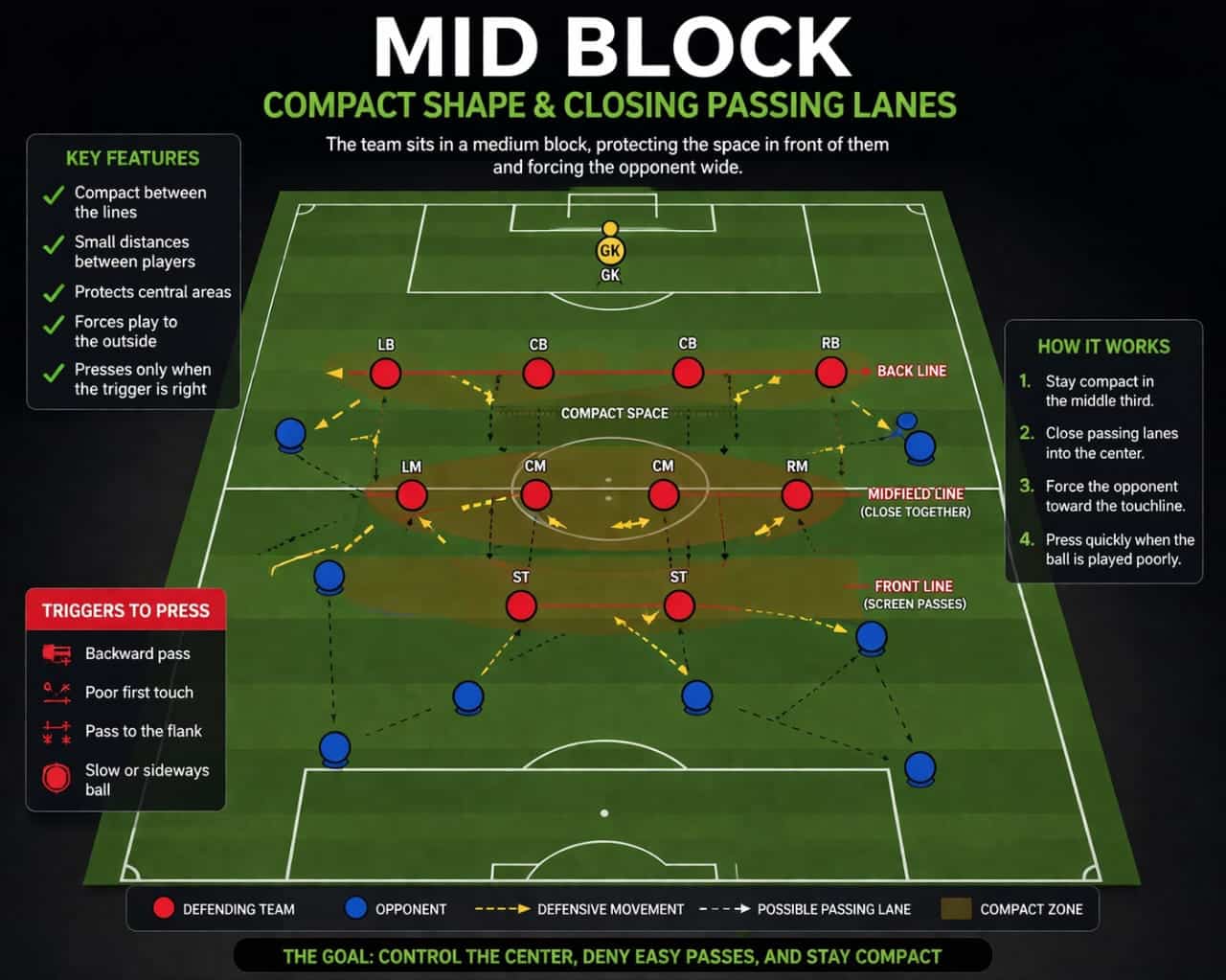
A mid block in football is a defensive system where a team organizes itself in the middle third of the pitch, maintaining compact distances between players to reduce space and limit attacking options. The structure is designed to protect key areas without overcommitting. The defensive line usually sits near the halfway line or slightly deeper, while the midfield line stays close enough to prevent gaps from opening between the lines.
This connection between units is what makes the system difficult to break. The objective is clear: protect central areas and force the opponent wide, where attacking options are more limited and predictable. By doing this, teams reduce the most dangerous threats and control how the opponent builds attacks.
Unlike aggressive systems such as counter-pressing in football, where teams immediately hunt the ball after losing possession, a mid block focuses on structure, patience, and controlled pressure.
To understand why the mid block is so effective, it is important to compare it with other defensive approaches used in modern football. Each system has its strengths, weaknesses, and tactical purpose.

A high press pushes the team high up the pitch to win the ball early and create quick attacking opportunities. However, it also leaves large spaces behind the defense, which can be exploited if the press is broken. A low block sits deep near the penalty area, focusing on protecting the goal and reducing risk.
While this improves defensive security, it often allows the opponent to dominate possession and control the game. The mid block sits between these two extremes, offering a balance between defensive stability and attacking potential. It reduces risk while still allowing teams to step forward and attack when opportunities arise.
The real strength of a mid block in football lies in its ability to control space rather than chase possession. Players position themselves intelligently to block passing lanes and limit forward options for the opponent. This forces opponents into predictable decisions, usually moving the ball toward wide areas.
Wide zones are generally easier to defend compared to central spaces, where most dangerous chances are created. One of the key objectives is to stop players from playing between the lines in football, which is where teams can turn and attack directly at the defense.
By closing central spaces and reducing time on the ball, the mid block limits creativity and forces the opponent into less effective attacking patterns.
Compactness is the foundation of every successful mid block. The team moves together as a unit, keeping distances short both vertically between lines and horizontally across the pitch. This creates a tight defensive structure that is difficult to break down, as there are very few gaps for attackers to exploit.
The closer the players are, the harder it is for opponents to find space. In a well-organized mid block, defenders and midfielders stay connected, the team remains narrow to protect central areas, and spaces between players are minimized at all times.
This structure limits time and space for the opponent, forcing mistakes and increasing the chances of regaining possession.
A key principle of the mid block is directing the opponent away from central areas, where they are most dangerous. Teams position themselves to block passing lanes into midfield and control central zones. As a result, the opponent is pushed toward the wings, where attacking options are more limited and easier to defend.
This is not accidental—it is a deliberate tactical decision. Wide attacks often rely on crosses, which are more predictable and easier to defend than central combinations. This reduces the overall threat level significantly.
By controlling where the opponent plays, the mid block turns defense into a structured and manageable process.
The mid block is built on patience rather than constant aggression. Players maintain their positions and avoid chasing the ball unnecessarily, which helps preserve the team’s structure. This discipline prevents gaps from opening and ensures that the defensive shape remains intact throughout the phase of play.
When the right moment appears—such as a poor touch, a slow pass, or a mistake—the team reacts quickly and applies pressure with intensity. This balance between patience and aggression is what makes the mid block both stable and effective.
Even within a controlled defensive system, there are moments when the team applies pressure. These moments are known as pressing triggers and are key to winning the ball.
These triggers allow the team to remain compact while still being aggressive at the right moments, combining structure with controlled intensity.
Teams use a mid block because it offers a strong balance between defense and attack, making it effective across different levels of football. It does not rely on extreme intensity or deep defending. It is energy efficient, as players do not need to press constantly, which helps maintain performance throughout the game.
This is especially important over long matches or congested schedules. It also provides defensive stability while creating opportunities to counter-attack when possession is regained in the middle third.
This combination of control, discipline, and attacking potential makes the mid block a highly reliable tactical system.
The biggest strength of a mid block in football is its balance between defensive security and attacking potential. It allows teams to stay organized without becoming passive. Unlike a low block, it does not trap the team deep in their own half, and unlike a high press, it does not expose large spaces behind the defense.
It sits perfectly between both approaches, offering flexibility, control, and tactical stability in different phases of the game. This balance is why the mid block remains one of the most widely used and effective defensive systems in modern football.
One of the biggest advantages of a mid block in football is what happens immediately after regaining possession. Because the team defends in the middle third, they are already in a strong position to launch attacks quickly. Unlike a low block, where the team must travel long distances to reach the opponent’s goal, a mid block allows for faster transitions.
Players are closer to attacking zones, which reduces the time needed to create chances. This makes counter-attacking more effective. The moment the ball is won, forward passes can be played quickly into space, often catching the opponent out of shape.
These situations are closely linked to how to beat a high press in football, where quick decision-making and positioning allow teams to escape pressure and attack with speed.
The mid block is not limited to one formation. It can be applied across different tactical systems depending on the team’s style and players. In a 4-4-2, the two banks of four create a compact and balanced structure.
The strikers stay close to midfield, helping block central passing lanes and guide play wide. In a 4-3-3, the midfield triangle allows more flexibility. The front three can press selectively, while the midfield controls space behind them.
Regardless of the formation, the principles remain the same: compactness, discipline, and control of central areas.
While the mid block is effective, it is not impossible to break. Teams that understand its structure can find ways to create opportunities. One common method is quick ball circulation.
Moving the ball from one side to another forces the defensive shape to shift, which can create small gaps. Another solution is positional movement. Players who move intelligently between lines can disrupt the compact structure and create passing options.
This is why concepts like breaking low block in football are also relevant, as both systems rely on compactness and require similar solutions to break them down.
Width is one of the most effective tools against a mid block. Since the structure is designed to stay narrow and protect central areas, wide spaces can be exploited. By switching play quickly from one side to the other, teams can stretch the defensive shape.
This creates situations where players are isolated, often leading to 1v1 opportunities, crosses, or cutbacks from wide areas. The key is speed. If the ball moves too slowly, the defensive block can shift across and remain compact.
Each player has a specific responsibility within a mid block, and the system only works when everyone performs their role correctly. Forwards are responsible for guiding the press and blocking passing lanes into midfield.
They do not press aggressively but instead control the direction of play. Midfielders are the most important unit. They protect central spaces, track movement, and ensure there are no gaps between lines.
Defenders maintain the structure behind them, staying compact and ready to deal with crosses or forward runs. This coordination is what turns the mid block from a simple shape into an effective defensive system.
Despite its effectiveness, the mid block can fail if not executed properly. Small mistakes in positioning or timing can create big problems. One common issue is losing compactness.
If the distance between players becomes too large, gaps appear that attackers can exploit. Another problem is poor timing when pressing. If players step out at the wrong moment, the structure breaks and spaces open up.
Discipline is essential. Without it, the mid block loses its effectiveness and becomes vulnerable.
The mid block is most effective when teams want to stay organized while still having attacking potential. It is often used against strong possession-based opponents. By sitting in the middle third, teams can limit central progression while preparing to counter-attack.
It is also useful when conserving energy, as it requires less constant running compared to a high press. This makes it a practical choice in many tactical situations.
Modern football is faster and more tactical than ever, which makes balance extremely important. The mid block provides that balance. It allows teams to defend effectively without becoming passive and to attack without taking unnecessary risks.
Because of this, it is widely used across different leagues and levels of the game. From top-level teams to developing squads, the mid block remains a reliable and adaptable system.
At its core, mid block in football is about control, discipline, and intelligent positioning. It is not just a defensive tactic—it is a complete system that influences how the game is played. Teams that master the mid block are able to control space, limit danger, and create opportunities to attack.
It is this balance between defense and attack that makes the mid block one of the most effective strategies in modern football. Once you understand how it works, it becomes easier to read matches and recognize how teams control the game without always having the ball.