Physical Address
MICKYWORLDNG
Physical Address
MICKYWORLDNG

MICKYWORLDNG IS READER-SUPPORTED. WHEN YOU BUY THROUGH LINKS ON OUR SITE, WE MAY EARN AN AFFILIATE COMMISSION AT NO EXTRA COST TO YOU.
Pressing triggers in football are the specific moments that signal a team to apply immediate, coordinated pressure on the opponent in possession, and these triggers are not random cues but carefully recognized situations where the opponent is most vulnerable and least prepared to deal with pressure.
At a basic level, pressing may look like players simply running toward the ball, but at a deeper level it is a structured reaction to instability, where the key idea is that teams do not press because they want to press but because the situation allows them to win the ball.
This distinction is important, because without triggers pressing becomes chaotic, with players chasing individually, distances increasing, and the opponent bypassing pressure easily, whereas with triggers pressing becomes synchronized and every movement is connected.
In this structured form, the opponent is forced into a controlled environment where their options are limited and their decisions become predictable under pressure. That is why pressing is not just about intensity, but about recognition and timing within a coordinated system.
One of the biggest misunderstandings about pressing is that it is something teams impose at all times, when in reality pressing is reactive and depends entirely on the opponent’s actions and positioning.
Teams do not press randomly but instead wait, observe, and position themselves in a way that allows them to react quickly when the right moment appears.
This waiting phase is just as important as the pressing itself, because it ensures that when the team commits, it does so with the highest probability of success.
Pressing should therefore be understood as a trap rather than a chase, where the objective is not to run endlessly toward the ball but to guide the opponent into situations where pressure becomes unavoidable.
Once the trigger appears, the reaction must be immediate, coordinated, and decisive to maximize the advantage.
If pressing were simply about effort, teams would press continuously, but football does not allow that because pressing requires players to leave their positions and commit to aggressive actions.
Every pressing action creates space behind the player stepping forward, and if this movement is not supported by structure, the opponent can exploit that space instantly.
This is why pressing must be selective, with teams choosing their moments carefully based on the opponent’s level of control and organization. Teams press when the opponent is disorganized or vulnerable, not when they are stable and comfortable in possession.
This selective approach ensures that pressing remains effective rather than becoming a risky and unsustainable tactic.
For pressing to work effectively, players must be positioned close enough to support each other, making compactness a fundamental requirement of any pressing system.
When distances between players are small, pressure can be applied quickly and collectively, with the pressing player immediately supported by teammates who close passing lanes and reduce available space.
If the team is stretched, pressing becomes ineffective, as even a quick reaction from one player cannot be supported by others who are too far away.In such situations, the opponent can easily play around the pressure and exploit the gaps between units.
This is why pressing is often associated with teams that defend higher up the pitch, where compactness is easier to maintain.
A high defensive line in football compresses space and brings players closer together, making it easier to react quickly to pressing triggers.The shorter the distance between players, the faster and more effective the collective reaction becomes.
Pressing triggers are not isolated actions but moments where multiple conditions combine to create vulnerability in the opponent’s structure and decision-making process.
These conditions often include limited time on the ball, restricted passing options, poor body orientation, and reduced awareness of surroundings.
When these factors align, the player in possession becomes exposed and susceptible to immediate pressure. This is the moment when pressing is activated, as the opponent is least prepared to respond effectively.
The key is not only identifying these triggers but recognizing them early enough to act before the opponent recovers control.
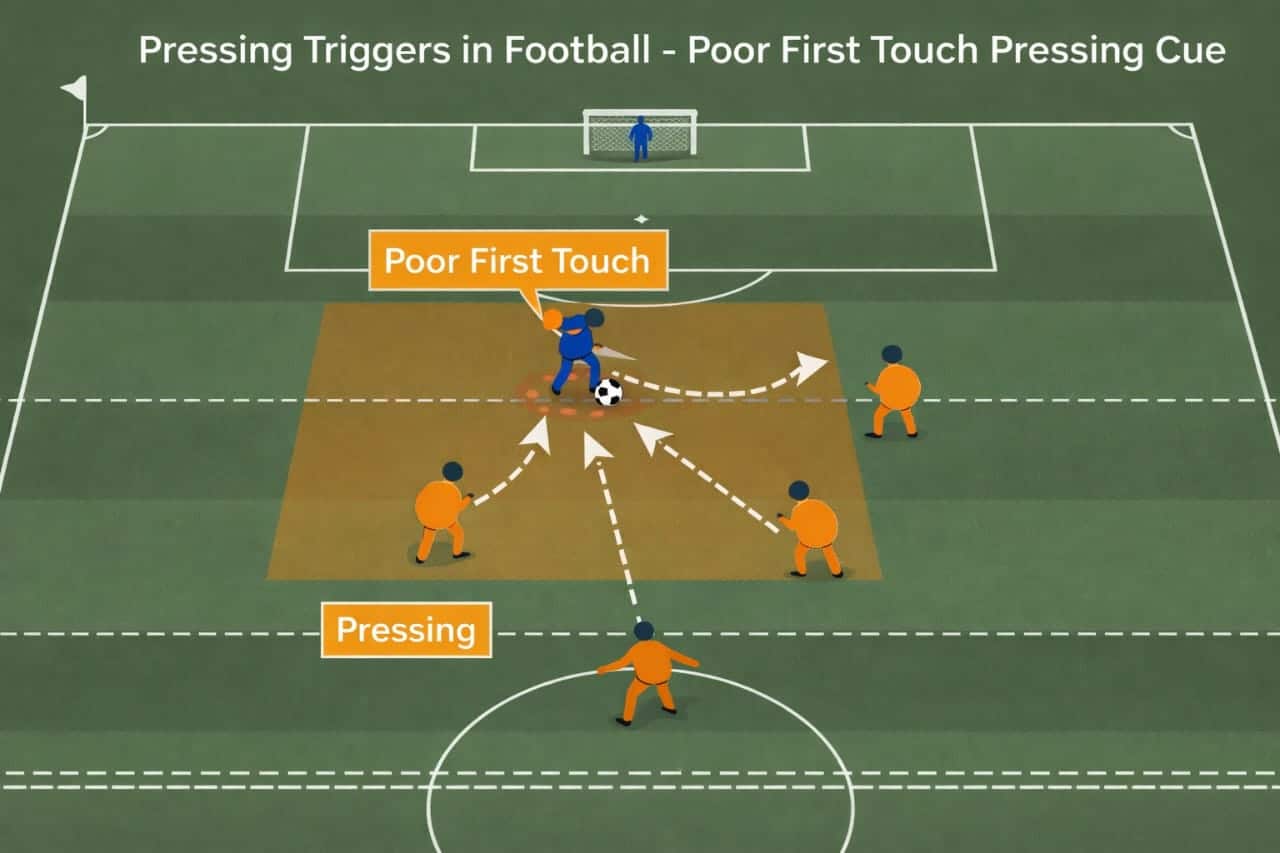
A poor first touch is one of the clearest and most effective pressing triggers in football, as it represents a moment where control is temporarily lost and the player becomes vulnerable.
When the ball moves slightly away from the player, they require an extra moment to regain control, and that moment becomes the window for pressing.
Elite defenders recognize this instantly and react without hesitation, closing the distance before the opponent can recover their balance or awareness.
This reaction must be explosive and decisive, ensuring that the advantage created by the poor touch is fully exploited. At the same time, teammates move to support by blocking passing lanes, marking nearby options, and isolating the player in possession.
What begins as a small technical mistake quickly becomes a significant tactical disadvantage for the opponent.This illustrates the essence of pressing triggers, where small errors are transformed into opportunities through coordinated pressure.
Football at the highest level is defined by control, with teams working constantly to maintain possession and minimize mistakes.This means that clear opportunities to win the ball are rare, making pressing triggers extremely valuable within the game.
Pressing triggers allow teams to create these opportunities rather than waiting for them to occur naturally.Instead of reacting after the opponent loses control, teams apply pressure at the right moment to force mistakes proactively.
This proactive approach distinguishes organized pressing from passive defending, as it shifts the initiative to the defending team. By acting before the opponent becomes comfortable, teams gain control over the situation and increase their chances of regaining possession.
Pressing is not only about speed but also about direction, as the angle of approach determines the options available to the opponent.
Players do not run directly at the ball without thought but instead angle their runs to block specific passing lanes and guide the opponent toward less dangerous areas.This directional pressing transforms pressure into control, as the opponent is forced into predictable movements and decisions.
The pressing player may approach from one side, deliberately forcing the opponent to play in a certain direction where teammates are already positioned to respond.This coordinated approach ensures that the opponent is not just pressured but controlled within a structured environment.
The first player to press is often the most visible part of the action, but they are only one element within a larger team process.
The success of pressing depends on the collective response behind that initial action, as supporting players must anticipate the next pass and close space effectively.
If this support is missing, the press fails, allowing the opponent to bypass the first player and exploit the space left behind.
This is why pressing triggers must be recognized and acted upon by the entire team rather than individual players acting alone.Only through collective understanding and coordination can pressing achieve its intended effect.
Timing is the most critical factor in determining whether pressing succeeds or fails, as reacting at the wrong moment reduces effectiveness significantly.
If the press is triggered too early, the opponent still has control and can play out of pressure comfortably, while if it is triggered too late, the opportunity has already disappeared.
The ideal moment occurs when the opponent is transitioning from control to action, where they are about to make a decision but have not yet executed it.This moment represents vulnerability, as the player is neither fully stable nor fully prepared to respond.
Elite teams identify this moment consistently and act with precision, applying pressure when the opponent is least prepared.This precision is what makes pressing triggers such a powerful tactical tool in modern football.
A backward pass is one of the most reliable pressing triggers in football because it often signals a loss of attacking momentum and limited forward options.
When a team is forced to play backwards, it usually indicates that forward passing lanes are closed, creating an opportunity for the defending team to step forward.
The receiving player is often facing their own goal, which reduces their awareness and makes decision-making slower and more predictable.
Pressing teams recognize this instantly, reacting as soon as the backward pass is played by accelerating toward the receiver and compressing space.

This creates a pressing trap, where the opponent appears to have a safe option but is actually being guided into a situation of unavoidable pressure.
These situations develop quickly, often before the receiving player can adjust their body or scan the field.Coordination is essential, as one player presses while others block passing lanes and the team shifts forward collectively.
When executed correctly, the opponent is left with only risky options such as forced passes, long clearances, or turnovers.
The sideline is one of the most effective tools in pressing because it naturally limits the opponent’s movement and available options.Unlike central areas where players can move in multiple directions, wide areas restrict movement and reduce escape routes.
When the ball is played toward the touchline, the pitch itself acts as an additional defender, increasing the effectiveness of pressing actions.
Pressing teams use this advantage by forcing play wide and applying pressure aggressively in these areas.The player in possession has fewer options, and the angle of escape becomes limited, making it easier to isolate and challenge them.

The pressing player approaches quickly while teammates block passes inside, effectively trapping the opponent between the touchline and the pressing unit.This is not simply pressure but controlled and directed pressure designed to eliminate safe options entirely.
Pressing triggers are often used to create traps rather than simply reacting to mistakes, allowing teams to guide opponents into vulnerable situations intentionally.
Teams may allow passes into specific zones, knowing that once the ball arrives, the conditions for pressing will be optimal.
This involves controlling passing lanes, shaping defensive positioning, and anticipating the opponent’s next move.Instead of chasing the ball, the team controls where the ball is directed and prepares to apply pressure at that moment.
Once the ball enters the targeted zone, the press is triggered instantly, maximizing the chance of success.This transforms pressing into a strategic tool rather than a purely reactive action.
Pressing does not function in isolation but is closely linked to the overall defensive structure of the team.Some teams press aggressively to win the ball high, while others prefer to remain compact and wait for deeper triggers.
This contrast is evident when comparing approaches such as a low block vs high defensive line in football, where teams balance risk and control differently.
The chosen approach depends on tactical identity, player characteristics, and risk tolerance.Regardless of the approach, pressing triggers remain essential in determining when to step forward and when to stay compact.
While pressing focuses on the ball, the defensive line behind the press plays a crucial supporting role in maintaining structure.
If the back line does not move in sync with the pressing action, gaps can appear between units and become exploitable.These gaps can be attacked quickly if the opponent bypasses the initial pressure.
Defensive coordination ensures that as the press moves forward, the rest of the team adjusts accordingly to maintain compactness.
This coordination is often linked to the use of an offside trap in football, where defenders step up together to reduce space.This synchronization ensures stability even during aggressive pressing phases.
Not every pressing action succeeds, and when the opponent escapes the press, the defending team must react immediately.
This requires quick recovery positioning, with players reorganizing, tracking runners, and closing space to prevent dangerous situations.Effective teams transition smoothly from pressing to defending without losing their structure or balance.
The ability to recover quickly is just as important as the ability to press effectively.Pressing triggers in football are not minor tactical details but fundamental elements of how the modern game is played.They allow teams to regain possession quickly, control space, and disrupt the opponent’s rhythm consistently.More importantly, they turn defensive moments into attacking opportunities by winning the ball high up the pitch.
This creates immediate chances before the opponent can reorganize defensively.Pressing is therefore not about constant aggression but about recognizing the right moment to act.
Teams that master pressing triggers do not just defend effectively—they control the flow of the game and force opponents into situations where mistakes become inevitable.