Physical Address
MICKYWORLDNG
Physical Address
MICKYWORLDNG

MICKYWORLDNG IS READER-SUPPORTED. WHEN YOU BUY THROUGH LINKS ON OUR SITE, WE MAY EARN AN AFFILIATE COMMISSION AT NO EXTRA COST TO YOU.
When to play short vs long in football is one of the most important decision-making processes in the modern game. Every pass is a choice, and that choice determines whether a team keeps control, breaks pressure, or creates an attacking opportunity. At the highest level, players are not just executing passes—they are constantly reading the game, evaluating risk, and selecting the most effective option in real time.
This article is part of the Football Tactical Mastery Series.
The decision between short and long passing is never random. It is a constant evaluation of risk, space, and opportunity, often made within seconds. The best players do not think in terms of style—they think in terms of solutions, adapting their choices based on what the situation demands rather than following a fixed pattern.
In modern football, the game moves too quickly for hesitation. Players must process information before the ball arrives, not after, which is why decision-making is closely linked to scanning, body orientation, and awareness. Every situation presents a different problem, and the best players do not rely on one style—they adapt based on what the game demands.
That is the foundation of decision-making in football, where understanding context becomes more important than preference, and where flexibility becomes the defining trait of high-level performance.
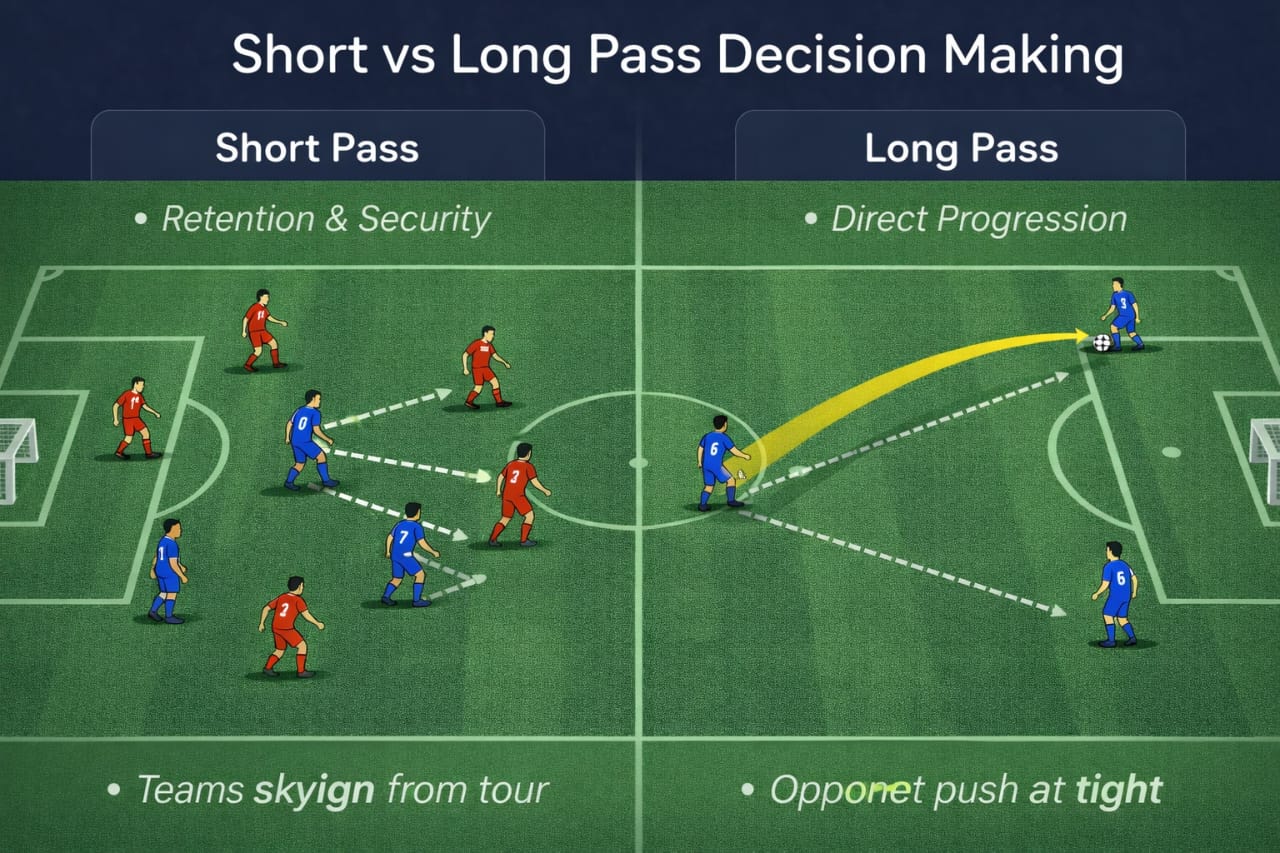
Short passing is primarily about control, allowing teams to maintain possession, circulate the ball, and manipulate the opponent’s shape. When used effectively, it creates angles, overloads, and numerical superiority in specific areas of the pitch, making it easier to progress the ball without losing control while also maintaining structural balance.
Long passing, on the other hand, is about progression, aiming to move the ball forward quickly and often bypass multiple opponents in a single action. Instead of building through pressure, long passes can eliminate it completely, turning defensive situations into attacking opportunities within seconds.
This difference is crucial because one prioritizes stability while the other prioritizes verticality, but neither is inherently better. The effectiveness of each depends entirely on the situation, which is why understanding context is more important than choosing a style.
Short passing becomes most effective when a team can create numerical superiority around the ball. If a player has multiple nearby options, quick combinations can break pressure and maintain control, especially in structured build-up phases where teams aim to progress through organized passing sequences.
By using short passes, teams can draw opponents toward the ball, creating space elsewhere on the pitch. This concept is often used to manipulate pressing systems, where teams invite pressure intentionally and then exploit the space that appears as a result.
This is closely related to how teams handle press resistance in football, where composure, positioning, and awareness allow players to escape tight situations without losing control of possession.
However, short passing under pressure requires precision. Poor spacing or slow decision-making can lead to turnovers in dangerous areas, which is why players must constantly adjust their positioning to remain available and create passing angles. Without this structure, short passing becomes risky rather than effective.
Long passing is most effective when the opponent commits players forward to press, because in these situations space naturally opens behind the defensive structure. Instead of playing through multiple lines of pressure, a single long pass can bypass them entirely and create immediate attacking opportunities.
This often leads to open situations against the defensive line and can turn defensive pressure into an attacking transition within a single action. It is not just a clearance—it is a strategic decision that changes the state of the game instantly.
Long passes are also useful when short options are limited. If passing lanes are closed and pressure is intense, attempting to play short can be dangerous, and in these moments playing long reduces risk while shifting the game into a safer or more advantageous area.
This approach is a key part of how teams beat a high press in football, where bypassing pressure becomes more effective than engaging with it directly. However, long passing is not just about distance—it requires timing, accuracy, and coordinated movement, otherwise possession can be lost easily.
The most effective teams do not rely exclusively on short or long passing. Instead, they combine both approaches to create unpredictability, reflecting a shift in modern football where adaptability is more valuable than strict adherence to a single style.
This is known as a hybrid approach, where teams may begin with short passes to draw the opponent forward and then switch to a long pass once the press is triggered and space opens behind. This sequence turns defensive pressure into an attacking opportunity.
It is not about choosing one style—it is about using both intelligently. Players must recognize the moment when the game shifts from control to progression, and this transition is where decision-making becomes most important.
The ability to switch between short and long passing at the right time is what defines high-level football intelligence.

Decision-making in football is driven by triggers, which are visual cues that help players determine the best option in real time. One key trigger is pressure intensity—if multiple opponents are closing down quickly, playing long may be the safer and more effective choice.
Another trigger is space availability. If there is space between or behind defensive lines, a long pass can exploit it, while limited space may favor short passing to maintain control. Positioning also plays a role, as well-positioned teammates make short passing easier and more reliable.
Timing is equally important because the same situation can produce different decisions depending on when the ball is played. This is why elite players constantly scan, adjust, and anticipate rather than simply reacting to what is happening in front of them.
Every pass carries a level of risk and reward. Short passes are generally safer but may not always progress play, while long passes can create immediate advantages but carry a higher risk of losing possession if executed poorly.
The key is balancing these factors based on the situation. In defensive areas, safety is often prioritized to avoid costly mistakes, while in attacking areas risk becomes more acceptable because the potential reward is higher.
This balance shapes decision-making throughout a match, as players must constantly evaluate whether maintaining possession or advancing the ball offers the greater advantage. There is no fixed answer, and the correct decision changes with every situation.
That is what makes football a dynamic and complex game.
The decision of when to play short vs long in football becomes clearer when broken down into phases of play, because each phase presents a different tactical problem. Football is fluid, and what works in one moment may become ineffective in the next.
In the build-up phase, short passing is often used to establish control. Teams spread out, create passing angles, and progress the ball with structure, focusing on stability rather than speed while manipulating the opponent’s shape to open passing lanes.
However, this approach depends heavily on spacing and support. If the opposition applies aggressive pressure, continuing to play short becomes risky, and in these moments long passing becomes a strategic solution rather than a last resort.
As play moves into midfield, the decision becomes more complex, requiring players to balance control and progression. In the final third, short passing is used to break compact defenses, while long diagonal passes can stretch defensive structures and create isolation on the far side.
Positioning shapes every decision on the ball, as available options are defined before a player even receives possession. Good positioning creates clear passing angles, supports short combinations, and maintains structure.
When spacing is poor, options disappear, forcing players into difficult decisions under pressure. In these situations, long passing often becomes the safer option because it removes immediate pressure and shifts play to a different area.
Well-structured teams avoid this problem by maintaining consistent spacing, ensuring players are always available. This connection between positioning and decision-making is also visible in counter-pressing in football, where structure supports immediate reactions after losing possession.
Good positioning prepares the team for every possible outcome, not just the current situation.
Long passing is often misunderstood because focus is placed on the initial pass rather than what follows. In reality, the second ball is where control is truly decided.
When a long ball is played, it often leads to a duel, and the outcome determines where the ball drops next. Teams that anticipate this moment gain a significant advantage by positioning players around the expected landing zone.
This creates a structured environment where winning the second ball becomes more likely. Without this structure, long passes become ineffective because the opposition can recover possession easily.
This is why long passing must be supported by coordinated movement—it is part of a wider tactical plan rather than an isolated action.

Decision-making is guided by repeating patterns in the game. Pressure, defensive positioning, and player movement all act as triggers that influence whether short or long passing is more effective.
When opponents press aggressively, long passing becomes more effective because space opens elsewhere. When teams defend deep, short passing becomes necessary to break down compact structures.
Movement also plays a key role. Runs behind the defense create opportunities for long passes, while close positioning supports short combinations. Recognizing these patterns allows players to make faster and more accurate decisions.
This awareness connects directly to transitions in football, where identifying moments of imbalance can quickly turn defense into attack.
Short and long passing influence tempo in different ways. Short passes slow the game down and allow teams to maintain control, while long passes increase tempo by moving the ball quickly into advanced areas.
This change in tempo can disrupt defensive organization, making it a valuable tactical tool. Teams may slow the game to reduce risk or speed it up to exploit disorganization.
The decision between short and long passing is therefore also about controlling rhythm, not just space. Players must understand when to control the game and when to accelerate it.
This balance is essential for managing different situations effectively.
Many mistakes in football come from poor decisions rather than poor technique. Forcing short passes under heavy pressure often leads to dangerous turnovers, while playing long without structure results in lost possession.
Hesitation is another major issue because delayed decisions reduce the effectiveness of both short and long passing. Good decision-making requires clarity, speed, and confidence.
Players must commit to their choices and execute them without hesitation, which comes from understanding the game rather than simply reacting to it.
The best teams are not defined by one style—they adapt continuously based on the situation. They use short passing to control the game and long passing to exploit opportunities.
This flexibility makes them unpredictable and difficult to defend against, as opponents cannot prepare for a single approach. The strategy evolves constantly during the match.
This adaptability reflects a deeper understanding of the game and the ability to apply that understanding in real time.
When to play short vs long in football ultimately comes down to decision-making. Every moment requires players to interpret the situation, evaluate options, and choose the most effective action.
This process involves awareness, positioning, timing, and understanding of the game. There is no fixed rule, as the correct decision changes constantly depending on context.
Players who master this skill are able to control matches, influence tempo, and create consistent advantages for their team, making decision-making the true foundation of modern football intelligence.