Physical Address
MICKYWORLDNG
Physical Address
MICKYWORLDNG

MICKYWORLDNG IS READER-SUPPORTED. WHEN YOU BUY THROUGH LINKS ON OUR SITE, WE MAY EARN AN AFFILIATE COMMISSION AT NO EXTRA COST TO YOU.
Press resistance in football is not just a technical ability—it is a complete tactical behavior that determines whether a team can survive and progress under pressure. In modern football, where pressing systems are aggressive, coordinated, and relentless, players are constantly forced to operate in tight spaces with minimal time.
This means that the difference between losing the ball and breaking through pressure is often decided before the ball even arrives, as the best players do not simply react to pressure but anticipate it, prepare for it, and manipulate it through intelligent movement and awareness.
At its highest level, press resistance is built on three interconnected foundations: scanning, body orientation, and first touch. These elements do not function separately but form a continuous sequence that allows a player to receive, turn, and escape pressure in one fluid action.
In modern football, pressing systems have become more aggressive and structured, making press resistance one of the most valuable qualities on the pitch. Teams that cannot operate under pressure are forced into predictable play, while those that can consistently escape it gain control of both possession and tempo.
Understanding this sequence is what separates average players from elite ones, because while many players can control the ball, very few can do it effectively while being pressed aggressively from multiple directions at once.
To truly understand press resistance, you must first understand what happens in the seconds before a player receives the ball, as those moments determine everything that follows.
Scanning is the starting point of press resistance, as it involves constantly checking surroundings to gather information about space, opponents, and passing options before the ball arrives. Without scanning, a player receives the ball blindly, but with scanning they receive with a clear plan already formed.
The most effective players scan multiple times before receiving, using quick checks to build a mental picture of their environment. They identify where pressure is coming from, where free space exists, and which passing options are available, allowing them to act immediately rather than hesitate.
This process follows a clear pattern, beginning with broad scans that assess the overall structure of the pitch, including defensive lines, teammate positioning, and available space. This is followed by the most important moment—the final scan before receiving—which updates information in real time.
During this final scan, players identify the nearest defender, the angle of pressure, and the safest direction to move. This is why scanning is directly linked to decision-making speed, as players who have already gathered information do not need extra time after receiving the ball.
In tight areas, especially when playing between the lines, scanning becomes even more critical because pressure can come from multiple directions, including blind spots that are difficult to detect without awareness.
With proper scanning, situations that appear dangerous become opportunities, as players can turn into space, combine quickly, or bypass pressure entirely. However, awareness alone is not enough if the player is not positioned correctly to use that information effectively.

Once a player has scanned and understood their surroundings, the next step is positioning their body correctly before receiving the ball. Body orientation is one of the most underrated yet most important aspects of football, as it determines whether a player can escape pressure or become trapped.
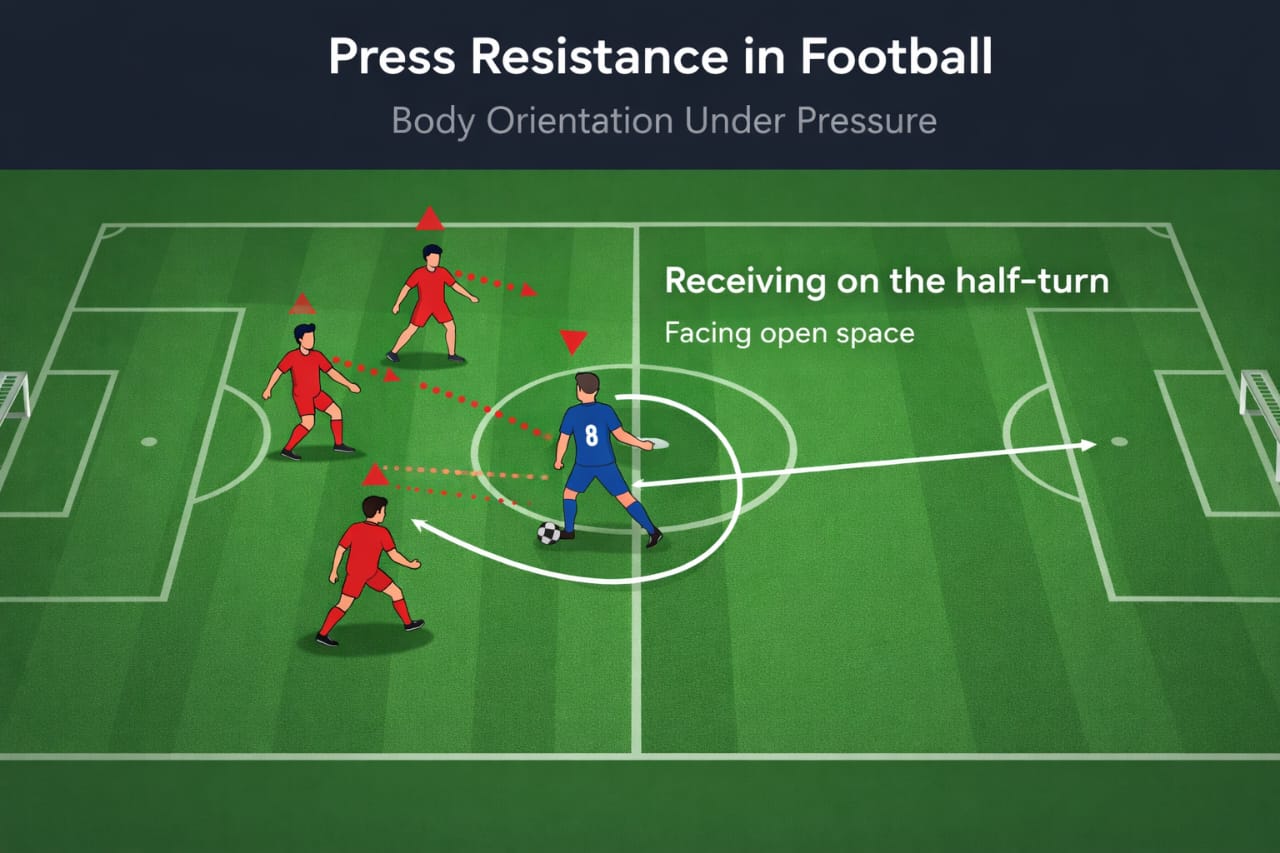
The key principle is to receive the ball in a way that keeps as many options open as possible. This is why elite players rarely receive facing their own goal and instead position themselves on the half-turn, allowing them to see both the passer and the space ahead.
This small adjustment changes everything, as receiving on the half-turn enables immediate forward movement, whether through dribbling, passing, or accelerating into space without needing additional touches.
In contrast, receiving square or facing backwards slows down decision-making, giving defenders time to close down and apply pressure. Body orientation also helps create separation, as slight positional adjustments can create a buffer zone between the player and the defender.
This buffer provides just enough space to execute the next action, while balance ensures the player can move in multiple directions. This unpredictability makes it much harder for defenders to anticipate and intercept movements.
In many situations, correct body orientation alone can eliminate pressure before the first touch is even made, demonstrating its importance in the overall sequence of press resistance.
If scanning provides information and body orientation creates options, then the first touch is where everything comes together, determining whether a player escapes pressure or becomes trapped.
At elite level, this moment is rarely reactive, as it is pre-planned through scanning and positioning. This allows players to execute their next action in a single movement, reducing time and increasing efficiency under pressure.
A common mistake is treating the first touch as simple control, but in reality it must have a clear purpose—moving the ball away from danger and into space. This is known as directional control, where the touch actively shapes the next action.
Instead of stopping the ball, players guide it into safer or more advantageous areas, whether that means turning away from pressure, moving into space, or setting up a pass. This requires anticipation, as the player must already know where the space is before receiving.
Touch speed also matters, as smaller and quicker touches allow for better control and faster adjustments in tight areas. The surface of the foot is equally important, with different techniques used depending on the situation.
This is closely linked to the broader concept of first touch in football, where control is not passive but actively shapes the next phase of play.
What separates elite players is not just technique but their ability to manipulate time and space. Press resistance is not about having more time—it is about creating time through intelligent actions.
By scanning early, positioning correctly, and executing the right first touch, players slow the game down for themselves while speeding it up for their opponents. This creates a psychological advantage where defenders are forced to react rather than control the situation.
Over time, this shifts the balance of the game, as teams that resist pressure effectively gain control of possession, dictate tempo, and create better attacking opportunities. In contrast, teams that struggle under pressure are forced into mistakes and rushed decisions.
This is why press resistance is not just an individual skill but a key part of a team’s tactical identity.
In modern football, midfielders are judged heavily on their ability to operate under pressure, as central areas are the most congested and demanding spaces on the pitch. Players must receive, turn, and progress the ball while being pressed aggressively.
Those who excel in these situations become the foundation of their team’s build-up play, connecting defense to attack and maintaining control even in difficult conditions.
Without press-resistant players, teams struggle to progress through pressure and are often forced into long balls or turnovers. With them, the same pressure becomes an opportunity rather than a threat.
This is the true value of press resistance—it transforms defensive pressure into attacking advantage.
While individual ability is essential, press resistance becomes far more effective when combined with team structure and coordinated movement. Football is a collective game, and the best way to escape pressure is often through quick combinations rather than individual actions.
Short passing sequences, particularly one-touch or two-touch combinations, allow the ball to move faster than pressing players can react. This reduces pressure on the ball carrier and creates opportunities to progress forward.
The concept of the third man is especially important, where a player under pressure passes to a teammate who then finds a third player in space. This movement disrupts defensive structure and creates new passing angles.
This principle is explained in third man runs in football, where coordinated movement provides solutions that static positioning cannot offer.
When executed correctly, these combinations break pressing lines completely and allow players to face forward with space, making speed and timing critical.
Not every situation allows for immediate escape, and there are moments when players must hold possession under pressure while waiting for support. This is where shielding becomes a critical tool.
Shielding is not just about strength but about positioning, as players use their body to protect the ball while maintaining balance and control. The best players do this while keeping the flow of the game intact.
By adjusting body angle and weight, they create time for teammates to reposition and open new passing options. Even small delays can significantly change the situation in tight areas.
One of the most advanced aspects of press resistance is the ability to attract pressure intentionally rather than avoid it. Top players sometimes hold the ball just long enough to draw defenders toward them.
This creates space elsewhere on the pitch, which can then be exploited with a quick pass or combination. This “bait and release” action disrupts defensive structure and creates immediate opportunities to progress.
It requires precise timing, awareness, and composure, as mistakes can lead to turnovers. However, when executed correctly, it breaks pressure efficiently and with minimal effort.

Press resistance depends not only on the player in possession but also on how teammates position themselves. A well-structured team always provides multiple passing options at different angles and distances.
This spacing is essential, as players who are too close attract the same pressure while those too far away make passes risky. The balance between support and spacing determines effectiveness.
Teams often create triangles and diamond shapes around the ball to ensure constant passing options, forcing defenders to cover multiple angles simultaneously.
These principles are closely linked to how teams beat a high press in football, where structure and positioning are key to breaking pressing systems.
Even the best players struggle when small details are not executed correctly, as press resistance depends on precision in multiple areas.
Lack of awareness leads to players being caught off guard, while poor body orientation limits options and slows decision-making. A poor first touch can invite pressure and result in turnovers.
These small errors are punished immediately at the highest level, which is why press resistance must be developed consistently through training and match experience.
Press resistance in football is no longer optional but essential in the modern game. Teams that can operate under pressure maintain control, dictate tempo, and create more attacking opportunities.
Those that cannot are forced into mistakes, long clearances, and defensive situations. At the individual level, press-resistant players stand out because they remain calm and effective under pressure.
They turn tight situations into advantages and make difficult actions look simple, demonstrating the true value of this skill.
Ultimately, press resistance is not just about surviving pressure—it is about turning it into the starting point of control, progression, and tactical dominance.