Physical Address
MICKYWORLDNG
Physical Address
MICKYWORLDNG

MICKYWORLDNG IS READER-SUPPORTED. WHEN YOU BUY THROUGH LINKS ON OUR SITE, WE MAY EARN AN AFFILIATE COMMISSION AT NO EXTRA COST TO YOU.
Football positions explained is one of the most important foundations for understanding how the game actually works. Every player on the pitch operates within a role, but those roles go far beyond simple labels like defender, midfielder, or attacker.
This article is part of the Football Tactical Mastery Series.
At the highest level, positions define how a team controls space, builds attacks, and defends effectively. Without understanding positions, it becomes difficult to understand tactics, movement, or decision-making in football.
Modern football has evolved beyond rigid structures. Players are no longer fixed to one zone—they move, rotate, and adapt depending on the situation. This means understanding roles is now more important than simply memorizing positions.
To truly understand the game, you must understand what each position does, how it connects to others, and why it exists within a tactical system.
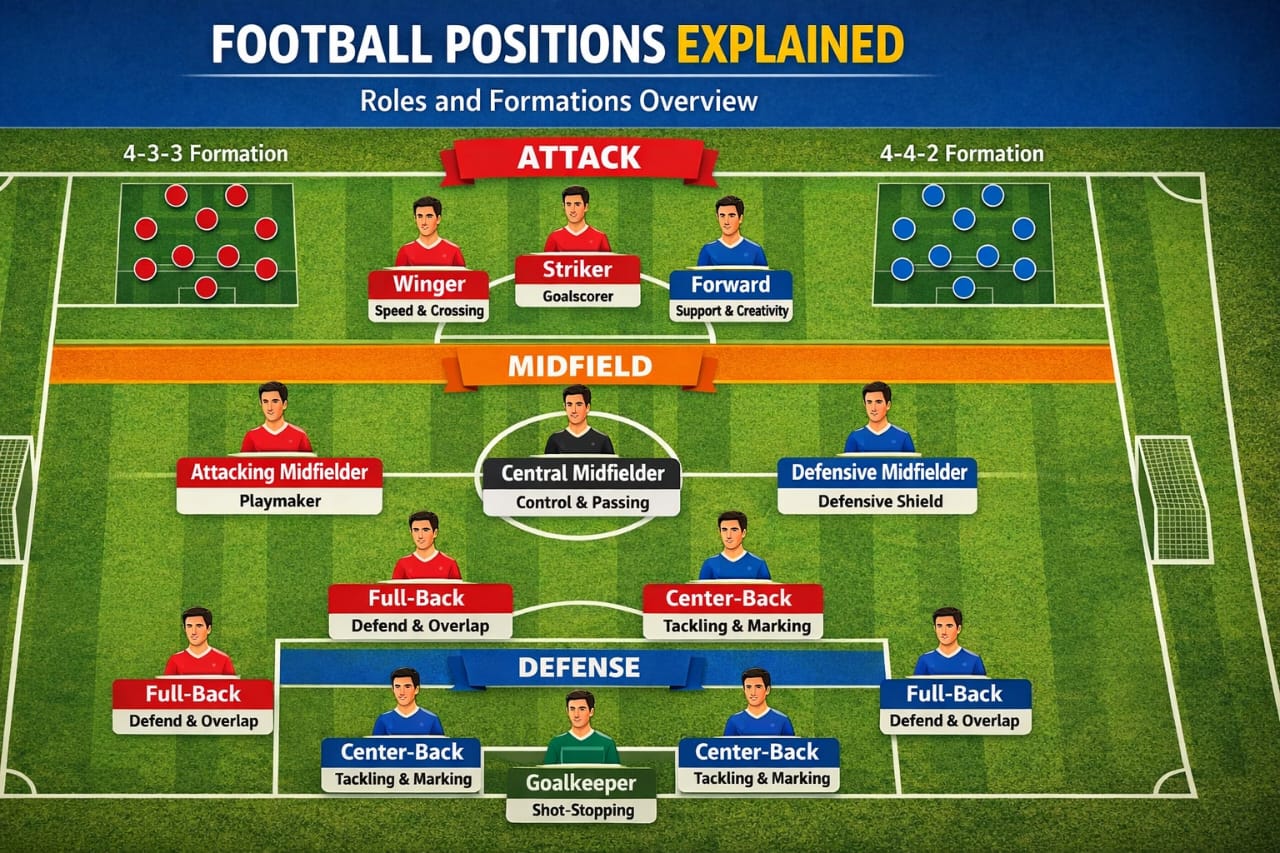
Every football team is built around three main units. These units create balance across the pitch and ensure that all areas are covered.
This structure may seem simple, but within each unit, roles vary significantly depending on tactics and formations. For example, a midfielder in one system may focus on defending, while in another system they may operate higher up the pitch creating chances.
This is why understanding roles is more important than just naming positions.
The goalkeeper is traditionally seen as the last line of defense, but in modern football, their role has expanded significantly. Today’s goalkeepers are expected to start attacks from the back, act as an extra outfield player in build-up, organize the defensive line, and cover space behind defenders.
This evolution is closely connected to how teams build play under pressure. In systems that emphasize possession, the goalkeeper becomes a key part of the structure. Without a goalkeeper who is comfortable on the ball, it becomes difficult to control the game from deep areas.
Defenders are responsible for stopping the opposition, but they also play an important role in possession. Modern defenders are expected to contribute both defensively and offensively.
Center-backs operate in central defensive areas and are responsible for marking attackers, winning aerial duels, maintaining defensive structure, and progressing the ball forward.
In modern football, center-backs are also expected to be composed on the ball and capable of initiating attacks.
Full-backs operate on the sides of the defensive line and have a dual role, combining defensive responsibility with attacking contribution.
In many systems, full-backs are key to stretching the pitch and creating space for midfielders. Some teams even use inverted full-backs, where they move into central areas instead of staying wide.
Midfield is the most important area of the pitch because it connects defense and attack. Midfielders influence the tempo of the game, control possession, and help both defensively and offensively.
This role is closely connected to playing between the lines in football, where positioning and awareness are key to receiving the ball in dangerous areas. Midfielders must constantly scan, adjust their positioning, and make quick decisions.
Forwards are responsible for scoring goals, but their role also includes creating space and disrupting defensive structures. Different types of forwards include strikers, wingers, and inside forwards, each contributing in different ways.
Modern forwards are also expected to press defenders and contribute defensively, which makes their role more complex than simply scoring goals.
Positions are always connected to formations. A formation determines how players are arranged on the pitch and directly influences their responsibilities.
Each formation changes the responsibilities of positions. For example, a winger in a 4-3-3 may stay wide, while in a different system they may move inside more often. This shows that positions cannot be understood in isolation—they must be understood within a system.
One of the biggest changes in modern football is positional fluidity. Players are no longer restricted to a single zone but instead rotate positions, adapt to different phases of play, and exploit space dynamically.
This concept is strongly linked to positional play in football, where structure and spacing are more important than fixed positions. Teams use this fluidity to create advantages and break defensive structures.
Every position exists to control space on the pitch. Defenders protect central areas, midfielders control transitional zones, and attackers exploit advanced spaces.
Understanding how positions relate to space is what allows players to make better decisions. This is why positional awareness is a key part of tactical intelligence.

At the highest level, football is not just about where you play—it is about how you use your position to influence the game. Players who understand this become more effective, more adaptable, and more valuable within any system.
Understanding football positions explained at an advanced level requires going beyond basic roles and looking at how positions function within modern tactical systems. In today’s game, players are not defined by where they stand, but by what they do in different phases of play.
This shift has transformed football from a positional game into a functional one. A player may start in one position but perform multiple roles depending on whether the team is attacking, defending, or transitioning.
As a result, the modern game demands intelligence, adaptability, and a deep understanding of space.
Traditional football relied on fixed positions. Defenders stayed back, midfielders stayed central, and attackers stayed forward. That structure no longer exists at the highest level.
Today, players constantly rotate and adjust their positioning to create advantages. A full-back may move into midfield, a winger may drift centrally, and a midfielder may push into the attacking line.
This fluidity creates unpredictability, making it harder for opponents to maintain defensive structure. Instead of thinking in positions, modern teams think in functions—who is controlling space, who is creating width, and who is occupying central zones.
To fully understand roles, you must look at how they change across different phases of the game.
When a team has the ball, positions are structured to create passing options, stretch the opposition, and control the tempo. Players spread out to occupy key zones, ensuring that the team can progress the ball effectively.
When defending, positions become more compact. Lines stay close together, central areas are protected, and players shift as a unit to reduce space and limit attacking options.
Transitions are where roles change instantly. A midfielder may become a defender within seconds, while a defender may initiate an attack immediately after winning the ball.
This is closely connected to counter-pressing in football, where positioning after losing possession determines how quickly a team can regain control.
Modern football has introduced specialized roles that go beyond traditional positions.
Instead of staying wide, the full-back moves into central midfield areas, helping create numerical superiority and improving ball circulation.
The striker drops deeper into midfield instead of staying high, pulling defenders out of position and creating space for other attackers.
This role requires covering large areas of the pitch, contributing defensively and supporting attacks by arriving late into the penalty area.
These roles show how modern football prioritizes function over fixed positioning.
One of the most effective ways teams create space is through positional rotation, where players switch positions during play to confuse defenders.
This constant movement forces defenders to make decisions, often leading to mistakes. When done correctly, rotations create gaps that can be exploited quickly.
Positioning directly affects decision-making. A player in a good position has more options, more time, and more control, while a player in a poor position becomes predictable and easier to press.
This is why awareness is critical. Players must constantly scan their surroundings to understand where the pressure is coming from, where space is available, and what the next action should be.
This concept connects strongly with football scanning awareness, where players gather information before receiving the ball.
At the highest level, positions are used to control the game rather than just occupy space. Teams aim to create numerical advantages, control central areas, and stretch the opposition both horizontally and vertically.
By positioning players correctly, teams can dominate possession and dictate the tempo of the match. This is why structure is more important than individual movement.
Space is the most important concept in football. Every positional decision is based on how to create it, how to use it, and how to deny it.
Players who understand space can influence the game without even touching the ball, which is what separates intelligent players from reactive ones.
Not all players naturally understand positioning. Common problems include poor awareness of teammates and opponents, incorrect spacing between players, and lack of understanding of tactical roles.
These issues often lead to poor decision-making and loss of possession. Improving positional understanding requires practice, repetition, and tactical education.
Football continues to evolve, and positions evolve with it. Some of the biggest changes in recent years include goalkeepers acting as playmakers, defenders stepping into midfield, and attackers dropping deeper to link play.
These changes show that football is becoming more fluid and complex, requiring players to adapt to remain effective.

At the highest level, football positions explained is not just about where players stand—it is about how they function within a system. Each role is connected to others, forming a structure that allows the team to attack, defend, and transition effectively.
Players who understand this system gain a major advantage. They make better decisions, position themselves more effectively, and contribute more to the team.
In modern football, success is not about playing a position—it is about understanding the game through positioning. And once a player understands that, the game becomes easier, faster, and more controlled.