Physical Address
MICKYWORLDNG
Physical Address
MICKYWORLDNG

MICKYWORLDNG IS READER-SUPPORTED. WHEN YOU BUY THROUGH LINKS ON OUR SITE, WE MAY EARN AN AFFILIATE COMMISSION AT NO EXTRA COST TO YOU.
Half-spaces in football are one of the most important tactical concepts in the modern game, used by top teams to create better passing angles, break defensive lines, and generate high-quality chances. Instead of attacking only through the center or the wings, elite teams now focus on these inner channels to control matches more effectively.
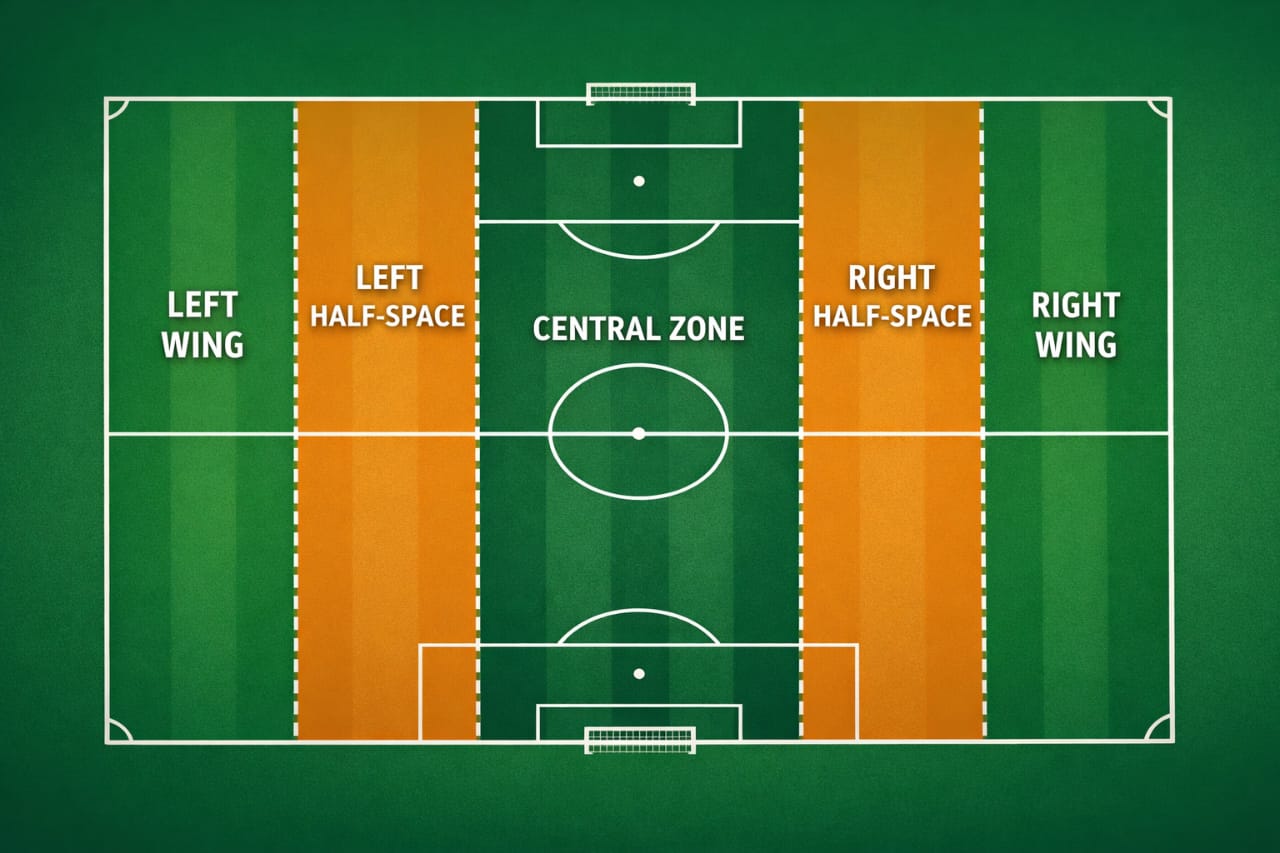
In today’s tactical systems, the pitch is no longer viewed as just wide and central areas. At elite level, many attacking sequences are specifically designed to access these zones, because a single reception in the half-space can destabilize an entire defensive structure. Coaches divide it into five vertical lanes, and the half-spaces sit between the central corridor and the flanks. These zones are often described as the most dangerous areas on the pitch because they combine space, access to goal, and multiple passing options.
At the highest level of the game, teams consistently position their most creative players in these zones because controlling half-spaces directly improves chance creation and attacking efficiency.
Half-spaces in football refer to the vertical channels located between the central area of the pitch and the wide touchlines. When the pitch is divided into five vertical lanes, the half-spaces are the second and fourth lanes—commonly known as the left half-space and right half-space.
These zones are not random tactical ideas. They are part of structured systems like positional play in football, where players are positioned to maintain spacing, create passing triangles, and ensure constant support around the ball.
Unlike the central area, which is often crowded and heavily defended, or the wings, which can limit passing angles, half-spaces offer the perfect balance. Players operating in these zones can receive the ball with more time and more options, making them extremely difficult to defend.
Because of this, half-spaces are often referred to as the “golden zones” of modern football, especially in the final third where matches are decided.
The effectiveness of half-spaces comes from the unique tactical problems they create for defenders. When attackers occupy these zones, they force the defensive structure into constant decision-making under pressure.
1. Superior Passing Angles
Players in half-spaces have access to multiple passing directions. They can play forward into the box, wide to overlapping runners, or back into midfield to recycle possession. This flexibility makes it harder for defenders to predict and intercept passes.
2. Defensive Indecision
Half-spaces exist between defensive lines and roles. A full-back may hesitate to step inside, while a center-back may be unsure whether to leave their position. This small hesitation creates space and time for attackers to turn and progress the ball.
3. Direct Goal Threat
Attacking from half-spaces provides better shooting and crossing angles compared to the wings. This is why many dangerous chances come from these zones, often leading to patterns like cutbacks in football, where the ball is pulled back into high-probability scoring areas.
4. Connection Between Build-Up and Attack
Half-spaces act as a bridge between midfield and the final third. Movements such as third man runs in football frequently target these areas, allowing teams to break through defensive lines with timing and coordination.
Because of these advantages, teams that dominate half-spaces often control both possession and chance creation.
Modern football has evolved to prioritize structure, spacing, and positional discipline. Half-spaces are central to this evolution because they allow teams to maintain balance while still being aggressive in attack.
One key principle is the creation of triangles and passing networks. By positioning players across different vertical lanes—including the half-spaces—teams can always provide at least two passing options for the player on the ball. This reduces the risk of losing possession and increases control.
Another important concept is manipulation of defensive shape. When attackers consistently occupy half-spaces, they stretch the opposition horizontally. Defenders are forced to either stay compact and leave the flanks open, or spread out and create gaps centrally.
This constant pressure on defensive structure is what makes half-spaces so effective, forcing repeated adjustments that eventually lead to exploitable gaps.
At the highest level, this is no longer optional. Teams that fail to use half-spaces effectively often struggle to break down organized defenses, especially against low blocks.
Half-spaces do not exist naturally throughout a match. They are constantly created, closed, and reopened depending on how teams move, position themselves, and circulate the ball. The most effective teams are those that can repeatedly manufacture access to these zones rather than waiting for them to appear.
The first step in creating half-spaces is horizontal stretching. By positioning players wide—typically through wingers or advanced full-backs—teams force the defensive line to expand. As defenders shift wider, the distances between them increase. These gaps, particularly between the full-back and center-back, are where half-spaces begin to open.
The second step is vertical occupation. Teams place players between defensive lines, especially in the space between midfield and defense. These players are often positioned directly inside half-spaces, ready to receive the ball in advanced areas.
However, positioning alone is not enough. The ball must move in a way that shifts defenders before entering the half-space. This is why circulation is critical. Teams move the ball from side to side, forcing defenders to constantly adjust. Eventually, a moment appears where the defensive structure is slightly unbalanced, and that is when the pass into the half-space is played.
This process is not random—it is rehearsed, repeated, and refined. The best teams recognize these moments instantly and exploit them with precision.
Half-spaces become even more important when viewed in relation to defensive structures. Different defensive systems attempt to control space in different ways, but half-spaces consistently remain one of the most difficult zones to defend.
Against a compact defensive block, defenders prioritize protecting the central area. This often leaves half-spaces slightly more open. While the space may be small, it is usually enough for technically strong players to receive and turn.
Against wider defensive systems, where full-backs stay closer to the touchline, the half-spaces become transitional zones. Attackers can receive between defenders and quickly combine or attack the space behind.
In pressing systems, half-spaces act as escape routes. When central passing lanes are blocked, players can move the ball into these zones to bypass pressure and progress forward.
In every case, half-spaces sit at the intersection of defensive responsibility. They are not clearly owned by any single defender, which makes them inherently unstable areas in defensive structures.

This instability is what attacking teams exploit. By consistently targeting half-spaces, they force defenders into repeated decisions, increasing the likelihood of mistakes.
The closer play moves to the goal, the more valuable half-spaces become. In the final third, space is limited and defensive pressure is high. However, half-spaces provide just enough room to operate while maintaining proximity to goal.
From these zones, players have a wider range of effective actions compared to other areas of the pitch. They can:
Because of these options, defenders are constantly reacting rather than controlling the situation. A defender stepping forward to press may open space behind, while staying deeper gives the attacker time to execute a pass or shot.
This dynamic is why many of the most dangerous chances in football originate from half-spaces. The attacker is close enough to goal to be dangerous, but far enough from pressure to make decisions.
This attacking pattern is often linked with final third combinations in football, where quick passing sequences create the final opening needed for a chance.
Half-spaces are rarely used in isolation. They are often part of a wider tactical plan involving overloads, where teams concentrate players in a specific area to create numerical superiority.
When a team overloads one side of the pitch, defenders are forced to shift across to deal with the immediate threat. This movement leaves space in other areas—particularly in the opposite half-space.
Once this space is identified, the ball is moved quickly into that zone. Because the defense has already shifted, it cannot recover in time, allowing the attacker to receive in a more open and dangerous position.
This connection is central to overloads in football, where numbers are used not just to maintain possession, but to manipulate space and create opportunities.
In this way, overloads and half-spaces work together. One creates the condition, the other provides the space to exploit.
One of the biggest mistakes teams make is occupying half-spaces too early. If a player stands in the half-space without proper movement, defenders can easily mark them and remove the threat.
The key is timing. Players must arrive in these zones at the exact moment the ball is played. This makes it much harder for defenders to react.
Several types of movement are particularly effective:
These movements ensure that half-spaces remain dynamic rather than static, which is essential for maintaining their effectiveness.

Half-spaces are not equally effective at all times. Their impact depends on the phase of play and the opponent’s defensive organization.
During build-up: Half-spaces offer safer progression routes compared to central areas, especially against pressing teams.
Against low blocks: These zones provide access to goal without forcing play through crowded central areas.
After switching play: The weak-side half-space is often exposed because the defense has shifted toward the ball.
In transition: Defensive structures are not yet set, making half-spaces easier to access and exploit.
In sustained attacks: Continuous occupation of half-spaces forces defenders into repeated decisions, eventually creating openings.
Recognizing these moments is what separates effective teams from those that struggle to create chances.
Half-spaces in football have become central to how the game is played because they offer the perfect balance between structure and creativity. They allow teams to maintain control while still being unpredictable in attack.
They are not just useful—they are essential for breaking down organized defenses, progressing the ball efficiently, and creating high-quality chances.
Teams that dominate half-spaces are often the ones that dominate matches. By controlling these zones, they control both the tempo of the game and the quality of opportunities they create.
As football continues to evolve, half-spaces in football will remain one of the most important tactical concepts for controlling matches, creating chances, and breaking down defensive structures.