Physical Address
MICKYWORLDNG
Physical Address
MICKYWORLDNG


MICKYWORLDNG IS READER-SUPPORTED. WHEN YOU BUY THROUGH LINKS ON OUR SITE, WE MAY EARN AN AFFILIATE COMMISSION AT NO EXTRA COST TO YOU.
Offside rule explained simply is one of the most searched topics in football because it confuses beginners and even some regular viewers. At its core, the rule is not about where a player stands—it is about timing, positioning, and involvement in play.
Many people think offside is complicated, but when broken down properly, it becomes easy to understand. The rule exists to prevent players from gaining an unfair advantage by staying too close to the opponent’s goal without participating in normal build-up play.
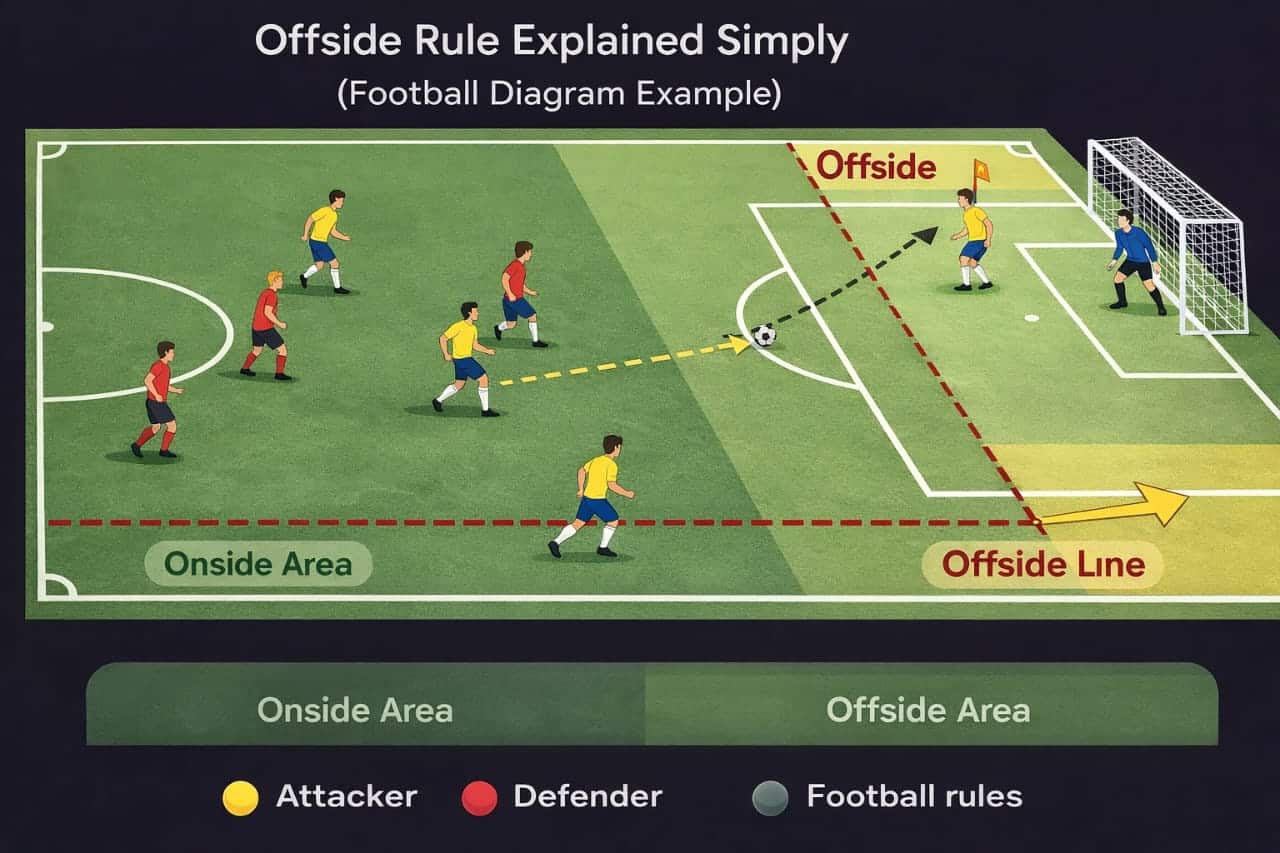
In simple terms, a player is offside if they are closer to the opponent’s goal than both the ball and the second-to-last defender at the exact moment the pass is played. Simple definition: You are offside if you are ahead of the defense when the pass is made and you become involved in the play.
This single detail—the timing of the pass—is what most people misunderstand. Offside is not judged when the player receives the ball. It is judged the moment the ball is played forward.
To understand offside rule explained simply, you need to break it into three key elements: position, timing, and involvement.
1. Position: A player must be in the opponent’s half and closer to the goal than the second-to-last defender. 2. Timing: The decision is made when the ball is passed—not when it is received. 3. Involvement: The player must be actively involved in play.
If any of these elements are missing, it is not offside. This is why football is deeply connected to positional play in football, where structure and spacing determine how players operate within a system.
The easiest way to understand offside is through what many call the “golden rule”: You cannot be offside if you are level with the second-to-last defender.
This means attackers can stand exactly in line with defenders and still be onside. This small margin is why offside decisions can be extremely tight, especially in modern football where technology is used to detect even the smallest differences.
Understanding this rule changes how you watch football. You begin to notice how attackers time their runs and how defenders maintain their line.
Many beginners assume the last defender determines offside, but it is actually the second-to-last defender. This is because the goalkeeper is usually the last defender, but not always.
If the goalkeeper moves forward, another defender becomes the last line. Using the second-to-last defender ensures the rule remains consistent in all situations.
This concept is closely related to how teams defend space and maintain structure, especially when controlling central areas and protecting depth.
One of the biggest misunderstandings in football is the difference between being in an offside position and committing an offside offence. Simply standing in an offside position is not a foul.
It only becomes an offence when the player is actively involved in play. This includes:
This is why players can stand beyond the defensive line and still not be penalized if they are not involved. Understanding this difference is key to mastering the rule.

The most critical part of offside rule explained simply is timing. The referee looks at the exact moment the ball is played forward. Everything depends on this split second.
If the attacker is onside at that moment, they remain onside—even if they run past defenders afterward. If they are offside at that moment, it does not matter where they go next—the offence has already occurred.
This is why timing runs is one of the most important attacking skills in football, especially when playing under pressure in midfield, where decisions must be made instantly.
It is also why awareness plays a huge role in decision-making, especially when players operate in tight spaces or make forward movements.
At a high level, attackers do not just avoid offside—they use it strategically. They position themselves right on the defensive line, waiting for the perfect moment to make their run.
This allows them to:
This movement is closely linked to playing between the lines in football, where players operate in spaces that are difficult for defenders to control.
The best attackers are not the fastest—they are the best at timing.
Defenders also use the rule as a tactical weapon. By stepping forward at the right moment, they can catch attackers in an offside position. This is called the offside trap.
It requires:
If executed correctly, it can stop attacks instantly. If executed poorly, it can leave defenders exposed.
Even after understanding the basics, many people still get confused about offside. Common mistakes include:
These mistakes usually come from not understanding the core principles. Once you focus on timing and positioning, everything becomes clearer.
The offside rule is not there to confuse people—it is there to make football fair and competitive. Without it, attackers could simply stand near the goal waiting for long passes, making the game less structured and less tactical.
Instead, the rule forces teams to:
This is what makes football a tactical and strategic sport rather than just a physical one. Understanding offside rule explained simply is not just about knowing the rule—it is about understanding how the game is played at a deeper level.
To fully master offside rule explained simply, you need to understand that the rule operates within extremely small time margins. At the professional level, the difference between being onside and offside is often less than a second.
This means attackers are not just running—they are synchronizing their movement with the exact moment the ball is played. A run that is even slightly early will result in an offside call, while a perfectly timed run creates a clear goal-scoring opportunity.
Because of this, elite attackers develop an instinct for timing. They study defensive lines, observe body shapes, and react to cues from the passer.
Defenders, on the other hand, rely on coordination. They move as a unit to maintain a straight line, stepping forward at the precise moment to catch attackers offside.
This constant battle of timing is what makes offside one of the most tactical rules in football.
Defensive lines are not random—they are structured and controlled. Teams train to move together horizontally and vertically, ensuring there are no gaps between players.
When the ball is in front of the defense, the line stays compact. But as soon as a forward pass is about to be played, defenders often step forward aggressively. This movement is known as an offside trap.
If executed correctly, attackers are caught ahead of the defensive line at the exact moment the pass is made. However, this system requires perfect discipline.
If one defender reacts late or drops deeper, the entire trap fails, creating space for attackers to exploit.
This defensive coordination is closely related to how teams structure their shape in low block in football, where maintaining compactness is key.

Great attackers do not rely on speed alone—they rely on intelligence. Instead of making straight runs, they curve their movement. This allows them to stay onside while still moving toward goal.
They also delay their runs deliberately. By waiting until the last possible moment, they maximize their advantage over defenders.
Another key technique is scanning the defensive line before making a run. This allows attackers to adjust their position and avoid stepping into an offside position too early.
These small adjustments are what separate elite forwards from average players.
Modern offside decisions consider any playable part of the body. This means a player can be offside if their head, shoulder, or foot is ahead of the second-to-last defender—even if the rest of their body is onside.
Because of this, body control becomes extremely important. Players must not only time their runs but also control their posture.
Leaning forward too early can result in an offside call. This level of detail shows how precise football has become at the highest level.
Offside becomes more unpredictable during transitions. When possession changes quickly, both attackers and defenders are moving at high speed.
Defensive lines may not be fully organized, and attackers may find themselves in large spaces. In these moments, timing becomes even more difficult.
Some teams use quick forward passes immediately after winning the ball to exploit defensive disorganization. Others rely on structured movement to maintain control and avoid unnecessary offside risks.
This is why transitions are often linked to counter-pressing in football, where reactions after losing or winning the ball define the situation.
At its highest level, offside rule explained simply is not just a rule—it is a system that connects movement, timing, awareness, and decision-making.
Once you understand how these elements work together, the rule becomes clear and logical. You begin to see patterns in matches—how attackers time runs, how defenders step forward, and how passes are played to exploit space.
This deeper understanding allows you to read the game in real time without relying on replays. And that is when football becomes much more than just watching—it becomes understanding.