Physical Address
MICKYWORLDNG
Physical Address
MICKYWORLDNG

MICKYWORLDNG IS READER-SUPPORTED. WHEN YOU BUY THROUGH LINKS ON OUR SITE, WE MAY EARN AN AFFILIATE COMMISSION AT NO EXTRA COST TO YOU.
Overloads in football are one of the most important tactical principles used by modern teams to control matches, break defensive structures, and create high-quality chances. At the top level, games are no longer decided only by talent, but by which team can consistently create numerical advantages in key areas of the pitch.
Rather than playing in fixed positions, players constantly adjust their positioning to support the ball, create passing angles, and outnumber opponents. This is what allows teams to dominate possession, escape pressure, and progress into dangerous zones.
In simple terms, overloads are about having more players than the opponent in a specific area—but in reality, they are about timing, spacing, and intelligent movement.
Overloads in football occur when a team creates a numerical advantage in a specific zone of the pitch. This can happen in wide areas, central midfield, or during the build-up phase.
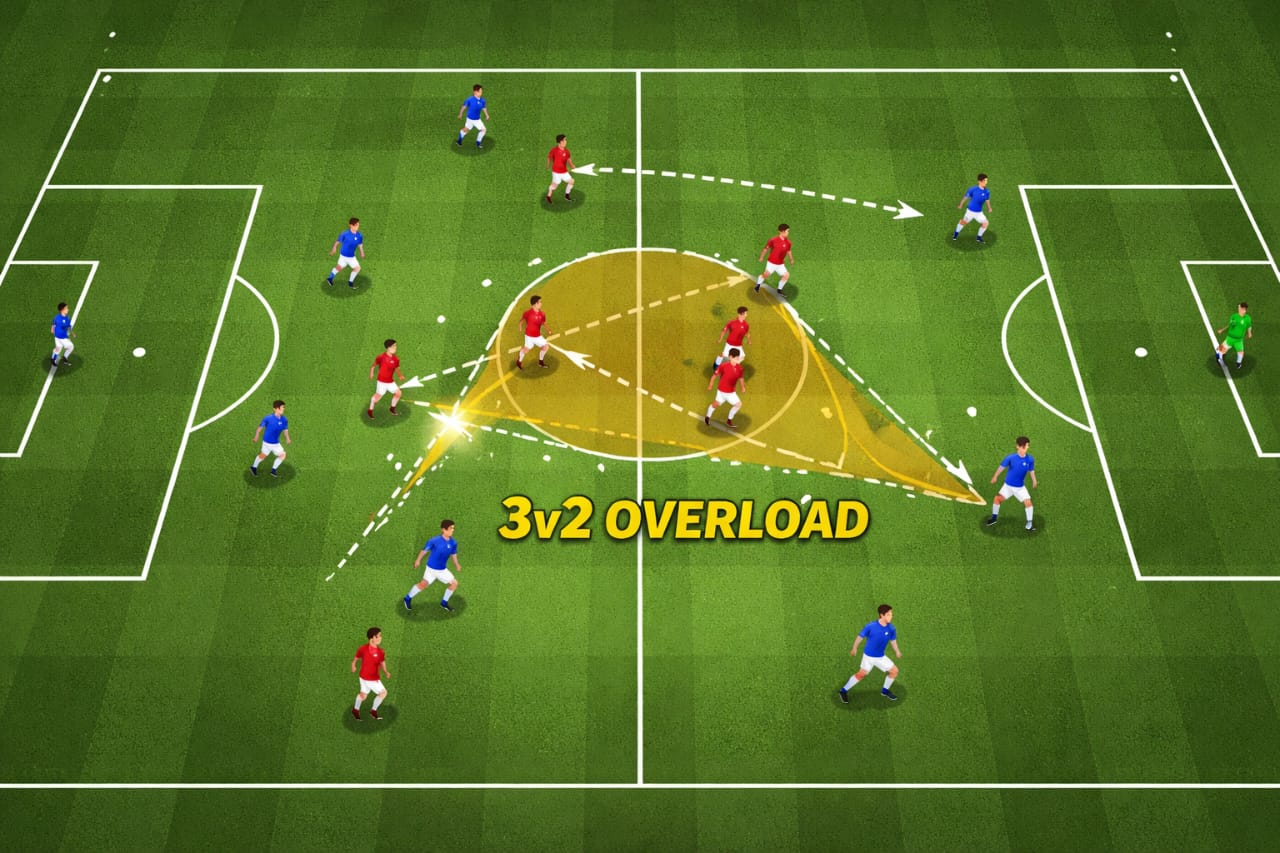
For example, if three attacking players position themselves against two defenders, the attacking team has created a 3v2 overload. This advantage allows them to circulate the ball more easily, attract defenders, and find free players.
The key idea is not just numbers, but superiority. A team can have equal numbers but still be disadvantaged if their positioning is poor. Overloads work best when players are spaced correctly, offering multiple passing options and clear angles.
This is why overloads are a core part of positional play in football, where teams structure themselves to always provide support around the ball.
Modern football is highly organized defensively. Teams defend with compact shapes, close spaces between lines, and reduce time on the ball. Because of this, simply passing the ball is not enough—you must create an advantage.
Overloads provide that advantage.
When a team creates a numerical superiority, defenders are forced into difficult decisions:
Every decision creates a weakness. The attacking team’s job is to identify and exploit that weakness before the defense can recover.
This is why overloads are not just about keeping possession—they are about manipulating the opponent’s shape and creating openings.
Overloads are not accidental. They are created through coordinated team movements and tactical structure. The best teams repeat these patterns consistently to control matches.
Players move towards the ball to provide support and increase numbers in that area. Midfielders often drop deeper, while full-backs step inside or push forward to join attacks.
This creates short passing options and allows the team to escape pressure more easily.
One of the most effective ways to create overloads is through third-man combinations. Instead of passing directly, teams use an extra player to receive the ball in space.
This movement is explained in detail in third man runs in football, where timing and positioning allow a free player to exploit the overload.
Players rotate positions to confuse defenders and create temporary advantages. For example, a winger may move inside while a full-back overlaps, creating a new overload on the flank.
This constant movement makes it difficult for defenders to track players and maintain structure.
Teams often invite pressure into one area to create space elsewhere. By drawing defenders towards the ball, they can open passing lanes and exploit gaps in the defensive shape.
This is particularly effective when breaking defensive lines in football, as overloads help create the passing angles needed to progress forward.
The most common overload situations in football are 2v1 and 3v2. These moments are where tactical structure turns into real attacking advantage.
In a 2v1, a single defender is outnumbered by two attackers. This usually happens in wide areas, where a winger and full-back combine against an opposing full-back.
The defender is forced to choose:
Either decision gives the attacking team an advantage.
In a 3v2, the attacking team has even greater control. These situations are common in midfield, where an extra player creates better passing angles and numerical superiority.
This allows teams to:
Because of the extra player, defenders must cover more space, which naturally creates gaps.
Overloads are not just about having more players—they depend on timing and spacing.
If players arrive too early, defenders can adjust. If they arrive too late, the opportunity is lost. The movement must happen at the exact moment the ball is played.
Spacing is equally important. Players must position themselves at the right distances to create clear passing lanes and avoid being easily marked.
When timing and spacing are correct, overloads become extremely difficult to defend. They allow teams to control the game, progress the ball efficiently, and create consistent attacking opportunities.
This is why overloads remain one of the most powerful tactical tools in modern football.
Overloads in football are most effective when used at the right moment. Creating numerical superiority alone is not enough—the timing, location, and purpose behind the overload determine its success.
When executed correctly, overloads allow teams to control not just possession, but also the opponent’s defensive behavior.
One of the best moments to use overloads is during build-up play. When facing a pressing opponent, teams can create a numerical advantage in the first phase to bypass pressure and progress the ball forward.
Another key moment occurs in wide areas, where creating a 2v1 on the flank allows teams to isolate a full-back and open space for crosses, cutbacks, or direct dribbles into the penalty area.
Overloads are also highly effective against compact defensive blocks. When central spaces are crowded, teams can overload one side, draw defenders in, and then exploit the opposite side.
This approach works closely with width and depth in football, where stretching the pitch creates the space needed for overloads to succeed.
One of the most important uses of overloads is to create isolation. By attracting defenders to one area, teams can free a player in another area for a 1v1 situation.
For example, a team may overload the left side with multiple players, forcing the defense to shift across. Once this happens, the ball is switched quickly to the right side, where a winger is left alone against a single defender.
This is where overloads connect directly with individual attacking quality. The team creates the situation, but the player must execute the action.
Quick ball movement is essential here, which is why switching play in football plays a key role in turning overloads into real attacking opportunities.

In advanced areas of the pitch, overloads become even more dangerous. Teams use them to create space inside the penalty area and generate clear goal-scoring opportunities.
Wide overloads are commonly used to reach the byline, where attackers can deliver crosses or cutbacks. Central overloads, on the other hand, help create passing combinations that break defensive lines and open shooting opportunities.
These patterns are closely linked to final third combinations in football, where quick passes and coordinated movement are used to create chances in tight spaces.
The effectiveness of overloads depends on how quickly teams can recognize and attack the space created once the defensive structure is disrupted.
Central overloads are particularly effective for controlling possession and dictating the tempo of the game. By placing more players in midfield, teams can dominate the ball and limit the opponent’s ability to press.
These overloads often take the shape of triangles and diamonds, providing multiple passing options and angles. This makes it easier to retain possession and progress through the center.

By controlling central areas, teams can decide when to speed up play and when to slow it down, maintaining control over the flow of the game.
While overloads are effective, they can also create risks if used incorrectly.
Successful teams balance aggression with control, ensuring they maintain structure while creating advantages.
Overloads in football remain a key tactical principle because they allow teams to create advantages without relying solely on individual skill. By using positioning, movement, and timing, teams can consistently outnumber opponents and control key areas of the pitch.
From build-up play to final third attacks, overloads provide a reliable way to break defensive structures, create space, and generate scoring opportunities.
Teams that consistently apply overloads in football gain a clear tactical advantage, using numerical superiority to control matches, manipulate defensive structures, and create high-quality scoring opportunities.