Physical Address
MICKYWORLDNG
Physical Address
MICKYWORLDNG

MICKYWORLDNG IS READER-SUPPORTED. WHEN YOU BUY THROUGH LINKS ON OUR SITE, WE MAY EARN AN AFFILIATE COMMISSION AT NO EXTRA COST TO YOU.
Scanning in football is one of the most important yet often misunderstood aspects of the modern game. While physical ability and technical skills are visible to everyone, scanning operates in the background, shaping every action a player takes before they even touch the ball.
At the highest level, players do not simply react after receiving possession. Instead, they gather information continuously before the ball arrives. This process allows them to make faster decisions, play forward more often, and operate effectively under pressure.
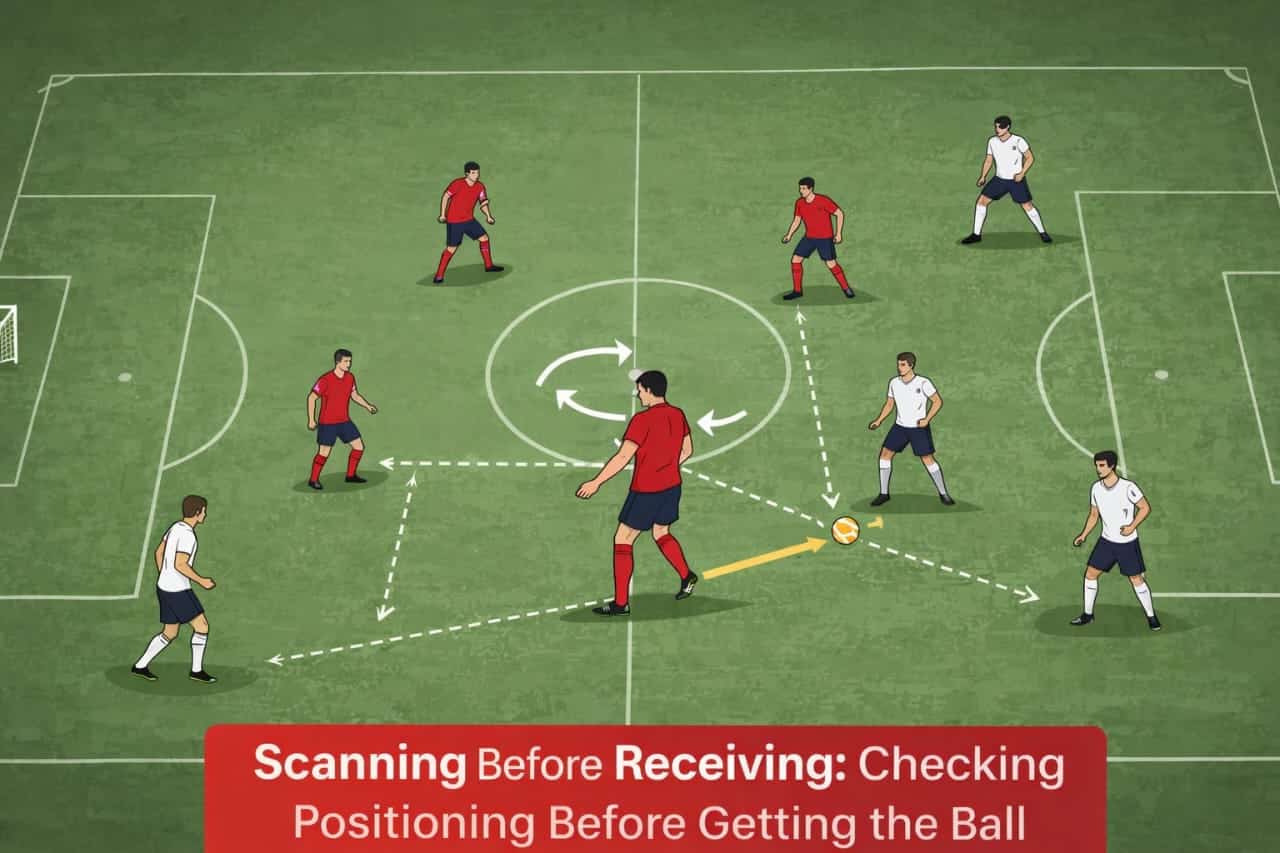
In simple terms, scanning is the act of checking surroundings—teammates, opponents, space, and passing options—before receiving the ball. However, at elite level, it goes far beyond occasional head movements. It becomes a structured, timed, and purposeful behavior that directly influences performance.
The difference between average and elite players is not just how often they scan, but when and how they scan.
Scanning in football refers to the continuous process of gathering visual information about the environment before receiving or playing the ball. This includes identifying the position of teammates, opponents, available space, and potential passing lanes.
Rather than reacting after the ball arrives, players who scan effectively already know their next action. This reduces hesitation and allows them to play with speed and confidence.
For example, a midfielder receiving the ball under pressure has two possible outcomes. Without scanning, they may take multiple touches, hesitate, or lose possession. With effective scanning, they can receive and immediately play forward, breaking pressure in a single action.
This is why scanning is closely connected to tactical concepts like breaking defensive lines in football, where quick decisions and awareness are essential to progress the ball through compact structures.
Traditionally, scanning has been described simply as “awareness.” However, modern football has moved beyond this basic understanding. The concept has evolved into what is now referred to as pre-orientation.
Pre-orientation is the ability to not only see information, but to align the body and mind before receiving the ball. It connects scanning with positioning, allowing players to act immediately rather than adjust after the first touch.
This means a player is not just looking around—they are preparing their body shape, deciding their next action, and positioning themselves to execute it efficiently.
For example, a player who scans and notices space behind them will adjust their body before receiving, allowing them to turn instantly. Without this preparation, the same player would need extra touches, giving defenders time to recover.
This shift from awareness to pre-orientation is one of the biggest differences between modern tactical football and older approaches.
One of the most critical aspects of scanning is timing. It is not enough to scan frequently; players must scan at the right moments.
Elite players often scan while the ball is traveling towards them. This ensures that the information they gather is up-to-date by the time they receive possession.
This concept is sometimes referred to as “scan-to-touch synchronization.” The idea is simple: the final scan should occur just before the ball arrives, allowing the player to act immediately.
If a player scans too early, the information becomes outdated. If they scan too late, they lose time on the ball. The best players consistently balance this timing, ensuring they always operate with current information.
This is why scanning is not random—it is rhythmic and connected to the movement of the ball.
Scanning alone is not enough. What a player does with that information depends heavily on their body orientation.
Body orientation determines whether a player can play forward, retain possession, or escape pressure. Players who position their bodies correctly can see more of the pitch and access more passing options.
The most effective receiving position is the half-turn, where the player is angled to see both the ball and the forward direction at the same time.

Receiving on the half-turn allows players to:
This is particularly important in structured systems like positional play in football, where players are expected to receive between lines and make quick decisions in tight spaces.
Every decision a player makes is based on the information available to them. Scanning increases both the quantity and quality of that information.
When players fail to scan, they operate blindly. Their decisions become reactive rather than proactive. This leads to slower play, missed opportunities, and increased turnovers.
On the other hand, players who scan effectively can anticipate situations before they happen. They recognize patterns, identify space early, and choose the best option faster.
This is why scanning is directly linked to decision-making speed. The more information a player has before receiving, the less time they need after receiving.
In modern football, where time and space are limited, this advantage is crucial.
One of the most interesting aspects of scanning is how it changes under pressure. While it might seem logical that players should scan more when under pressure, the reality is more complex.
Under intense pressure, excessive scanning can actually reduce efficiency. Players must balance awareness with ball security.
Elite players understand this balance. They know when to scan aggressively and when to focus on protecting the ball. This ability to adjust behavior based on context is a key indicator of tactical intelligence.
In tight situations, scanning often becomes quicker, sharper, and more focused rather than frequent and exaggerated.
Modern football is faster, more structured, and more demanding than ever. Teams press aggressively, reduce space, and force quick decisions.
In this environment, scanning becomes essential. It allows players to stay one step ahead, maintain control under pressure, and execute actions with precision.
More importantly, scanning connects every phase of play. It influences how teams build attacks, break defensive lines, and create chances in advanced areas.
Without scanning, these overloads may exist but remain unused because players fail to recognize them in time.
This is why scanning in football is no longer just a skill—it is a fundamental requirement for playing at the highest level.
The importance of scanning in football becomes even clearer when we analyze how it is applied across different zones of the pitch. The demands on a player’s awareness change depending on their position, the structure of the team, and the level of pressure from the opposition.
In deeper areas, such as central defense or defensive midfield, scanning is primarily focused on identifying pressure and maintaining safe progression. Players must constantly check for pressing triggers, opposition positioning, and forward passing options.
In midfield zones, scanning becomes more complex. Players are surrounded by opponents and must process information in multiple directions. This is where the ability to receive between lines and play forward quickly becomes crucial.
In advanced areas, especially in the final third, scanning is about exploiting small spaces and making fast decisions. Players must identify runs, defensive gaps, and opportunities to combine in tight spaces.
In real match situations, these moments happen quickly, and players often have less than a second to decide their next action.
Scanning plays a key role in attacking structures like final third combinations in football, where quick awareness and decision-making are essential to unlock compact defenses.
One of the biggest advantages of scanning is its ability to help teams break organized defensive systems. Modern defenses are compact, disciplined, and designed to limit space between lines.
Without scanning, it becomes extremely difficult to find solutions against such structures. Players may recycle possession without progressing or lose the ball under pressure.
When players scan effectively, they can identify gaps that are not immediately obvious.
These small details often determine whether a team can break through or remain stuck in possession.
Scanning is also critical when exploiting spaces like the half-spaces in football, where players can receive with multiple passing options and create dangerous attacking situations.
In these zones, awareness must be constant. Players must know not only where space is, but also how quickly it will close.
Scanning is not just about avoiding pressure—it is also essential for identifying opportunities to attack.
One of the most effective tactical advantages in football is creating numerical superiority. However, these advantages are useless if players cannot recognize them in real time.
Through scanning, players can quickly identify situations where their team has more players in a specific area. This allows them to exploit these moments before the opposition can adjust.
This directly connects with concepts like overloads in football, where teams intentionally create 2v1 or 3v2 situations to gain control and progress the ball.
Without scanning, these overloads may exist but remain unused. With effective scanning, they become immediate attacking opportunities.
Scanning does not only influence what decision a player makes—it also determines how quickly that decision is executed.
Players who scan early and effectively often need fewer touches on the ball. In many cases, they can play the ball with their first touch.
This has a direct impact on the tempo of the game. Faster decisions lead to quicker ball circulation, making it harder for opponents to organize defensively.
On the other hand, players who do not scan often require extra touches to understand their surroundings. This slows the game down and allows defenders to close space.
In high-level football, where every second matters, this difference is critical.
Despite its importance, scanning is often performed incorrectly, especially at lower levels. Understanding these mistakes helps clarify what effective scanning actually looks like.
Scanning without purpose: Some players move their heads frequently but do not process meaningful information. Effective scanning must be intentional and focused.
Poor timing: Scanning too early or too late reduces its effectiveness. The best players scan at the exact moment when information is most relevant.
Ignoring body orientation: Even if a player scans well, poor body positioning can limit their ability to act on the information.
Over-scanning under pressure: In tight situations, excessive scanning can lead to hesitation. Players must balance awareness with quick execution.
Correcting these mistakes is essential for improving both individual performance and team effectiveness.

Coaching approaches have evolved to emphasize scanning as a core tactical skill. Rather than training it in isolation, modern methods integrate scanning into game-like situations.
One key approach is constraint-based training, where players are placed in environments that force them to scan. For example, limiting touches or increasing pressure encourages players to gather information before receiving.
Another method is positional games, where players must constantly adjust their positioning based on the movement of teammates and opponents. These exercises naturally develop scanning habits.
Coaches also focus on cues such as:
Over time, these principles become automatic, allowing players to operate without hesitation.
As football continues to evolve, scanning is becoming more measurable and more important than ever.
Clubs now analyze scanning frequency, timing, and effectiveness using advanced data tracking. This allows coaches to identify patterns and improve player performance in a more structured way.
Technology is also playing a role. Tools such as video analysis, virtual reality training, and wearable sensors are helping players develop awareness and decision-making in controlled environments.
Despite these advancements, the core principle remains the same: players who gather better information make better decisions.
At its core, scanning in football is about control—control of information, control of decisions, and ultimately control of the game.
It allows players to think ahead, act faster, and perform under pressure. It connects technical ability with tactical intelligence, turning simple actions into effective solutions.
The best players are not just faster or more skillful—they are more aware of what is happening around them. They see more, understand more, and act sooner.
That is why scanning is not just an optional skill. It is one of the defining qualities of elite football performance.