Physical Address
MICKYWORLDNG
Physical Address
MICKYWORLDNG

MICKYWORLDNG IS READER-SUPPORTED. WHEN YOU BUY THROUGH LINKS ON OUR SITE, WE MAY EARN AN AFFILIATE COMMISSION AT NO EXTRA COST TO YOU.
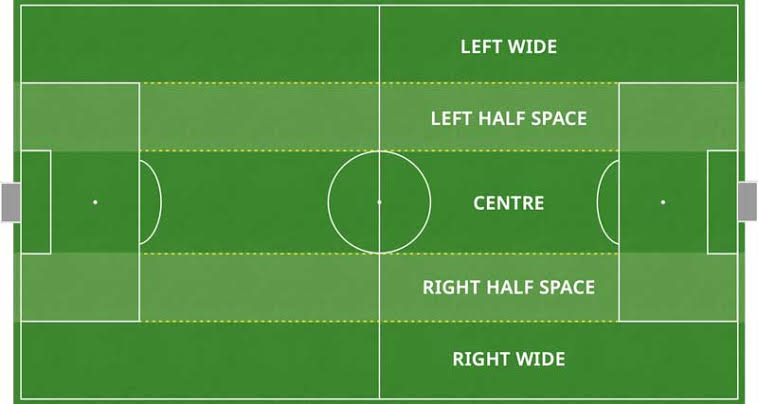
Half-spaces in football are one of the most important tactical concepts in the modern game. These zones, located between the central and wide areas of the pitch, have become key spaces where teams create chances, break defensive lines, and control attacking play.
Rather than relying only on central or wide attacks, modern teams focus heavily on these interior channels. Half-spaces provide the perfect balance between access to goal and freedom from defensive pressure, making them extremely difficult to defend.
This concept is deeply connected to structured systems like positional play in football, where players are assigned specific zones to maintain spacing and create tactical advantages.
Half-spaces are the vertical channels located between the central corridor and the wide flanks. When the pitch is divided into five vertical lanes, the half-spaces are the second and fourth lanes from the touchline.
These zones sit between the opposition’s full-backs and centre-backs, making them naturally difficult areas to defend.
Unlike wide areas, which can limit passing angles, or central zones, which are often crowded, half-spaces offer a unique combination of space and attacking potential.
Because of this, they are often described as tactical “sweet spots” in football.
Teams like Manchester City and Barcelona consistently use half-spaces to position creative players between defensive lines, allowing them to control possession and create chances more effectively.
Half-spaces provide several advantages that make them essential in modern attacking systems.
Less Defensive Congestion: Central areas are usually crowded with defensive midfielders and centre-backs. Half-spaces offer more room to receive the ball under less pressure.
Better Passing Angles: Players in half-spaces can pass in multiple directions—forward, backward, inside, or wide—making them more unpredictable.
Closer Access to Goal: Compared to wide areas, half-spaces provide a better angle to shoot or deliver dangerous passes into the box.
Defensive Uncertainty: These zones sit between defensive responsibilities. Full-backs and centre-backs must decide who steps out, often creating hesitation.
This combination of factors makes half-spaces one of the most effective areas for creating attacking opportunities.
Teams use half-spaces not just as passing zones, but as areas to create structural advantages.
By positioning players in these zones, teams can disrupt defensive organisation and open passing lanes.
For example, when an attacking midfielder receives the ball in a half-space, defenders are forced to react. If a centre-back steps forward, space opens behind. If a full-back moves inside, space opens on the wing.
This constant movement and decision-making pressure makes it difficult for defenders to maintain shape.
Half-spaces also play a key role in creating overloads in football, where teams gain numerical superiority in specific areas.
Positioning is critical when using half-spaces effectively. Players must occupy these zones at the right time and with the correct spacing.
Common roles that operate in half-spaces include attacking midfielders, inverted wingers, and advanced central midfielders.
These players often position themselves between the opposition’s defensive lines, making it harder for defenders to track them.

By staying in these zones, they can receive the ball on the half-turn, allowing them to face goal and attack quickly.
This positioning also creates passing triangles and diamonds, ensuring that the player on the ball always has multiple options.
Movement is what makes half-spaces truly effective. Simply standing in these zones is not enough; players must time their runs and movements correctly.
One of the most effective patterns involves coordinated runs between multiple players. For example, one player drops into the half-space while another makes a forward run, pulling defenders out of position.
This type of movement is closely linked to third man runs in football, where a third player arrives into space at the right moment to receive the ball.
These coordinated actions create dynamic attacking situations that are difficult to defend.
One of the main reasons teams use half-spaces is to break defensive lines.
From these zones, players can play diagonal passes that are harder to intercept than straight vertical passes.
They can also carry the ball forward, drawing defenders out and creating gaps in the defensive structure.
build-up play in footballThis makes half-spaces one of the most effective areas for progressing the ball into the final third.
Half-spaces are also used to manipulate the opposition’s defensive shape.
By placing players in these zones, teams force defenders to make difficult decisions about positioning and marking.
This often leads to defensive lines becoming stretched or disorganised.
Once this happens, the attacking team can exploit the gaps through passes, runs, or quick combinations.
This ability to control and manipulate defensive structures is what makes half-spaces such a powerful tactical tool in modern football.
The true impact of half-spaces in football is often seen in the final third, where attacking actions become more direct and decisive.
In these areas, players can combine, shoot, or deliver passes into the box with greater efficiency. The angles created from half-spaces make it easier to attack both the goal and the defensive line at the same time.

One of the most effective actions from half-spaces is the cutback. Instead of crossing from wide areas, players deliver low passes back toward central zones, making it harder for defenders and goalkeepers to react.
These passes often target arriving midfielders or forwards, creating high-quality scoring opportunities.
Teams use specific patterns to maximise the effectiveness of half-spaces.
Underlapping Runs: A wide player holds the touchline while a teammate makes a run inside into the half-space. This creates confusion for defenders and opens direct paths toward goal.
Combination Play: Quick one-touch passes between players in tight areas allow teams to bypass defensive pressure.
Switching Play: Teams may overload one side, then quickly switch the ball to the opposite half-space where a player has more time and space.
These patterns are closely linked to structured systems like positional play in football, where spacing and movement are coordinated to create advantages.
Defending half-spaces is one of the most challenging tasks in football.
Because these zones sit between defensive lines, they often create confusion over responsibility. Centre-backs may hesitate to step out, while full-backs may be unsure whether to move inside.
This hesitation gives attackers valuable time and space to make decisions.
Teams that defend aggressively using pressing triggers in football often struggle in these areas if their structure is not perfectly coordinated.
If one player presses too early or too late, gaps can quickly appear in the half-spaces.
While attacking through half-spaces is highly effective, teams must also maintain defensive balance.
Committing too many players forward can leave space open during transitions.
This is why half-space usage is often connected to rest defence in football, where teams maintain a stable structure behind the ball.
This ensures that if possession is lost, the team is still protected against counter-attacks.
Half-spaces provide several key advantages that make them central to modern tactics.
Improved Creativity: Players have more freedom to create chances and find passing solutions.
Better Shooting Angles: The angle from half-spaces allows players to shoot more effectively than from wide positions.
Unpredictability: Multiple passing and movement options make it difficult for defenders to anticipate actions.
Breaking Defensive Lines: Diagonal passes and runs are more effective from these zones.
These advantages explain why top teams consistently use half-spaces as part of their attacking strategy.
Despite their effectiveness, half-spaces also come with certain risks.
Loss of Possession: Losing the ball in these central areas can lead to dangerous counter-attacks.
High Tactical Demand: Players must understand positioning, timing, and movement to use these zones effectively.
Dependence on Structure: Without proper spacing, half-spaces can become crowded and ineffective.
These limitations highlight the importance of coordination and discipline within the team.
Some of the best players in football have mastered the use of half-spaces.
Kevin De Bruyne: Frequently operates in the right half-space, delivering crosses and passes into dangerous areas.
Lionel Messi: Known for drifting into half-spaces to create and score, especially from the right side.
David Silva: Excelled at finding pockets of space between lines in the left half-space.
Inverted Wingers: Players who start wide but move inside into half-spaces to shoot or combine.
These examples show how important these zones are at the highest level of the game.
Half-spaces in football have become one of the most important tactical tools in the modern game. They provide the perfect balance between space, angles, and access to goal.
By using half-spaces effectively, teams can create chances, manipulate defensive structures, and control attacking play.
When combined with movement, positioning, and structure, half-spaces offer a consistent and powerful way to break down even the most organised defences.