Physical Address
MICKYWORLDNG
Physical Address
MICKYWORLDNG

MICKYWORLDNG IS READER-SUPPORTED. WHEN YOU BUY THROUGH LINKS ON OUR SITE, WE MAY EARN AN AFFILIATE COMMISSION AT NO EXTRA COST TO YOU.
Build-Up Play in Football refers to the structured phase in which a team moves the ball from its defensive third into midfield and attacking areas with control rather than urgency. Instead of clearing possession under pressure, organised sides use this phase to manipulate opponents, create numerical advantages, and establish positional control.
This progression phase is not defined by passing for its own sake. It is a calculated attempt to draw pressure, shift defensive blocks, and open forward lanes. When executed with structure and spacing, build-up play becomes the platform for sustained territorial dominance.
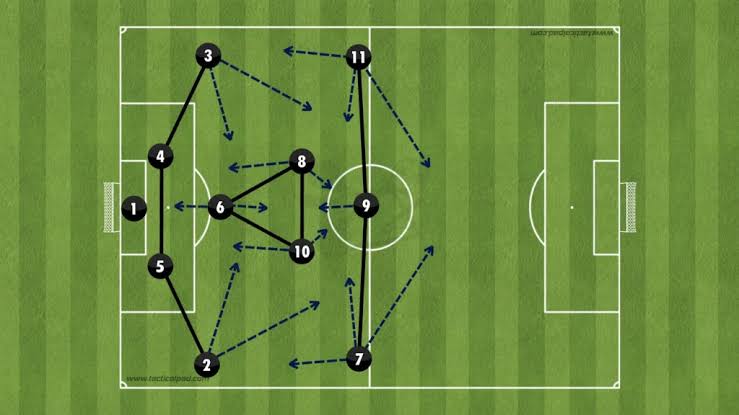
At its base, build-up play begins with goalkeeper distribution and defensive positioning. Centre-backs typically split to widen the first line, creating space centrally for a defensive midfielder to drop between or alongside them. This adjustment often forms a temporary back three during initial circulation.
The objective is to stretch the opponent’s first pressing line horizontally. By expanding width, the team in possession increases passing angles and reduces the chance of immediate interception.
The goalkeeper plays a crucial role in this structure. Acting as an additional outfield option, the goalkeeper provides numerical superiority against front-line pressure. This principle links closely with the evolution of the sweeper-keeper role in football, where distribution quality influences the stability of progression.

Progression from the back is rarely direct. Elite teams aim first to establish superiority in specific zones. Numerical superiority occurs when more players are positioned in a targeted area than the opposition can mark effectively.
Positional superiority, however, concerns space occupation rather than raw numbers. Players are arranged between defensive lines to create forward-facing receiving options. A single unmarked player between midfield and defence may offer greater value than an extra defender near the penalty area.
These two forms of superiority frequently overlap. When the defensive midfielder rotates into the back line and an interior midfielder drops into space behind the first press, new triangles are formed. These triangles create safer circulation pathways.
One recurring feature of effective build-up play is the third-man concept. Instead of passing directly through pressure, teams use a relay pattern. The first pass draws an opponent. The second pass redirects the ball to a third player who is positioned beyond the pressing angle.
This mechanism allows teams to bypass immediate pressure without relying on risky dribbles. Because the third receiver often faces forward, attacking momentum accelerates after the sequence.
Pressing systems attempt to block such rotations through coordinated triggers, a concept explored in pressing triggers in football. The relationship between structured build-up and structured pressing defines many modern tactical battles.
Build-up play has evolved beyond symmetrical back-four positioning. Full-backs increasingly adopt inverted roles, moving into central midfield during possession. This movement reinforces the pivot and creates overloads in the centre.
Rather than both full-backs behaving identically, asymmetry often appears. One may advance high and wide to stretch defensive width, while the opposite full-back tucks inside to support circulation.
This adjustment transforms the defensive line into a flexible structure that can resemble a 3-2 or 2-3 shape during early phases. The intent is not aesthetic variation but spatial balance.
Effective build-up must survive the opponent’s first line of pressure. Compact spacing between defenders ensures short, secure passes remain available.
If the press closes central lanes, controlled wide distribution may become necessary. From there, teams attempt to find midfielders who can turn and face forward.
Vertical progression is rarely forced immediately. Patience ensures that lines are drawn out before decisive passes are attempted.
While possession circulates, defensive security cannot be ignored. Rest-defense refers to the positioning of players behind the ball to manage potential transitions.
Typically, two or three defenders remain staggered to counter immediate counter-attacks. Midfielders positioned deeper provide cover in case of turnover.
This layered structure ensures that progression does not compromise stability.

Teams that maintain an advanced defensive line reduce recovery distances if possession is lost. A higher back line compresses the pitch vertically, allowing midfielders to contest loose balls more quickly.
This concept connects with the principles outlined in High Defensive Line in Football, where territorial control complements controlled progression.
Without vertical compactness, even well-structured build-up becomes vulnerable to transitions.
Spatial expansion remains central to build-up play. Wingers positioned high and wide force opposition full-backs to defend broader zones. Simultaneously, forwards may threaten depth through angled runs.
By stretching defensive blocks both horizontally and vertically, midfield spaces enlarge. These gaps allow interior players to receive without immediate pressure.
The combination of width and depth opens routes toward the attacking third without relying solely on individual skill.
While short progression remains foundational, variation is essential. Direct passes may bypass multiple lines when space permits. Controlled longer distributions prevent predictability.
However, these choices are not random. They respond to the opponent’s positioning. If pressing lines commit heavily, clipped balls beyond the first wave can be justified.
Balance remains critical. Excessive directness undermines control; excessive caution invites pressure.
Build-up behaviour changes depending on the opposing defensive height. Against a deep block, central patience becomes necessary. Quick vertical passes into crowded spaces are unlikely to succeed.
In contrast, facing aggressive pressure may require sharper combinations and angled movement.
This dynamic relates to structural contrasts discussed in Low Block vs High Defensive Line in Football, where the height of defence influences progression strategy.
Spacing between midfielders shapes both attack and protection. If midfield lines stretch too far apart, passing lanes become predictable.
Compact midfield positioning, as explored in Midfield Compactness in Football, ensures support angles remain short and accessible.
This internal cohesion strengthens circulation under pressure.
Build-up sequences often conclude with attacking transitions. When possession advances, the defensive line must remain coordinated. Poor alignment risks exposure to through balls.
The principles that govern offside management, detailed in Offside Trap in Football, highlight how defensive coordination underpins attacking structure.
Attack and defence remain intertwined throughout progression.
Build-Up Play in Football is not a decorative passing exercise. It is a calculated method of territory control, pressure manipulation, and risk management. Structured movement at the base of possession establishes the rhythm of the entire attacking phase.
Teams that master spacing, superiority creation, and rest-defense convert early possession into sustained advantage. Those that neglect structural balance often find themselves forced into reactive patterns.
As tactical systems continue to evolve, the fundamental principles of Build-Up Play in Football remain rooted in spatial awareness, coordinated movement, and controlled progression from the back.