Physical Address
MICKYWORLDNG
Physical Address
MICKYWORLDNG

MICKYWORLDNG IS READER-SUPPORTED. WHEN YOU BUY THROUGH LINKS ON OUR SITE, WE MAY EARN AN AFFILIATE COMMISSION AT NO EXTRA COST TO YOU.
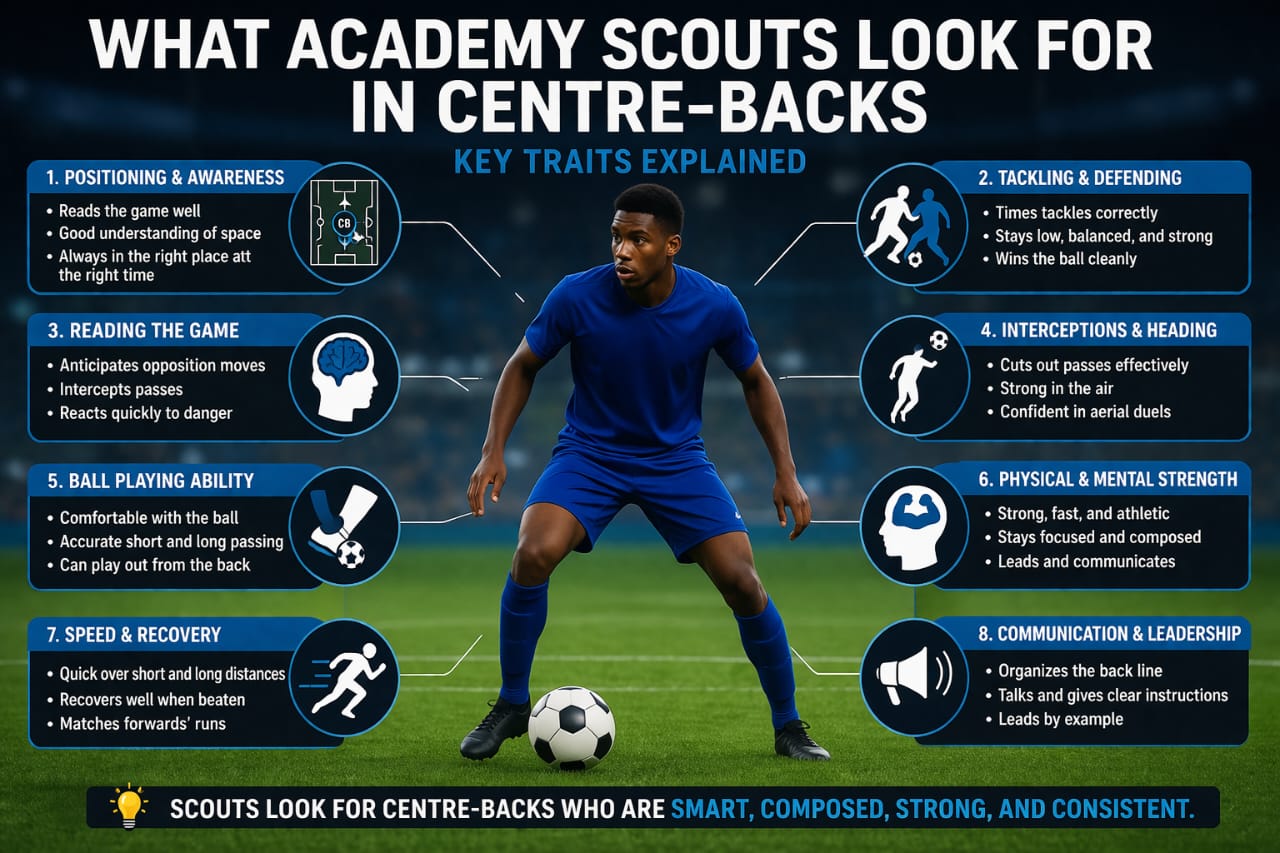
What Academy scouts look for in centre-backs has changed completely in modern football, especially at academy level where the focus is no longer just on defending. Today, centre-backs are expected to control space, handle pressure, and contribute to the overall structure of the team. This means their role goes far beyond tackles, headers, and clearances.
Scouts now look for players who can think, scan, and make decisions consistently under pressure. The modern defender must be comfortable receiving the ball, progressing play, and staying composed even when pressed aggressively. These qualities are what separate average defenders from those identified as high-potential prospects.
In many ways, the centre-back has become one of the most important positions on the pitch. They are involved in both defensive organization and attacking build-up, acting as a connection point between different phases of play. This dual responsibility is what makes scouting this position more detailed than ever.
Because of this evolution, scouts no longer judge centre-backs based on a single strength. Instead, they evaluate a combination of physical ability, technical quality, tactical awareness, and mentality to determine long-term potential.
The modern game has forced defenders to adapt to new tactical demands, especially with teams building from the back and playing through pressure. Centre-backs are now expected to stay calm on the ball and make progressive decisions rather than simply clearing danger.
This shift has come from structured systems where every player contributes to maintaining possession and controlling space. In these systems, defenders are not isolated—they are fully integrated into how the team plays.
This is closely connected to positional play in football, where structure, spacing, and passing options define how effectively a team controls the game from the back.
As a result, scouts now prioritize intelligence and composure just as much as traditional defensive ability when evaluating centre-backs.
Physical attributes still matter, but the way scouts evaluate them has changed. It is no longer just about height or strength—it is about how those qualities translate into real match situations.
Recovery pace has become one of the most important traits, especially with teams pushing higher up the pitch. When space opens behind the defensive line, centre-backs must be able to react quickly and recover effectively.
This is particularly important in systems that use a high defensive line in football, where defenders are constantly exposed to runs in behind.
Alongside pace, balance and mobility are also key, as they allow defenders to adjust quickly, stay stable in duels, and maintain control in fast transitions.
One of the biggest differences in modern scouting is how much importance is placed on ball-playing ability. Centre-backs are now expected to stay composed under pressure and make the right decision consistently.
This starts with a clean first touch and proper body orientation, which allows the player to see more of the pitch and avoid unnecessary pressure. These small details often determine whether a defender keeps possession or loses it.
Press resistance also includes the ability to stay calm when being closed down, using simple passes or quick adjustments to maintain control. This is what allows teams to build attacks rather than break down under pressure.
Scouts pay close attention to how comfortable a player looks in these situations, because composure under pressure is one of the clearest signs of high-level potential.
Scanning is one of the most underrated but important traits in a centre-back. It allows players to understand what is happening around them before they even receive the ball.
By constantly checking their surroundings, defenders can identify danger early, track movement, and position themselves more effectively. This transforms defending from reacting late to anticipating early.
Scouts often focus on this detail because it shows how quickly a player processes information. A defender who scans regularly will almost always make better decisions.
This awareness gives players more time on the ball, reduces mistakes, and allows them to stay in control even during high-pressure situations.
Reading the game is what truly separates elite centre-backs from average ones. It is not about reacting to danger—it is about preventing it before it develops.
This includes anticipating passes, recognizing movement patterns, and positioning correctly at all times. These actions may not always be visible, but they are critical to defensive stability.
Great defenders rarely need to make last-ditch tackles because they are already in the right position. They solve problems early instead of chasing them late.
This becomes even more important when dealing with attackers playing between the lines in football, where small positional mistakes can quickly turn into dangerous situations.
Centre-backs are responsible for organizing the defensive structure, which makes communication a key part of their role. However, leadership is not just about shouting instructions.
Modern scouts look for players who can guide teammates, adjust positioning, and maintain structure without disrupting the flow of the game. This is often referred to as tactical communication.
These players act as the “secret captain,” controlling the defensive line and ensuring that the team remains compact and organized at all times.
This type of leadership is subtle but extremely valuable, especially in high-level football where small details can decide matches.
Mentality is one of the most important factors in scouting centre-backs. Mistakes are part of the game, but how a player reacts to them reveals their true level.
Top prospects do not panic or lose focus after an error. Instead, they reset quickly, stay composed, and continue making the right decisions.
This ability to recover mentally is what allows players to perform consistently over long periods, even under pressure.
Scouts look for this resilience because it shows whether a player can handle the demands of higher-level football.
Centre-backs do not operate alone—they function within a team structure that depends on spacing, timing, and coordination. Understanding this structure is essential for consistent performance.
Players must know when to step forward, when to drop, and how to maintain compactness with teammates. These decisions happen constantly throughout the game.
Without this understanding, even strong defenders can struggle, especially against well-organized attacking teams.
At academy level, this is one of the key areas scouts evaluate, because it shows whether a player can adapt to different tactical systems.
One of the most overlooked details scouts pay attention to is how a centre-back positions their body before receiving the ball. This small detail has a huge impact on what the player can do next and how quickly they can react under pressure situations during build-up play.

An open body shape allows the defender to see more of the pitch, making it easier to play forward instead of backward. This increases options, improves decision-making speed, and reduces pressure immediately because the player already knows what is around them before receiving.
Players who receive the ball with poor body orientation often limit themselves, forcing rushed decisions or unnecessary passes under pressure. This usually leads to mistakes, loss of possession, or slowing down the entire team’s attacking structure.
At academy level, scouts look closely at this because it shows technical awareness and understanding of space, not just ability on the ball. It is one of those small details that clearly separates players who understand the game from those who simply react to it.
Football at higher levels is played at a much faster pace, which means decision-making becomes more important than time on the ball. Centre-backs must think and act quickly because even one extra second can invite pressure or create danger.
Scouts observe how fast a player processes information when under pressure, especially when being closed down by attackers. Do they panic, hesitate, or do they stay calm and choose the correct option consistently?
This includes knowing when to pass, when to carry the ball forward, and when to reset play to maintain control. These decisions must be made early, often before the ball even arrives.
Players who consistently make the right decision quickly stand out immediately because they make the game look simple, controlled, and structured even in difficult and high-pressure situations.
Modern centre-backs are expected to contribute actively during build-up play, not just act as safe passing options. This means being involved in combinations, supporting teammates, and helping the team progress the ball forward.
Short passing sequences between defenders and midfielders are often used to break pressing structures and create space higher up the pitch. These combinations require awareness, timing, and confidence on the ball.
This is where understanding angles and positioning becomes important, especially when connecting with midfield players under pressure. A small adjustment in position can open passing lanes that change the entire situation.
These patterns are similar to what happens in playing under pressure in midfield, where quick decisions, awareness, and positioning determine whether a team keeps control or loses it.
Even with all the tactical and technical demands, centre-backs must still be strong in individual defending situations. One-on-one defending remains a core requirement that cannot be ignored at any level.
Scouts look at how defenders approach these moments, focusing on patience, control of distance, and timing. The best defenders do not rush into tackles unnecessarily or get drawn out of position.
Instead, they stay composed, delay the attacker, and force them into less dangerous areas before making a challenge. This reduces risk and increases the chance of winning the ball cleanly.
This level of discipline shows maturity and understanding, especially when facing quick or skillful attackers who rely on speed and unpredictability to create chances.
Transitions are one of the most dangerous moments in football, and centre-backs play a key role in controlling them. When possession is lost, positioning becomes more important than speed or strength.
Scouts observe whether defenders react immediately, adjust their position quickly, and protect space before the opponent can exploit it. These small reactions often prevent big problems.
This includes recognizing danger early, tracking runners, and maintaining defensive balance even when the team is momentarily disorganized.
These reactions are closely linked to counter-pressing in football, where quick responses and positioning can stop attacks before they fully develop into dangerous situations.
One of the biggest differences between average and elite players is consistency throughout the entire game. Scouts are not just looking for moments of quality but for sustained performance over time.
Centre-backs must remain focused from the first minute to the last, maintaining concentration even when they are not directly involved in play for long periods.
Lapses in concentration often lead to goals, which is why this trait is heavily evaluated. One mistake can undo an otherwise strong performance.
Players who remain disciplined, alert, and consistent throughout the match are seen as more reliable and better prepared for the demands of higher-level football.
Modern defenders must constantly balance risk and safety in their decision-making. Not every situation requires a risky forward pass, and not every moment should be played safe.
Scouts look closely at whether players understand when to take calculated risks and when to keep things simple to maintain control.
This balance is important because poor decisions can expose the team defensively, while overly safe play can limit attacking progress and make the team predictable.
Centre-backs who manage this balance well are able to influence the game positively without putting their team under unnecessary pressure.
At academy level, scouts are not just evaluating what a centre-back can do now, but what they can become in the future. Potential is a major factor in decision-making.
Players who combine physical ability, technical quality, and tactical intelligence stand out immediately because they can adapt to different systems and styles of play.
The most important factor is not perfection, but consistency in the right habits such as scanning, positioning, decision-making, and composure under pressure.
When a player shows these qualities regularly, they become difficult to ignore, and that is ultimately what gets the attention of scouts and creates opportunities for progression.