Physical Address
MICKYWORLDNG
Physical Address
MICKYWORLDNG

MICKYWORLDNG IS READER-SUPPORTED. WHEN YOU BUY THROUGH LINKS ON OUR SITE, WE MAY EARN AN AFFILIATE COMMISSION AT NO EXTRA COST TO YOU.
Tempo control in football is one of the most important tactical concepts in the modern game. It refers to a team’s ability to control the speed, rhythm, and flow of a match depending on the situation. Rather than playing at a constant pace, top teams constantly adjust how quickly they move the ball, how they position themselves, and when they choose to accelerate or slow down.
This ability to manage tempo allows teams to control not just possession, but also the behavior and positioning of the opponent. Teams that control tempo decide how the game is played. They can slow the match down to maintain possession and stability, or suddenly increase the speed to exploit gaps in the opposition’s defensive structure.
In modern football, controlling tempo is not optional. Against organized defenses and coordinated pressing systems, teams must be able to manipulate rhythm to create advantages. Without tempo control, possession becomes predictable and attacking play loses its effectiveness.
At the highest level, matches are often decided not by how much a team has the ball, but by how well they control the rhythm of play during key moments.
Tempo control in football refers to how a team manages the speed of play through passing, movement, and decision-making. It includes both the physical speed of the ball and the mental speed of decisions made by players.
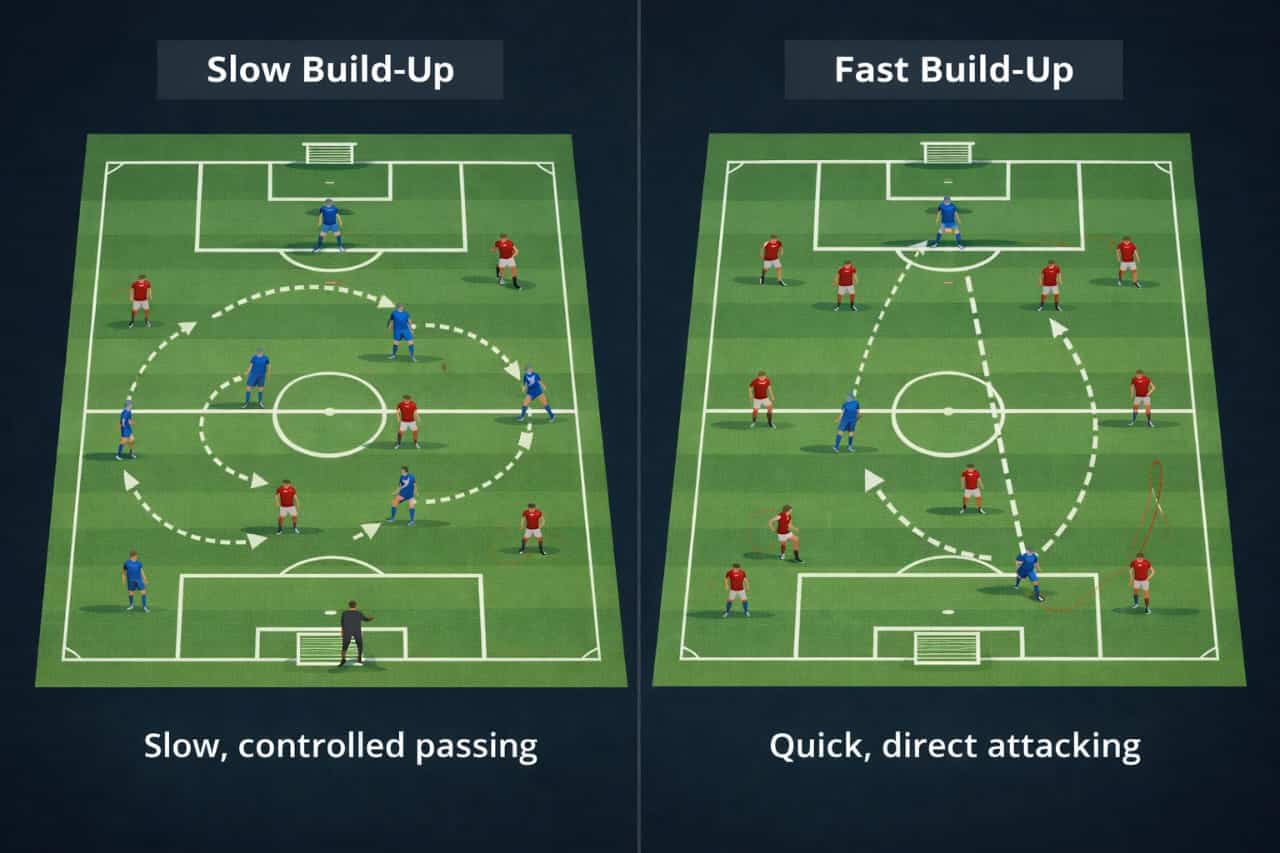
A team playing at high tempo moves the ball quickly, often using one-touch or two-touch passing to progress forward. A team playing at low tempo circulates possession more patiently, focusing on structure and control rather than immediate penetration.
The key is not choosing one over the other, but knowing when to switch between them. Teams that can change tempo at the right moment become unpredictable and much harder to defend.
This concept is closely connected to structured systems like positional play in football, where players are positioned to maintain passing options and support both fast and slow phases of play.
Modern football is defined by organization. Defensive blocks are compact, pressing systems are coordinated, and spaces are limited. Because of this, simply moving the ball is not enough. Teams must control how and when they move it.
Tempo control allows teams to manipulate the opponent’s shape. When the ball is circulated slowly, the defending team is forced to shift across the pitch repeatedly. Over time, this movement creates small gaps between players.
Once these gaps appear, the attacking team increases tempo with quicker passes and forward movement. This sudden change is what creates opportunities. It is not just speed that breaks defenses, but the contrast between slow and fast phases.
This is especially important when breaking defensive lines in football, where timing and speed of passing determine whether a defensive structure is penetrated or not.
Understanding tempo control requires a clear distinction between high tempo and low tempo play. Both are essential, and effective teams use them together rather than relying on one approach.
High tempo football involves quick passing, rapid decision-making, and forward movement. The objective is to exploit spaces before the opposition can organize defensively.
This approach becomes more effective when supported by movements like third man runs in football, where players create additional passing options to accelerate play.
Low tempo football focuses on maintaining control and structure. Instead of forcing attacks, teams circulate the ball to retain possession and wait for the right moment to progress.
Low tempo is not passive. It is a deliberate strategy used to manage the match, draw opponents out of position, and prepare for a more effective attacking phase.

Tempo control is built on several tactical principles that work together to maintain rhythm and balance.
Passing Speed: The speed at which the ball moves directly influences tempo. Faster passing increases pressure on defenders, while slower passing allows teams to maintain control.
Positioning: Players must be positioned correctly to support both fast and slow phases. Good positioning ensures that the ball can move efficiently without unnecessary touches.
Decision-Making: Players must recognize when to play forward and when to retain possession. Poor decisions can disrupt tempo and lead to loss of control.
Movement: Off-ball movement creates passing options and maintains rhythm. Without movement, tempo becomes static and predictable.
Midfielders are central to tempo control. They act as the link between defense and attack, making decisions that determine how quickly the team plays.
Deep midfielders often slow the game down, ensuring stability and control. They recycle possession and maintain structure. Advanced midfielders, on the other hand, are responsible for increasing tempo by playing forward passes and supporting attacking movements.
These roles must work together. One controls the rhythm, while another changes it. This balance allows teams to remain unpredictable and maintain control of the match.
In many cases, teams also create numerical advantages in midfield to control tempo more effectively. This is closely related to concepts like overloads in football, where having more players in an area allows better control of possession and rhythm.
The most effective teams do not play at a constant speed. Instead, they constantly change tempo to manipulate the opponent.
If a team plays too quickly all the time, they lose control and become predictable. If they play too slowly, they struggle to create chances. The key is variation.
By alternating between slow and fast phases, teams can destabilize defensive structures and create openings. This constant change forces defenders to adjust repeatedly, increasing the likelihood of mistakes.
Tempo control in football is therefore not about speed alone, but about timing. Knowing when to accelerate and when to slow down is what defines top-level teams.
Controlling tempo in football is not just a theoretical idea—it is something teams actively manage throughout a match. Every pass, movement, and decision contributes to how fast or slow the game is played.
One of the main ways teams control tempo is through ball circulation. By moving the ball across the pitch, especially from one side to the other, teams force the opposition to constantly shift their defensive shape. This repeated movement gradually creates gaps that can be exploited.
When the objective is to slow the game down, teams circulate the ball patiently, often recycling possession through midfield and defense. This reduces risk, allows players to regain structure, and limits the opponent’s opportunities to press effectively.
When the objective is to speed the game up, teams reduce the number of touches and increase the speed of passing. Instead of recycling possession, they look to progress the ball forward quickly into attacking areas.
This shift between slow and fast phases is what makes tempo control effective, as it forces defenders to constantly adjust their positioning and timing under pressure. It is not the speed itself that creates danger, but the contrast between different speeds.
Transitions are one of the most important moments for controlling tempo. When possession changes, teams must quickly decide whether to accelerate or slow the game.
If the opponent is disorganized, the best option is often to increase tempo immediately. Quick forward passes and direct movement can exploit spaces before the defense has time to recover.
However, if the opponent is already well-structured, forcing a fast attack can lead to loss of possession. In this case, slowing the tempo and maintaining control becomes the better option.
This decision-making process is central to effective game management. Teams that consistently make the right choices during transitions are able to control matches more effectively.

Tempo Phase |
Tactical Purpose |
|---|---|
Slow Tempo |
Control possession and move defensive shape |
Fast Tempo |
Exploit gaps and attack disorganized defenses |
Transition Acceleration |
Take advantage of defensive imbalance |
Controlled Circulation |
Reduce risk and maintain structure |
Tempo has a direct impact on how teams create chances. In attacking phases, controlling the speed of play determines whether a defense can remain organized or becomes exposed.
Slower tempo is often used to prepare attacks. By circulating the ball, teams can move defenders out of position and create the conditions needed for a more effective final action.
Once these conditions are created, the tempo increases. Quick passing combinations and forward movement allow teams to exploit the gaps that have appeared.
This is closely connected to concepts like final third combinations in football, where quick interactions between players create scoring opportunities in tight spaces.
Tempo also influences individual situations. When the speed of play increases, defenders have less time to react, making it easier for attackers to succeed in situations like 1v1 situations in football.
Tempo control is not only about attacking. Defensive structure also plays a key role in determining how fast or slow a game becomes.
Teams that defend in compact shapes naturally slow the game down by reducing available space. This forces opponents to circulate possession and limits their ability to play quickly.
On the other hand, teams that press aggressively increase the tempo of the game. By applying pressure on the ball, they force quicker decisions and create chaotic situations.
This interaction between attacking and defensive approaches means that tempo is always influenced by both teams. The side that imposes its rhythm usually gains control of the match.
Knowing when to reduce tempo is just as important as knowing when to increase it. Slowing the game down is often used to regain control and manage risk.
In these situations, patience becomes a tactical advantage. By controlling the ball and reducing the speed of play, teams can limit the opponent’s influence on the game.
Increasing tempo is most effective when the opponent is vulnerable. This usually happens when defensive structure is broken or when players are out of position.
Quick decisions and rapid ball movement are essential in these moments. Delaying the attack allows defenders to recover and removes the advantage.
This is why vertical progression and direct play are often used when increasing tempo, especially when switching play in football to exploit weak-side spaces.
The most effective teams find the right balance between control and speed. They do not rely solely on fast attacks or slow possession, but combine both approaches depending on the situation.
Maintaining this balance requires strong tactical understanding and communication between players. Every player must recognize when to accelerate and when to slow down.
This balance is what allows teams to remain unpredictable. Opponents cannot easily anticipate whether the next action will be slow and controlled or fast and direct.
Tempo control in football is one of the defining characteristics of elite teams. It allows them to dictate matches, control opponents, and create better attacking opportunities.
Teams that master tempo are able to manage every phase of the game—from build-up to final third play and transitions. They understand when to be patient and when to be aggressive.
In modern football, where organization and structure are highly developed, this ability to control rhythm is often the difference between winning and losing.
Ultimately, teams that master tempo control in football are able to dictate matches, manage pressure, and consistently create better attacking opportunities.